RSS

Author Archives: Comics Forum

Where did the ‘Stan Lee Excelsior Award’ come from? And where is it going? by Paul Register

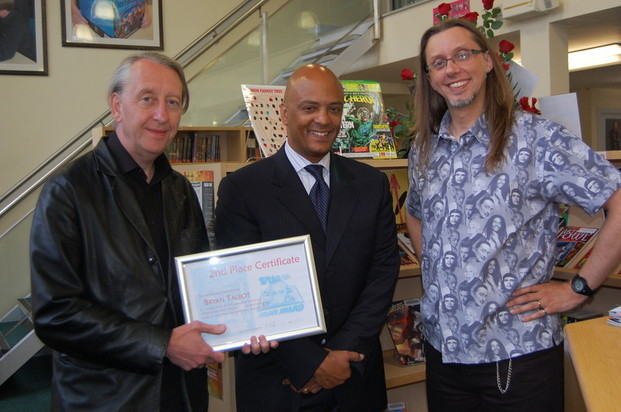
Left to Right – Bryan Talbot (writer/artist of Grandville, Alice in Sunderland, The Tale of One Bad Rat, etc.), Theodore Adams III (Chairman of the Stan Lee Foundation) and Paul Register (award founder and organiser)

In presenting a study of the background of the award, it is probably worthwhile having a very brief look at the background of its organiser too. My name is Paul Register. I’m 41, have a degree in English Studies and a long-standing love of comics, in all their myriad forms. As a young child, my mother fed me a steady diet of classic humour comics like Whizzer & Chips and Plug and British reprints of American superhero comics like Fantastic Four, Spider-Man, Hulk, X-Men, etc. I have been the Learning Resource Centre Manager (I prefer good, old-fashioned ‘Librarian’ as a professional label personally) at Ecclesfield School for the last three years and did a similar job at a school in Rotherham for eight years before that. That was preceded by a couple of years working for the bookstore chain Ottakar’s (before it was gobbled up by the retail giant that is Waterstone’s and slowly assimilated). That’s enough about the award’s organiser and founder though. This project has never been about self-promotion and never will be. The focus always has to be on the reading. The overall success of the award has to be gauged by the amount of reading it facilitates. That is its raison d’etre.
Read the rest of this entry »

 
3 Comments

Posted by on 2012/01/27 in Guest Writers


Tags: ,

A Reply to Simon Locke by Casey Brienza

It is both an honour and a privilege to have been invited to respond to Simon Locke’s article on Comics Forum. Many thanks to Ian Hague for this opportunity.

In ‘Constructing a Sociology of Comics’, Simon accuses me of a ‘retrograde’, ‘stultifying focus on production’. As methodological debates are one of the academe’s favorite pastimes, I am not at all surprised he has chosen this direction for his reply to my work. However, I am very disappointed by what is clearly not a particularly nuanced reading of it, for Simon vastly overstates the ambition of the argument of ‘Producing Comics Culture: A Sociological Approach to the Study of Comics’. Note that I in fact chose the subtitle of the Journal of Graphic Novels and Comics article deliberately; the text summarizes ‘a’ sociologically-informed methodological approach to the study of comics. I never claim that it is ‘the’ only one. I do not even, for that matter, claim that it is the best one. The following quote is taken directly from the original article:

Read the rest of this entry »

 
6 Comments

Posted by on 2012/01/20 in Guest Writers


Constructing a sociology of comics by Simon Locke

It’s amazing what re-branding can do. Once upon a time, ‘mass culture’ was beneath anyone’s interest, but nowadays ‘popular culture’ seems to have become everyone’s object of desire, to the point that academics snipe across disciplines to claim ownership rights. While humanities scholars insist on the validity of analysis of the cultural product (‘text’, in the broad sense) as an object in its own right, sociologists, at least so we are told, are equally insistent on the necessity to situate the text within its context of production and (if rather sotto voce) consumption.

But speaking as a sociologist, I find this rather odd. My interest in cultural analysis developed during the 1980s when, as I seem to recall, the groundbreaking shift occurred from the stultifying focus on production, hammered out on the anvil of structuralist marxism that beat the text into the mould of dominant ideology, towards an awareness of the importance of audiences as active constituters of cultural meaning. As it happens, an outstanding study to emerge from this shift was Martin Barker’s Comics: Ideology, Power and the Critics (Barker, 1989), which still remains one of the most fully developed works of its kind and by virtue of this is impossible to position definitively as either cultural studies (in its humanities sense) or sociology. It is genuinely both at once. Especially notable is that Barker calls for an analysis of comics that would incorporate production, text and audience, within a coherent theoretical and methodological framework that resists ascribing determinative priority to any one aspect, but sees each as formed within constraints and enablements that dialogically inform.

Read the rest of this entry »

 
2 Comments

Posted by on 2012/01/13 in Guest Writers


Traversing Frames: the Dialectic between Comics and Travel by Nina Mickwitz

This article proposes that the concept of travel can provide a useful framing device for a composite of enquiries relating to comics. It argues that there exists a dialectic between comics and travel, which perhaps has elided concerted attention, and which might yield fruitful areas for further research.

How to speak of travel? Travel practices and modes encompass divergent spheres of experience, yet commonality can be extrapolated in the movement of bodies across geographical locations (Kaur and Hutnyk, 1999: 1-4). Tourism has become one of the most significant global industries – in 2010 international tourist arrivals reached 940 million and figures are expected to continue growing (UNWTO) in spite of widespread financial downturns. Migrant workforces constitute close to 214 million (Migration Policy Institute website), while diasporas resulting from ethnic, religious and political persecution are a feature of the present as much as of the recent and more distant past. Current figures put the figure of forcibly displaced people in the worlds at 43.3 million (UNHCR). Movements and cross-cultural encounters, negotiations and hybridisations are most commonly examined in their relation to occidental expansion, imperialism and neo-colonialism, although it might be timely to remember that travel defined by west- east, or north -south relationships intrinsically reproduces a euro-centric model (Kaur and Hutnyk, 1999: 1).

Read the rest of this entry »

 
Leave a comment

Posted by on 2011/12/22 in Guest Writers


Tags:

Comics Forum 2011 Audio

Audio files from Comics Forum 2011 are now available for download in MP3 format.

Graphic Medicine: Visualizing the Stigma of Illness

Ian Williams’ introduction to Graphic Medicine: Visualizing the Stigma of Illness is available for direct download as an MP3 here (07:26, 6.9MB (right click and ‘Save target as…’)). Online streaming and alternative download formats are available here.

Sarah Leavitt’s talk ‘Documenting a Family’s Struggles with Alzheimer’s Disease: Using Comics to Break Through Stigma and Silence’ is available here (35:08, 32.2MB).Online streaming and alternative download formats are available here.

New talks will be added to the Comics Forum 2011 conference archive as they are released, and you can also subscribe to the Graphic Medicine podcast to receive all episodes of the series directly through iTunes here.

Materiality and Virtuality: A Conference on Comics

The second keynote session from Materiality and Virtuality: A Conference on Comics is available for direct download as an MP3 here (01:10:48, 64.9MB). Online streaming and alternative download formats are available here.

This talk featurs keynote speakers Tim Dant, Matthew Sheret and Tom Humberstone, and is introduced by Ian Hague. There are also contributions from Daniel Merlin Goodbrey, Dominic McNeil, Padmini Ray Murray, Hannah Wadle and others.

There is some background noise and music on this file due to the location of the recording, however, the speakers remain audible throughout.

The manifesto entitled ‘Declaration of The New Vague’, which was included in the first issue of Solipsistic Pop and is discussed by the speakers is available to read online here.

IH