Whether Comics Studies exists in Germany depends on our definition of the term. If we define it as “Comic-Wissenschaft” in analogy to Literaturwissenschaft (Literary Studies) or Kulturwissenschaft (Cultural Studies), then the answer might be a hesitant “no.” As Ole Frahm wrote in 2002: ‘Comics Studies doesn’t exist.’ [1] Taking into account the quantitative and qualitative increase of German comics scholarship over the last decade, however, we might come to a more positive conclusion. In fact, I would side with Martin Schüwer’s assessment that we are currently witnessing ‘islands of activity […] at the borders of different academic disciplines.’ [2] Thus, once we define “Comics Studies” as a conglomeration of increasingly networked research activities, the answer to the question of whether “Comics Studies” exists in Germany must be a tentative “yes.”
Author Archives: Comics Forum
The Indisciplined Middle Space by Tony Venezia
We all pined for those middle spaces, those summer hours when Josephine Baker lay waste to Paris, when “Bothered Blues” peaked on the charts, when a teenaged Elvis, still dreaming of his own first session, sat in the Sun Studios watching the Prisonaires, when top-to-bottom burner blazed through a subway station, renovating the world in an instant, when schoolyard turntables were powered by a cord run from a streetlamp, when juice just flowed […] A middle space opened and closed like a glance, you’d miss it if you blinked.
Jonathan Lethem [1]
Jonathan Lethem’s The Fortress of Solitude, a novel of friendship, family, music and comic books, concludes with an enticing and affective vision of an imaginative ‘middle space.’ Dylan Ebdus drives home with his father through a snow-storm listening to the swirling soundscape of a Brian Eno tape, invoking the aforementioned ‘middle space […] conjured and dwelled in’ (p. 509). The novel artfully weaves a highly personal story out of a pop culture collage of science fiction art, forgotten soul singers and New York superheroes, acknowledging the complexities of comics’ continuity as so much essential cultural history. The novel is itself something of a middle space where lines and boundaries are productively blurred.
Scholarly Resources
Today sees a slight reorganisation of the Comics Forum website, and the launch of a new set of downloadable resources for scholars.
The Affiliated Conferences page has now been moved into the new Scholarly Resources section (accessible from the top of all pages on the website). This section also includes our newly launched Digital Texts archive, which offers freely downloadable texts of relevance to comics scholars.
The digital text archive is currently in its launch phase and as such contains a small number of texts, but we hope to be able to expand this collection as time goes on in order to provide a useful centralised hub for freely available, open access comics scholarship. We are particularly keen to feature previously unpublished material, or texts that have gone out of print, in order to help develop the breadth, longevity and sustainability of comics scholarship, and contribute to overcoming the sense of ‘reinventing the wheel’ that was alluded to in a post on this site by Randy Duncan and Matthew J. Smith in July of this year, and by Charles Hatfield in a post on the Thought Balloonists blog in September 2009. We are also interested in publishing new material where it is available, with the hope that featuring such material on this website can help it to find a wider audience. If you are an author and you would be interesting in making your articles, books, dissertations, essays, fanzines, theses etc. available via this archive please contact Ian Hague at I.Hague@chi.ac.uk.
Already available in the Digital Texts archive we have Ian Gordon’s book Comic Strips and Consumer Culture 1890-1945, Dan Raeburn’s series of critical essays published as The Imp (four issues), and the UK Children and Young Person’s (Harmful Publications) Act, 1955, the genesis of which was discussed at length in Martin Barker’s A Haunt of Fears: The Strange History of the British Horror Comics Campaign. Click here to be taken directly to the digital texts archive.
Comics and Conflicts (2011) Update
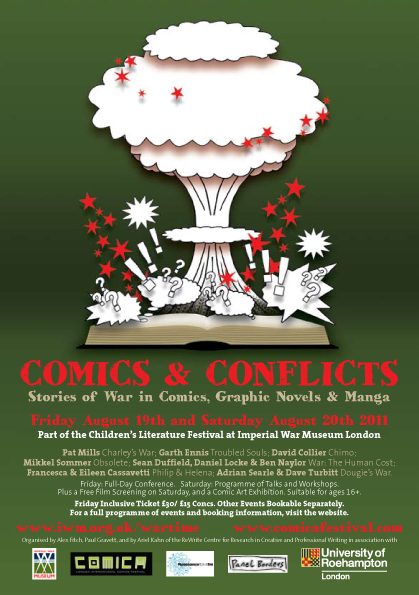
Also available online today is a new article in the Comics and Conflicts conference archive. This piece is by Ofer Berenstein, and is entitled ‘Redrawing the lines of “Best Practice” – Adapting documentary comics to war correspondence practices – two opposite case studies’. Here is the abstract:
One of the oldest notions in modern journalism is that there should be a separation between News and Views. The news are in essence “the facts of the matter” while the views are the commentating, analyzing and pondering over the original facts. Although this generalization is overall synonymous for the coverage of all the traditional journalistic content (i.e. politics, foreign affairs, sports and even gardening), variables such as New-Journalism, imbedded journalism and the web 2.0 user generated content, makes this distinction a little blur. To make things even more complicated, there is no such thing as a definitive guide to journalism’s “Best Practice Approach” and journalists often mix different coverage traditions and trends in their work. It is therefore no surprise that there is no consensus on the “Best Practice Approaches” to war correspondence coverage in particular.
True to that notion, this presentation argues that the same separation of News and Views exists in documentary comics dealing with real-world current events as well. Furthermore, this presenter wishes to draw lines between different journalistic coverage approaches and the art-form best suited to it. Strips or short form stories complement news coverage and traditional correspondence while long form stories and Graphic novels complement in depth analysis of data, and complex conflicts. Graphic Novels would also fit well with new-Journalism. A series of questions arises following this argument: is there a combined “best practice” of creating illustrated war correspondence leaning on both the journalistic aspects and the artistic ones? What elements – artistic, literary and journalistic, should it include and what are its limitations? The last point to be dealt at this presentation would be presenting the findings of a research which compared audience acceptance of messages in one short-form comics project (the strips in “To Afghanistan and Back” by Ted Rall) and one long form graphic novel (“Combat Zone” by Karl Zinsmeister  and Dan Jurgens (A)). The findings of this research answers some of the questions mentioned earlier. Combining both qualitative analyses of the different forms of documentary comics with a quantitative survey of the readers’ responses to the content also helps to understand the potential effect of the publication with the audience.
Click here to be taken to the Comics & Conflicts (2011) archive, where you can download the full paper and PowerPoint presentation.
Comics Forum 2011 Poster
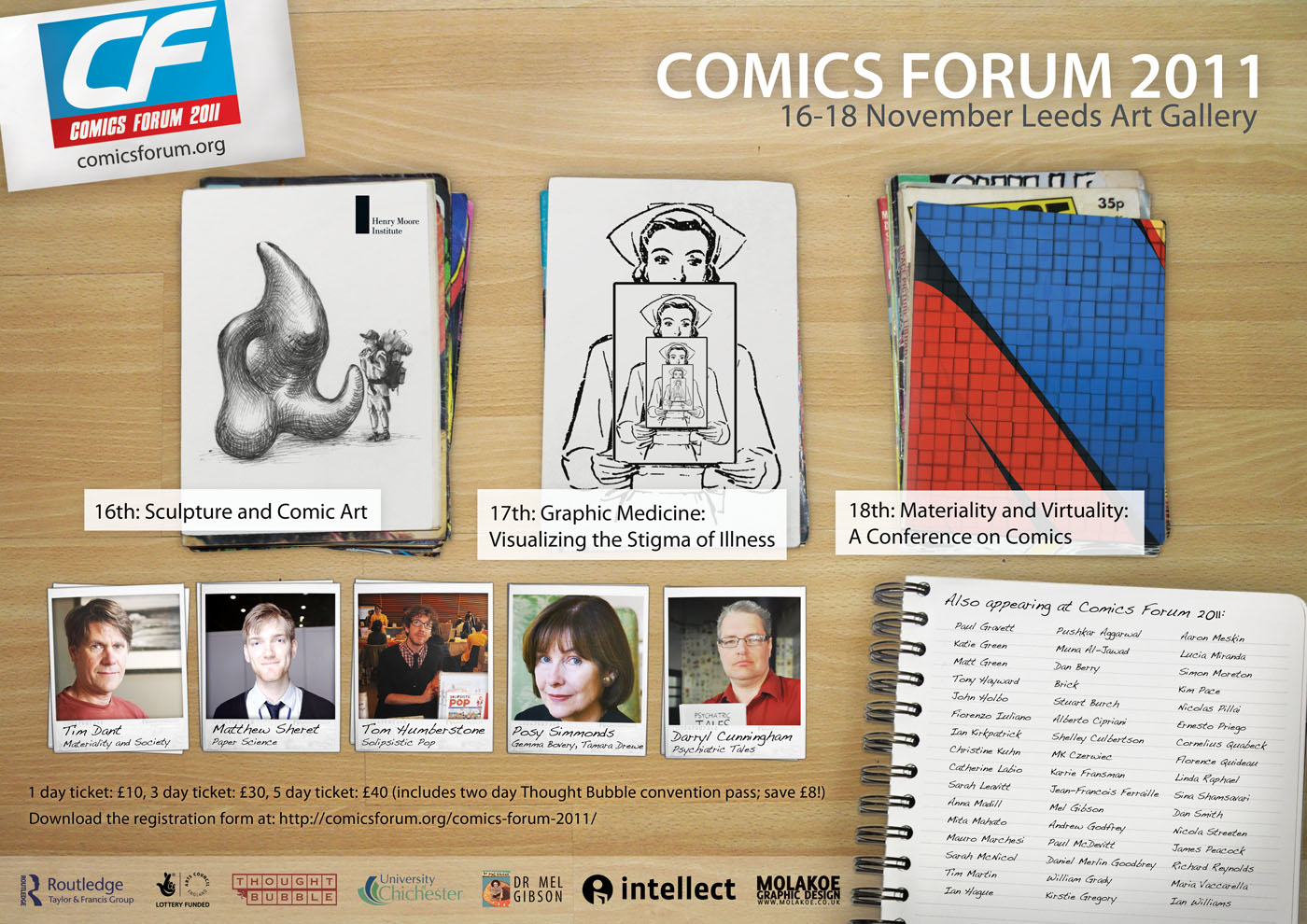
The Comics Forum 2011 poster, put together by Ben Gaskell of Molakoe Design, is out today. As always Ben’s done a great job and we’re very grateful for all his hard work! Click here for a larger PDF version, and feel free to circulate this to any interested parties; all welcome.
IH
Comics Forum 2011 is supported by Thought Bubble, the University of Chichester, the Henry Moore Institute, Dr Mel Gibson, Routledge, Arts Council England, Intellect and Molakoe Graphic Design.
Sculpture and Comic Art #5: Comic Dreams/Nightmare Sculpture by Kirstie Gregory
His weak spot was sexism. Like just about every 1960s icon (with the possible exception of John Lennon), he thought of women as ‘chicks’, second-class citizens whose function was the entertainment of men (ideally in a sexual sense). To say he was slow to recognise the aims of Women’s Liberation would be an understatement. [1]
Roger Sabin
I should state from the beginning of this posting that I have not been able to ascertain exactly how much Crumb worked on the sculptures I am discussing. Alexander Wood of Wildwood Serigraphs, who runs the official Robert Crumb website, told me:
Crumb worked on that with a sculptor. I think the piece you’re referring to is the Devil Girl piece, and that was constructed with plywood, wood, some wire and epoxy. There may also be bondo (a putty used for auto-body repair). Crumb worked on it (sanded) the sculpture a little, but mostly directed the project, especially the final touches, which had to be perfect for him. He [was] most active when painting it.[2]
The sculptures in question are certainly not unapproved pastiches of which he is not aware – and it seems he has had a significant hand in the production of at least some of them. I will be discussing them with this in mind.
Terry Zwigoff’s film Crumb (1994) begins with a slow scan of a selection of 3D works of Crumb characters in the artist’s home, beginning with an unhurried shot running over a (painted wooden?) sculpture of a woman’s semi-naked body, her head thrown back in ecstasy/anguish, a contemporary reinvention of Bernini’s Ecstasy of St Teresa. Of tough material, with rough surface, horrible facial expression, vastly exaggerated buttocks and breasts, the figure is semi-submissive by way of her uncomfortable contortion, the pose both acrobatic and pornographic. The figure is typical Crumb – his cartoons are full of his fantasy women swiftly, expertly, intuitively sketched: solid build, strong arms, stronger legs, large breasts, larger buttocks.[3] In his comics these women are often fleetingly and improbably sexually dominated by a man or men, often violently, emerging from an imagination utterly uninhibited, the pen an outlet for the artist’s darkest sexual imaginings.
Crumb inflates the female form and breaks it down (often literally) in order to underline his eccentric interests and odd observations such as affinities of the human body’s structure with furniture, missiles, balloons – he is alarmingly cavalier about dispensing with the head. These techniques, though disturbing from one perspective, are also often humorous and strangely compelling – the sculptures are by contrast simplistic and dull. I am reminded of a later scene in Zwigoff’s film wherein Crumb is having a conversation with an ex-girlfriend. She tells him that all the time they were in a relationship she thought his odd sexual ‘hang-ups’ were a pretence, a mistake Crumb finds humorous in its erroneousness. But though the artist may be self-aware regarding his sexual preferences unfortunately this self-knowledge does not extend to being able to judge sculpture. Later in the film we see Crumb attending a private view of an exhibition of his own work, with the gallery displaying his comics on the walls and a handful of large sculptures on the floor. One of these is an over-life-size woman with the head of a menacing bird (again a recurring character), which looks a bit like his current wife. I’ve always found the concept of ‘sexy animals’ quite off-putting in the gamut of sexual perversions, so Crumb was always going to be difficult for me, especially when one cannot flick through to another topic – his comic stories are usually quite ‘quick’, relatively short – it’s very easy to move between topics. Interspersed with scenes from the exhibition opening Zwigoff cuts to comment from art historian and critic Robert Hughes, who compares Crumb to Breughel and Goya, and gallerist Martin Muller, who suggests Daumier; I cannot but assume they are conveniently erasing these sculptures from his oeuvre.
One contemporary sculptor’s work with interesting connections is that of Rebecca Warren, a nominee for the 2006 Turner Prize, whose Croccioni (2000) and Helmut Crumb (1998) for example were made with an explicit awareness of Crumb’s female forms. Warren’s work however is not sexy – a pair of disembodied legs made of reinforced clay balanced on two plinths, for instance, appears to say more about the act of creation, and discovery through process. She is certainly concerned with the sexualised female shape, but in this messy clay medium she brings her figures far closer than Crumb to reality, fleshes them out, shows the peculiarity of a fetish for a single part of the female body. The comic is a medium of narrative, wherein one can explain, add depth, satire or somewhat balance a skewed initial view with an extended story and intelligent observation. All this potential is lost in Crumb sculpture, his skills and these benefits do not translate. Crumb seems incompetent to capture any depth one would think might emerge in the third dimension. The loss of words contributes – although much of the artist’s graphic work stands alone. I believe it is the wider narrative which is the chief blow to quality. If narrative is not usually physically an aspect of sculpture it is very often a strong invisible presence, something sculptors are very attuned to. Crumb seems not to be. By contrast, Chris Ware’s three-dimensional model-making skills are impressive, thoughtful and innovative. Similarly Seth’s models are delicate, subtle and atmospheric. Compared to the sculptural work of these two primarily comics artists Crumb seems to be satisfied to exhibit unfortunate misshapen lumps and nudge them by sleight of hand into the fine art world. Perhaps it’s all a big joke.
Crumb describes his first sexual experience being with a pair of his mother’s cowboy boots, alongside early sexual attractions to Bugs Bunny, and Sheena Queen of the Jungle.[4] Sex and comix and comics are inextricably linked, and the medium suits the subject. It is though more unsettling to be faced in 3D with one’s unwholesome 2D fascinations. It is not that sexual desire is not a valid subject for art, but sculptors with talent bring something more to their work – be it morality, amorality, beauty, complexity, even a tendency to push boundaries which Crumb displays in his comics, but not through these sculptures. Also perhaps worth noting, the female characters in Crumb’s cartoons are usually accompanied by pathetic or oddball male counterparts – but by themselves in the gallery space the objectification of the figures is magnified. Asked in an interview by fellow artist Steve Bell to define the purposes of satire Crumb answers, ‘to give us all relief from these taboos and these nervous tensions where things can’t be talked about. So humour and satire are a safety valve for releasing these nervous tensions’.[5] One gets the impression that for Crumb his pornographic characters are as much of a release and a compulsion as the elements of humour and satire. His sculptures stray from subversive humour to simply subversion (perversion?). In Zwigoff’s documentary Crumb displays these sculptures amongst comic collectible figurines. Perhaps this is how he thinks of his work – rather as super-sized versions of collectibles than genuine fine art contenders – a humorous mish-mash of the blow-up sex doll, the Surrealist mannequin and the Barbie doll. Paul Gravett sums up this tendency with a succinctness tempered by an awareness of Crumb’s genius for drawing:
With self-deprecating honesty, he shows how his conflicted feelings about women grew out of his teenage years, spent in lonely, horny, frustration, lusting after girls who ignored him. By the age of 20, he had not even kissed a girl. His hedonistic spree turned into a sort of twisted revenge.[6]
Kirstie Gregory is the co-convenor of Sculpture and Comic Art, taking place at Leeds Art Gallery on the 16th of November as part of Comics Forum 2011.
You can read previous editions of Sculpture and Comic Art in the Comics Forum Website Archive.
Comics Forum 2011 is supported by Thought Bubble, the University of Chichester, the Henry Moore Institute, Dr Mel Gibson, Routledge, Arts Council England, Intellect and Molakoe Graphic Design.
[1] – Roger Sabin, Comics, Comix & Graphic Novels: A History of Comic Art, Phaidon: London, 1996, p. 95. Later in this paragraph however Sabin notes that ‘Later in his career, Crumb would have second thoughts, and create some of the most rounded female characters in comics [. . .]’ p.103.
[2] – Email from Alexander Wood to Kirstie Gregory, dated 06/09/11.
[3] – These women are a constant in Crumb’s work. For this article I was particularly refering to Robert Crumb, The Complete Crumb Comics Vol. 7, Fantagraphic Books: Seattle, 1991.
[4] – Terry Zwigoff, Crumb, 1994.
[5] – Robert Crumb interviewed by Steven Bell 18 March 2005, Guardian website http://www.guardian.co.uk/film/2005/mar/18/robertcrumb.comics, accessed 14 August 2011.
[6] – Paul Gravett, Graphic Novels to Change Your Life, Aurum: London, 2005, p.172.

 Comics Forum