The prevalent academic approach to the study of comics and graphic novels might be understood as one that defines itself by negation; scholars have focused on those formal qualities that differentiate sequential art from poetry or prose in order to create a theoretical vocabulary that might serve the discipline. However, for a scholar such as myself coming to comics studies from a different disciplinary background – that of book history and publishing studies – such a valorisation seems intriguing in the face of the form’s insistent materiality, especially in the commitment of this approach to structuralist readings of image and text. Examining this tension becomes particularly crucial at a time when new technologies and digital transformations are challenging the very notion of the book, for two specific reasons. Firstly, the attachment to the codex form, which I call “container nostalgia,” has interesting ramifications for comic book culture, given that part of the enthusiasm of the comic book reader has been, historically, embedded in the collectability and rarity of the comic as artifact as well as for its content. Secondly, the rapid pace of digital developments means that the “basic elements” of the form are thrown into exaggerated relief – as Jenkins and Thorburn put it: “What is felt to be endangered and precarious becomes more visible and more highly valued” (4) – presenting a unique opportunity for comic book scholars to reflect on how to define their objects of study. In this article, I’d like to suggest that this self-reflection might be enriched by using methodologies from the fields of book history and publishing studies to study comics, graphic novels and their contexts. In order to do so, it might be instructive to present a brief history of book history itself, and the circumstances out of which it emerged [1].
Tag Archives: comics studies
Comics Studies in Greece by Lida Tsene
The relationship between comics and Greece is a rather interesting one. Having a tradition in political cartooning and with influences from Europe and the US, during the 80s we observe the first steps of the creation of a small local scene that seems to be growing each year. Nevertheless, the road to this growth wasn’t easy at all
Comics reached the Greek audience pretty late and that’s one reason why many Greeks have a specific, and often incomplete, understanding of them. In fact, the first comic series that reached the Greek market were mostly superheroes and Disney stories and that led to the perception that comics are just for kids, naive and funny stories. The frequent publication by religious and educational groups of critical reviews and statements about the bad influences comics presented also contributed to this idea.
What is the Philosophy of Comics? by Aaron Meskin
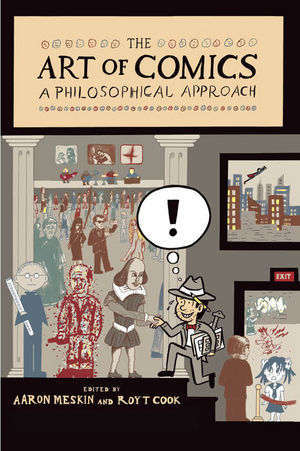
There are lots of ways philosophy and comics might be related. There are comics about philosophy and philosophers (Action Philosophers, Logicomix); other comics might be said to address philosophical issues without really being about philosophy or philosophers (Dinosaur Comics is sometimes like this); there is philosophy through comics — philosophical works that use comics to popularize philosophical ideas (see the Blackwell Philosophy and Pop Culture series); there are philosophically minded comics authors (Moore, Morrison and Ditko come to mind); and of course there are philosophers such as myself who like comics. (Philosophers in my department are well-known in the Leeds comics shops!) The philosophy of comics is something entirely different from all of these – it consists in the investigation of the philosophical questions raised by comics themselves.
Beyond Our Borders: Mapping the Space of Comics by Benjamin Woo
In a recent essay on the state of comics studies, Charles Hatfield notes comics scholars’ tendency to begin their contributions with an “attempt at definition”—that is, an effort to identify comics’ unique formal properties as a means of legitimating them as an object of scholarly (and also private) interest (¶10). He’s not the first to notice the mania for definitions that grips the field.
But this strategy begs the question: Attempts to define comics as a medium or form assume we already know what it is we’re trying to describe. That may seem like a pedantic point, but it’s actually a significant theoretical and methodological problem. Any description of the object of study presupposes some knowledge of it, which in turn rests upon our ability to classify examples as belonging (or not) to the relevant corpus. If our commonsense notions are in some ways skewed, biased, or even flat-out wrong, then our formal definitions will suffer, too.
Comics Studies in Germany: Where It’s At and Where It Might Be Heading by Daniel Stein
Whether Comics Studies exists in Germany depends on our definition of the term. If we define it as “Comic-Wissenschaft” in analogy to Literaturwissenschaft (Literary Studies) or Kulturwissenschaft (Cultural Studies), then the answer might be a hesitant “no.” As Ole Frahm wrote in 2002: ‘Comics Studies doesn’t exist.’ [1] Taking into account the quantitative and qualitative increase of German comics scholarship over the last decade, however, we might come to a more positive conclusion. In fact, I would side with Martin Schüwer’s assessment that we are currently witnessing ‘islands of activity […] at the borders of different academic disciplines.’ [2] Thus, once we define “Comics Studies” as a conglomeration of increasingly networked research activities, the answer to the question of whether “Comics Studies” exists in Germany must be a tentative “yes.”

 Comics Forum