RSS

Yearly Archives: 2013

Death and the Superhero: Strikeforce: Morituri

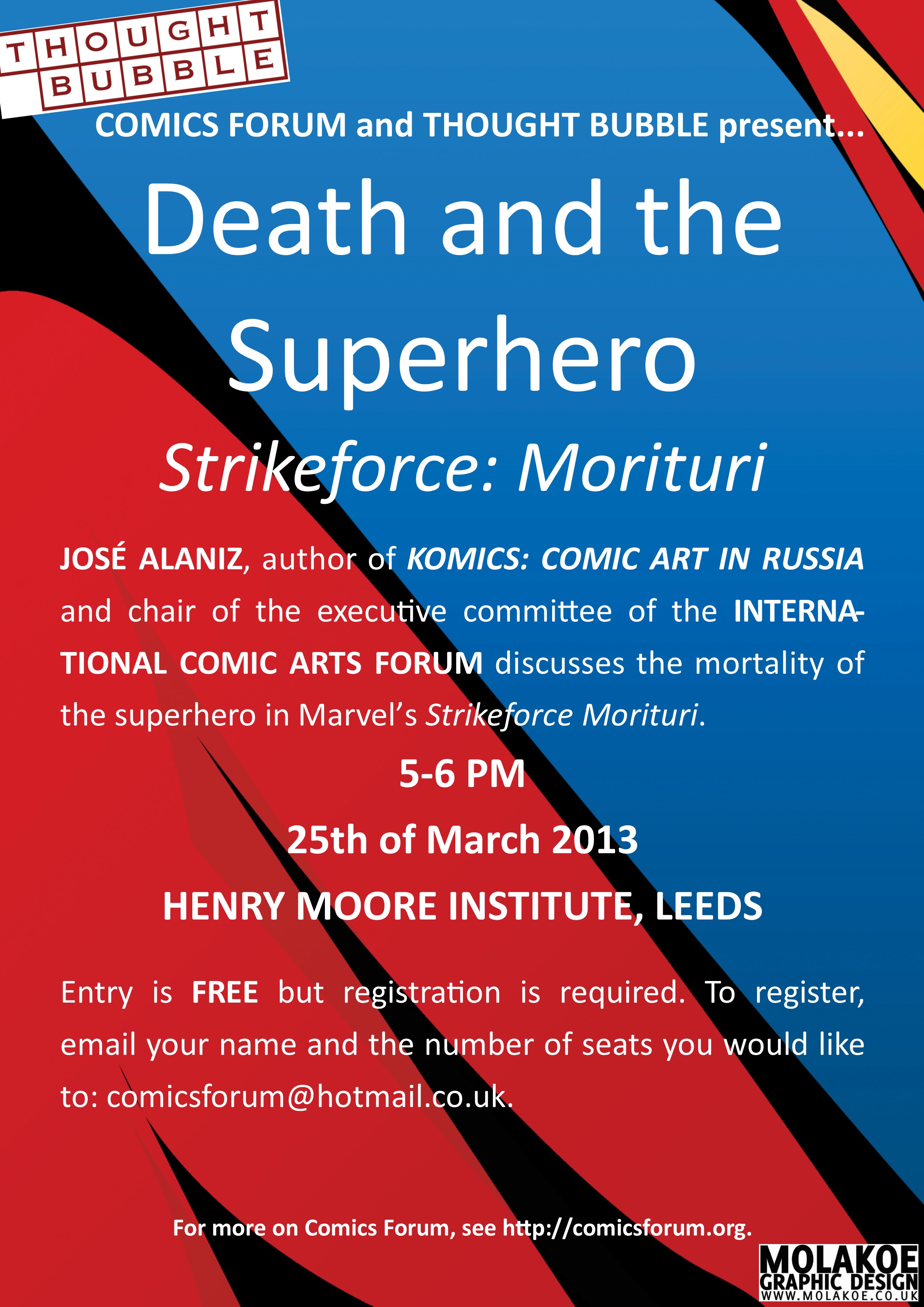
Jose Alaniz (2013) - Poster

To download a PDF of this poster click here.

Comics Forum is pleased to announce the second event in the ‘Comics Forum presents…’ series. José Alaniz, author of Komiks: Comic Art in Russia, guest author for the Comics Forum website and the current chair of the executive committee of the International Comic Art Forum, will appear at the Henry Moore Institute in Leeds (UK) on the 25th of March.

Death and the Superhero: ‘Strikeforce: Morituri’

Proceeding in part from the writings of cultural anthropologist Ernest Becker, the talk examines the late 1980s Marvel Comics series Strikeforce: Morituri (originally written by Peter Gillis with art by Brent Anderson), which took as its premise the inescapable mortality of its superteam’s members, for a consideration of the ways “real” death warps and complicates the routinely death-denying superhero genre.

José Alaniz, associate professor in the Department of Slavic Languages and Literatures and the Department of Comparative Literature (adjunct) at the University of Washington – Seattle, published his first book, Komiks: Comic Art in Russia (University Press of Mississippi) in 2010. His articles have appeared in the International Journal of Comic Art, the Comics Journal, Ulbandus, Studies in Russian and Soviet Cinema and Kinokultura, as well as the anthologies The Ages of Superman: Essays on the Man of Steel in Changing Times (McFarland, 2012), The Cinema of Alexander Sokurov (I.B. Tauris, 2011) and Russian Children’s Literature and Culture (Routledge, 2007). In 2009 he edited a symposium on Czech comics for IJOCA. He is currently the Chair of the Executive Committee of the International Comic Arts Forum (ICAF), the leading comics studies conference in the US. His research interests include Death and Dying, Disability Studies, Film Studies, Eco-criticism and Comics Studies. His current projects include Death, Disability and the Superhero: The Silver Age and Beyond and a history of Czech comics.

*          *          *

Entry to this event is free, but places are limited so registration is required. Places will be given on a first come first served basis, and early booking is strongly recommended. To register, send your name and the number of tickets you would like to comicsforum@hotmail.co.uk.

*          *          *

Laydeez do Comics Leeds

Following Death and the Superhero, Wharf Chambers (23-25 Wharf Street, Leeds LS2 7EQ) plays host to the third instalment of Laydeez do Comics Leeds (6:30-9:30pm). Entry costs £1.50. The event features a top line up guests:

Adam Cadwell: Artist, web comic The Everyday, co-founder of Great Beast books.

Dr Mel Gibson: Academic, Northumbria University.

Melanie Maddison: Artist of zine Colouring Outside The Lines.


News Review: February 2013

Africa

South Africa

Culture

The creators behind the graphic novel, Rebirth, will be in conversation Andy Mason at Book Lounge, Cape Town, on the 7th March. Link (English, MR)

Americas

Canada

Culture

The Vancouver Art Gallery is having a retrospective exhibition of Art Spiegelman’s work. Spiegelman also gave a lecture on the 13th February at Simon Fraser University Woodwards Campus associated with the event. Link (English, PW)

Shawn Conner of the Vancouver Sun interviews Art Spiegelman on his new exhibit, “CO-MIX: A Retrospective of Comics, Graphics, and Scraps” running from the 16th February to the 9th June, at the Vancouver Art Gallery. Link (14/02/2013, English, HMS)

The Toronto Comic Arts Festival (TCAF) updated its list of featured guests. Link (English, PW)

The Joe Shuster Awards produced a “work in progress” list of Canadian creators who published work in 2012 and are therefore eligible for the 2013 awards. Link (20/02/2013, English, PW)

The Vancouver Comic Arts Festival is gearing up for its May event. Link (English, PW)

United States 

Business

Diamond Comic Distributors, Inc. announce their top selling 100 comics for January 2013. Link (English, HMS)

Diamond Comic Distributors, Inc. announce their top selling 100 graphic novels for January 2013. Link (English, HMS)

Kevin Melrose for Robot 6 at Comic Book Resources reports that comic sales may have hit a 20 year high at 715 million dollars. Link (18/02/2013, English, HMS)

Culture

The Comics Beat reports that Tom Tomorrow, cartoonist creator of This Modern World, has been announced as the winner of the 2013 Herblock Prize, established in 2004 to honor editorial cartooning. Link (26/02/2013, English, HMS)

The Comics Beat features three graphic novels as winners of this year’s Cybil Awards, Children’s and Young Adult Bloggers’ Literary Awards, for books gaining attention from young readers and libraries. Link (21/02/2013, English, HMS)

Will Eisner Studios, Inc. announces upcoming Will Eisner Week events in several cities including readings, panels, and celebrations of the life and works of Will Eisner. Link (17/02/2013, English, HMS)

The LA Times features honorees in the field of graphic novels and comics for their prestigious Book Awards 2013.  Link (English, HMS)

The Comics Beat reports that Spain Rodgriguez and Mort Meskin have been nominated for automatic inclusion in the Eisner Award Hall of Fame, as well as listing other potential inductees. Link (04/02/2013, English, HMS)

Education

Columbia University announces the addition to its graphic novels archive of Elfquest materials, the latest acquisition in the library’s ongoing support for the research and teaching of graphic novels. Link (25/02/2013, English, HMS)

Ball State University announce registration for a Massive Open Online Course (MOCC) entitled, Gender Through Comics, for Spring 2013 running from the 2nd April to the 10th May. Led by Christina Blanch, the course will feature interviews with industry professionals such as Mark Waid, Brian K. Vaughn, and Terry Moore. Link (English, HMS)

Peter Gutierrez at Diamond Comic Distributors, Inc. “Bookshelf” newsletter provides tips and resources for “Creating Effective Teaching Guides for Graphic Novels” in school curriculums. Link (27/02/2013, English, HMS)

Research

The Comics Beat discusses the current reassessment of Frederick Wertham’s life and works, including library professor Carol Tilley’s recent accusation that Wertham falsified his research. Link (13/02/2013, English, HMS)

The call for papers for SANEjournal: Sequential Art Narrative in Education 4.1: “The Singularity Plurality” has been posted. The editors are seeking articles that examine the works and theories of individuals in relation to how their ideas can shape the integration of comics into educational settings. Submissions expects in November 2013. Link (English, WG)

inkt|art, a new journal dedicated to women working in graphic narrative, released its first issue. Link (English, WG)

The comix-scholars discussion list has recently launched an archive service (Link). You have to be a member of the list to get access, details of the list and how to join are available here: Link (English, WG)

The conference, Graphic Art: Violence and Healing in Comics and Graphic Novels (28th-30th May 2013), has extended its deadline for abstracts to the 15th March. This is alongside the announcement of special guest, Chris Ware, appearing at the conference. Link (20/02/2013, English, WG)

The call for papers for panels on Collaboration in Comics, Transnational Comics, and Fine Art and Comics are available on the Comics and Graphic Narratives website. The panels are for the MLA Annual Convention (January 2014). Abstracts for Collaboration in Comics, and Transnational Comics, are due by the 8th March 2013. Abstracts for Fine Art and Comics are due on the 1st April 2013. Link (English, WG)

Fantastic! Heroic! Disabled? “Cripping” the Comic Con is a one day symposium taking place at Syracuse University on the 11th April. The symposium will engage with the representations of disability in comic books, graphic novels, and mangaLink (English, WG)

Technology

Peter Kafka at All Things D reports on the possibilities of combining comics and augmented reality on an iPad platform via Anomaly Productions at the ‘D: Dive into Media’ conference. Link (23/02/2013, English, HMS)

Asia

Japan

Culture

There is an exhibition at the Kyoto International Manga Museum – SKETCHTRAVEL – featuring illustrations from artists from all over the world. It takes place from the 7th March to the 2nd June. Link (English, JBS)

The Kita Kyushu Manga Museum is exhibiting work by artists from the oldest fanzine (dojinshi) circle in Japan, between the 2nd and the 10th March. Link (Japanese, JBS)

Research

The Foreign Manga Study Group (including comics, BD, etc.) of the Japan Society for the Study in Cartoon and Comics will hold its fifth meeting on the 10th March, at the Kyoto International Manga Museum, 3F, 12:30-17:30. Link (Japanese, JBS)

The Japan Society for the Study in Cartoon and Comics is now accepting abstract submissions for presentations at their 13th Conference on the 6th and 7th June (only members of the JSSCS are eligible), the deadline is the 1st April. Link (24/01/2013, Japanese, JBS)

There is a call for papers for the conference, Exporting Young Japan: Between Text and Image, which seeks to explore the dynamic relations between Japan and Europe through the specific angle of the exportation of visual and textual representations of Japanese youth. 300 word abstracts are due on the 4th March, for the conference taking place between the 29th and 30th June, at Konan University. Link (English, WG)

Singapore

Culture

The inaugural Manga Festival outside of Japan was held in Singapore from the 15th to the 17th February. The festival consisted of lectures, business forum, autograph sessions and an exhibition. There was a discussion with young fans to understand how they consume and procure their manga and anime. Link (English/Japanese, LCT)

Europe 

Belgium

Obituary

Maurice Rosy, who notably wrote the first Boule et Bill story died on the 23rd February, aged 86. Rosy was one of lesser known figures in the classic Spirou magazine. He wrote many scripts for Tif et Tondu, from 1955 to 1968, a series for which he created the super-villain M. Choc. He also co-wrote two Spirou stories with Franquin: Le dictateur et le champignon (The Dictator and the Mushroom) and Les pirates du silence (Pirates of Silence). Link (24/02/2013 French, NL) Link 2 (25/02/2013, French, LTa)

Croatia

Culture

It has just been announced that the comic book and street art festival OHOHO! will be held from the 18th to 20th April, at the club Attack/Medika in Zagreb. Link (27/02/2013, Croatian, LO)

Internationally acclaimed comic book illustrator Igor Kordej, who is now working for the French publisher Delcourt, participated in the discussion event that took place in Zagreb on the 19th February. Kordej talked about his early work and his international career. This was a part of the regular comic book program Strip-tease at the book club Booksa. Link (19/02/2013, Croatian, LO)

A radio show Na kraju tjedna, that is being aired on the public radio channel HR3, featured Saša Čobanov, a freelance journalist specialized on comic books, and Marko Šunjić, a comic book publisher. Čobanov and Šunjić talked about the social and economic status of the comic book art in Croatia. Link (12/02/2013, Croatian, LO)

Denmark

Business

Comics magazine nummer9 reports that the comics store, Komics, in Aarhus has been closed down. Link (07/02/2013, Danish, RPC)

Finland

Culture

Pop-up Comics @XL art space lists its workshop and exhibitions. Link (02/02/2013, English/Finnish, RPC)

The Helsinki Nordic Comics Competition in 2013 is looking for new children’s comics artists from Nordic/Baltic countries. The competition will also produce a Finnish-language anthology from the comics and publish it at the Helsinki Comics Festival (6th September 2013). Link (04/02/2013, Finnish/English/Swedish, RPC)

France

Business/Technology

250 Dupuis bande dessinée titles are made available on the digital book-streaming platform Youboox. Link (26/02/2013, French, LTa)

Culture

Marjane Satrapi’s paintings are on display at the Galerie Jerome de Noirmont, in Paris. They are brightly colored women portraits, echoing her familiar style, but also drawing on Matisse or Balthus in their flirtation with abstraction. Link (French, NL)

Les fantômes du Louvres./ The Ghosts of the Louvre, is an Enki Bilal exhibit, currently being shown at the Musée du Louvres until the 18th March. Bilal worked on photos of 400 of the works and paintings in the museum’s collection, then retained 23 of them, which he painted over, to include them in a dialogue with his own characters and visual motifs. Link (French/English, NL)

An exhibition centred on the work of bande dessinée artist Enki Bilal will be presented at Paris’ Musée des Arts et Métiers from the 4th June until the 5th January 2014. Link (08/02/2013, French, LTa)

The author of bande dessinée series Quai d’Orsay is revealed as French diplomate Antonin Baudry. Link (03/02/2013, French, LTa)

Germany

Business

Spanish publisher Diábolo Ediciones will start publishing German translations of Spanish and French comics. Link (18/02/2013, German, MdlI)

Culture

Wonderfully Vulgar, an exhibition on early British comics, opens at Oldenburg University Library on the 14th March. Link (12/02/2013, German, MdlI)

Research

Students in a comics analysis class at Freiburg University have started an accompanying weblog. Link (German, MdlI)

A workshop on the “audiovisuality” of comics will take place at Ruhr-Universität Bochum on the 27th April. Link (18/02/2013, German, MdlI)

Ireland

Culture

2D Comics Festival, taking place between the 30th May and the 2nd June in Derry/Londonderry, has just announced several guests set to appear at the event. Link (14/02/2013, English, WG)

There is a William Simpson (Judge Dredd, et al.) exhibition at Belfast’s W5 Centre, which will be hosted until the 28th April. Link (English, WG)

The first Irish comic month is being held in March, boasting a number of events. Link (22/02/2013, English, SC)

Research

The symposium, Grant Morrison And The Superhero Renaissance, held at Trinity College in September 2012, has been reviewed. Link (English, SC)

Norway

Research

Sven-Arve Myklebost defends his PhD thesis on manga and Shakespeare. Link (28/02/2013, Norwegian, RPC)

Scandinavia

Research

The second issue of the Scandinavian Journal of Comic Art has been published online. Link (English, RPC)

Switzerland

Culture

The annual festival Fumetto – Internationales Comix-Festival Luzern is announced to be held from the 16th to the 24th March, and will feature the exhibition “Robert Crumb & The Underground (US).” Link (28/02/2013, German, MdlI)

UK                 

Culture

The Dundee Comics Expo will take place at the University of Dundee on the 30th March. A talk will be given by David Lloyd, and a talk and workshop by Karrie Fransman. Link (26/01/2013, English, WG)

The BD & Comics Passion Festival will take place at London’s Institut Français from the 30th May to the 2nd June. The festival will include workshops, live drawing, and special guests  Patrick Sobral (Les Légendaires), Etienne Davodeau (Les Ignorants), and François Boucq (BouncerJérôme Moucherot). Link (21/02/2013, English, WG)

Leeds based comics festival, Thought Bubble (17th to the 24th November 2013), has announced its first wave of special guests. Link (English, WG)

Jobs

The University of London has AHRC block grant studentships available in humanities and social sciences. Applications are due by the 18th March. Link (English, WG)

Research

A number of UK academics are looking at the possibility of creating a Comics Studies Network, and are seeking the participation by means of filling out a brief survey to find out what people would want from such a network. Link (English, WG)

A call for papers has been posted for Graphic Justice, a one-day symposium on the intersection of comics and graphic fiction with the concerns of law and justice. Abstracts are due by the 22nd March, for the event to be held at St Mary’s University College in London on the 11th September 2013. Link (15/02/2013, English, WG)

Registration is now open for the 4th APGR / Graphic Novel Symposium, taking place at Central Saint Martins on the 23rd March. Presentations from research students will explore the fields of animation and graphic novels. Link (English, WG)


*                    *                    *

News Editor: Will Grady (comicsforumnews@hotmail.co.uk)

Correspondents: Jessica Bauwens-Sugimoto (JBS, Japan), Rikke Platz Cortsen (RPC, Scandinavia), Shelley Culbertson (SC, Ireland), William Grady (WG, UK), Martin de la Iglesia (MdlI, Germany), Nicolas Labarre (NL, France), Hannah Means-Shannon (HMS, North America), Luka Ostojic (LO, Croatia), Moray Rhoda (MR, South Africa), Lise Tannahill (LTa, France), Lim Cheng Tju (LCT, Singapore), Peter Wilkins (PW, Canada).

Click here for News Review correspondent biographies.

Suggestions for articles to be included in the News Review can be sent to Will Grady at the email address above.
 
Leave a comment

Posted by on 2013/03/04 in News Review


On Rewriting Hemingway: Inside Joann Sfar’s Intertextual Web by Fabrice Leroy

Within Joann Sfar’s extremely diverse and prolific comics production, intertextuality constitutes a recurrent device by which an unusually erudite cartoonist weaves in, recycles, and reworks a multitude of literary, philosophical, and pictorial references inside his own whimsical creations. This essay focuses on a micro-sequence from one of Sfar’s early works, his imaginary biography of the Franco-Bulgarian modernist painter Pascin (written between 1997 and 1999, and initially published by L’Association in six short fascicles between 2000 and 2002), in an attempt to explore the various dimensions of Sfar’s habitual borrowing from external sources and integration thereof into his idiosyncratic universe.

A two-page passage of Pascin [1] (181-182) rewrites Ernest Hemingway’s ‘With Pascin at the Dôme,’ the famous description of his encounter with the painter in A Moveable Feast (81-86), Hemingway’s diary account of his experiences as a young expatriate writer in 1920s Paris. Unlike Hemingway’s chronicle of the event, the scene depicted by Sfar is told from Pascin’s point of view, and the extent to which Sfar takes liberties with the intertextual material and reverses not only its perspective, but also the portrayal of the two protagonists, is striking. Contrary to Hemingway’s account, in which Pascin waves to invite him to his table [2], in this version, it is Hemingway who initiates the encounter and intrudes upon the scene, as he ‘stops by to say hello’ to the painter, who is having drinks with two beautiful models at the Café du Dôme, a frequent Montparnasse hangout for 1920s bohemian artists who often referred to themselves as ‘Les Dômiers.’ The young American writer, initially anonymous, then identified parenthetically as Ernest Hemingway, is presented as a sweaty, overweight man with red ears and a mustache, a far cry from the ‘tall, handsome, muscular, broad-shouldered, brown-eyed, rosy-cheeked, square-jawed, soft-voiced young man’ described by his biographer Jeffrey Meyers (Meyers 70). In a sequence of four frames, Sfar summarizes the interaction among Hemingway, Pascin, and the two models in a manner that efficiently synthesizes the writer’s original account, but also distorts it considerably.

Read the rest of this entry »

 
Leave a comment

Posted by on 2013/02/28 in Guest Writers


Tags: , , , ,

‘Chercher dans le Noir’ – the gap as motif in Caboto by Lorenzo Mattotti and Jorge Zentner, by Barbara Uhlig

There have been many attempts at arriving at a definition for the comics medium. One of the defining elements in many of these definitions is the sequential arrangement of panels, arranged spatially adjacent to each other and separated out by the empty space surrounding them, the so-called “gutter” (see for example Kunzle 1973:2, Sabin 1993:5, Haymann and Pratt 2005:423). Thus one of the constituent elements of comics is the gap. In order to be able to follow the fragmented story told in the individual images, the reader has to mentally fill in the gaps, a process Scott McCloud called ‘closure’ (67). Both narrative and temporality are created in the gutter. In other words, the gutter is the major place for meaning making. This inter-frame gap has been extensively treated in research (i.e. Barnes 2009, Low 2012, Miller 2007). R. C. Harvey demonstrated in his 2001 essay ‘Comedy at the Juncture of Word and Image’ that the same principle of closure also applies to the gap between word and image in that the reader has to link both to be able to fully understand the panel. Finally, Barbara Postema showed in her dissertation Mind the Gap that gaps can be found on every level in comics: in image, page layout, sequence, image-text combinations and the narrative itself (3). She illustrates that according to Wolfgang Iser, the gap is an integral part of all fictional narrative as it ‘is always a matter of leaving openings to draw readers on’ (Postema 2011:5). This implies that gaps are responsible for engaging the reader, who must produce inferences to construct meaning in a narrative. The prime example for this is the crime story – the reader is left trying to figure out who the murderer is by interpreting the hints provided by the text and filling in the information gaps. While in literature this procedure is often invisible, the gaps in comics are often very noticeable, like the aforementioned inter-frame and word-image gaps. However, gaps can also be used to create narratives in which the gap explicitly takes on a thematic role.

This is exactly what happens in the comic El Cosmógrafo Sebastián Caboto: Trazar un Mapamundi (1992), in which Lorenzo Mattotti and Jorge Zentner apply the logic of the gap to the story itself. It is an account on the Italian explorer Sebastian Cabot who sailed to America shortly after its discovery by Columbus. Unfortunately, our knowledge of him is very patchy, his biography ‘nebulous’ (10). While gaps are something most biographers have to deal with to a certain degree, the ones Mattotti and Zentner are confronted with are particularly large. This may have influenced their decision to not smooth them over to create one harmonious, consistent story as is often done in fictional reconstructions of the past but to put its fragmentary nature at the center of their narrative, thus using the comic’s gutter structure to reinforce their own fractured narrative.

Read the rest of this entry »

 
1 Comment

Posted by on 2013/02/25 in Guest Writers


Tags: , , ,

Image [&] Narrative #10: Depicting Boredom: On Gestures and Facial Expressions by Greice Schneider

In previous installments, I’ve been tackling the subject of boredom and everyday life in contemporary comics, how it plays a role in the creative process, and how it is experienced in the act of reading. It is time now to address how it can be manifested on the level of content. In this post, I will quickly outline a few possibilities on the use of facial expressions and gestures [1], so central in the dramatic development of the actions in graphic narratives, since it is not possible to rely on motion or vocal intonations.[2] But how to address graphic representation of body movements when boredom is so often associated with lack of movements, constancy and stillness?

Boredom, as a state of apathy, indifference, lack of emotion could be conveyed precisely by an absence of movement. Such a state of physical inertia is very usual in the work of Daniel Clowes, an author who devotes considerable attention to the visage, as seen, for example, in the very first page of David Boring (2000), in which the protagonist’s undisturbed facial expression is highlighted by horizontal features, such as flat eyebrows, eyes partially covered by eyelids and mouth only slightly downturned. This affectless bored expression is placed just next to the title, linking his surname to his expression, in a double panel spread that highlights his face against a dark nocturnal urban landscape.

The whole vocabulary of body movements follows the same logic. Unlike the tension of the “pregnant moment” (and an implied before and after), boredom is better conveyed by the sameness of an “ever present”, suggested, for example, by a relaxed steady posture, shoulders down, body tilting forward, hands supporting head (as an attempt to avoid falling sleep), something found in a number of covers: the fake The Wonder Book of Boredom (suggestively labeled vol. IV – Collecting Sand), by English cartoonist Glen Baxter, featuring a boy holding his head with both hands, glancing at grains on the table; Dominique Goblet’s autobiographical Faire semblant c’est mentir (2007), in a similar pose, legs crossed, holding a glass; or Arne Bellstorf’s American inspired tale of suburban melancholy Acht, Neun, Zehn (2005) , in which the teenage protagonist’s boredom is visually represented through the refusal to charge the face with any kind of affection and the choice of conveying his body as an arch – an almost continuous piece that bends down.

On the opposite extreme of absence of movement, boredom and impatience can also be conveyed by relentless movement, in the form of repetitive actions as the body resists boredom, like tapping the foot or fingers. Linhart describes a form of these small repeating and intermittent gestures as a means of defense against boredom in the assembly line, as life “kicks and resists”:

The organism resists. The muscles resist. The nerves resist. Something in the body and in the head, braces itself against repetition and nothingness. Life shows itself in more rapid movements, an arm lowered at the wrong time, a slower step, a second’s irregularity, an awkward gesture, getting ahead, slipping back, tactics at the station.

(Linhart 1981, p.17).

The representation of these rhythmic gestures poses a challenge for the fixed image, but there are a couple of recurring solutions to avoid ambiguity. The first and more economical approach is to convey multiple repetitive movements in the same panel, with the help of lines and/or “sounds”. Faire semblant c’est mentir (2007) makes use of onomatopoeia (tic tic…) to signal the repetitive insistence of young Dominique playing with scissors. This rhythmic effect is also taken into consideration when drawing the words. The same repetitive pattern appears in a sequence from Acme Novelty Library #17 (2006), in which an art teacher Chris Ware (appearing here as a character), after spending some time doodling to kill time, starts tapping his pencil over the table, yawning and supporting his head with his hand.

Another facial sign of boredom and indifference can be found in the direction of the gaze. While a look directed to a specific element (even if outside the panel) indicates interest, curiosity, attunement to the external world, a wandering look suspends the curiosity about what happens in the surroundings, shifting the attention to the inner life of the character (or absence of it). This use of unfocused eyes is very frequent in the work of Adrian Tomine. In his New York Sketches (2005); the author portrays people in public urban environments (like the subway), paying close attention to their distracted attitudes during the journey – the situation of waiting in a confined space often leading to a state of impatience. The woman on the left, for example, seems lost in thought, staring at nowhere specific. On additional side notes, Tomine acknowledges repetitive movements, revealing both character’s state of restlessness: she was “unable to sit still for more than a few minutes”, and “his mouth moved as if he was chewing”.

Of course the examples described above show only a few possibilities on how characters can perform boredom, but they already reveal the ambiguity and interesting dynamics that define it, oscillating between states of complete stillness and relentless movement.

Bibliography

Baetens, Jan. “La Main Parlante.” Image [&] Narrative. Issue 9 (2004): http://www.imageandnarrative.be/inarchive/performance/baetens_main.htm

Bellstorf, Arne. Acht, Neun, Zehn. Reprodukt, 2005. Print.

Bremond, Claude. “Pour Un Gestuaire Des Bandes Dessinées.” Langages 3.10 (1968): 94–100.

Clowes, Daniel. David Boring. New York: Pantheon Books, 2000. Print.

Goblet, Dominique. Faire Semblant C’est Mentir. Paris: L’Association, 2007. Print.

Linhart, Robert. The Assembly Line. University of Massachusetts Press, 1981. Print.

Tan, Ed. S. “The Telling Face in Comic Strip and Graphic Novel.” The Graphic Novel (2001): 212. Print.

Tomine, Adrian. Adrian Tomine: New York Sketches 2004. Buenaventura Press, 2005. Print.

Ware, Chris. Acme Novelty Library #17. ACME Novelty Library, 2006. Print.

Greice Schneider recently finished a PhD on boredom and everyday life in contemporary graphic narratives at K.U. Leuven, in Belgium. She is a founding member and a member of the editorial board of The Comics Grid. She is on the editorial board of Image [&] Narrative.

Click here to read previous instalments of the Image [&] Narrative column.

[1] – For more on gestures and comics see (Baetens 2004) (Bremond 1968) (Tan 2001).

[2] – Such an approach should avoid the temptation to universalize by identifying a constant repertory of facial expressions and gestures recognizable across the world. Although it is difficult to support the idea that a determined combination of positions can directly correspond to a specific emotion, no matter what context, it is reasonable to assume that a shared vocabulary of gestures and facial expressions often plays an important role in graphic storytelling.

 
Leave a comment

Posted by on 2013/02/18 in Uncategorized