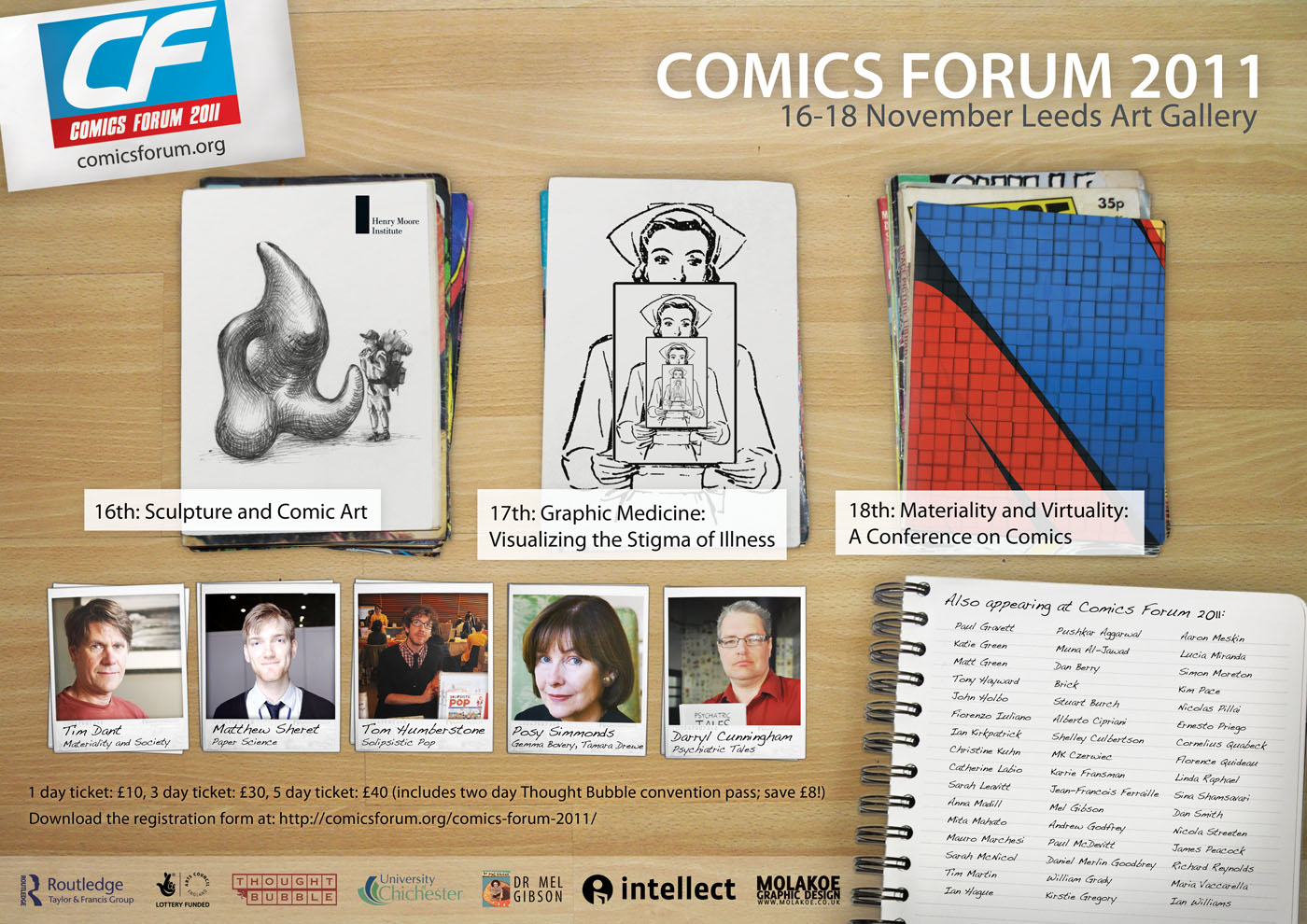
16/11: Sculpture and Comic Art (Kirstie Gregory)
The Henry Moore Institute is a world-recognised centre for the study of sculpture in the heart of Leeds. An award-winning exhibitions venue, research centre, library and sculpture archive, the Institute hosts a year-round programme of exhibitions, conferences and lectures, as well as developing research and publications, to expand the understanding and scholarship of historical and contemporary sculpture. The Institute is a part of The Henry Moore Foundation, which was set up by Moore in 1977 to encourage appreciation of the visual arts, especially sculpture. We are open seven days a week from 10am-5.30pm, with the galleries and library open until 9pm on Wednesdays. The library opens at 1pm on Sundays.
We are very pleased to be joining forces with Comics Forum for an event which considers comics and sculpture together from new perspectives.
Following a welcome to the three-day event from Comics Forum Director Ian Hague, Head of Sculpture Studies at the Institute, Lisa Le Feuvre, will give a brief introduction to the work of the Henry Moore Institute. Before the first session Kirstie Gregory will give a brief introduction to various themes of the day including experimental figuration, issues of narrative and space and the differences and dialogues between two-dimensional and three-dimensional art.
The first session will be chaired by artist and Academic Leader of Art at Leeds Metropolitan University, Chris Bloor, and the papers will look at historical interrelationships between sculpture and comic art. Richard Reynolds, from the School of Graphic Design at Central Saint Martins presents ‘The Superhero Genre and Sculptural Form – From Antiquity to Now’, in which he will look at the superhero genre as a key conduit for the reinvention of many themes of heroic sculpture (and painting) that have become disassociated from the discourse of contemporary fine art. This will be followed by Florence Quideau of Rutgers University, New Jersey, who in her paper, ‘The Visual Power of Sculpted Caricatures and Comic Lithographs’ will argue that sculpted caricatures and comic lithographs have an indelible visual power, also addressing the reversed practice of making two-dimensional drawings from three-dimensional caricatural statuettes, a method which emerged in Paris in the 1830s. Artist Ian Kirkpatrick will end the first session with ‘From Classics to Comics: Hero, Myth and Narrative in Contemporary Sculpture’ in which he will discuss his own practice in the context of comic art icons. He will propose that when enacted within contemporary artistic practice, comic icons fulfill similar roles to the ancient Greek and Christian heroes of classical painting and sculpture, offering familiar archetypes as touchstones for the examination of present-day concerns — while the structural innovations of comic art offer novel ways to convincingly depict narrative, character, scene and conflict.
After the lunch break author and curator Paul Gravett will chair a session concentrating on monuments, monumentality and multiples. Tim Martin of De Montfort University will in his paper, ‘Smithson Entropy and the New Comedy’ look at the humour of Smithson’s essays and his comedy of matter, his shared jokes with other artists and his aggressive jokes aimed at art critics. Martin will demonstrate the anxiety that drove the artist’s wit. Following this Nottingham Trent University’s Stuart Burch will present ‘Statue of Judgement: Estonia’s Bronze Soldier from a Dreddful Perspective’, which will compare fictional events in Judge Dredd with remarkably similar disturbances which occurred in the Estonian capital, Tallinn in 2007. Events in Tallinn formed the basis of Kristina Norman’s installation work After-War, Estonia’s contribution to the 2009 Venice Biennale. Burch will explore the migration of ideas between sculpture and comics art through these examples.
The final session in the day will be chaired by the Henry Moore Institute’s Research Curator, Jon Wood and will look at the expanded space of comics. Curator and artist Kim Pace was the originator of the national touring exhibition ‘Cult Fiction (Art and Comics)’ in 2007 in which the work of fine artists and comic artists was carefully juxtaposed. In her paper ‘The Beginnings of Comic Language in Spatial Terms’ she proposes to extend the relationship between the language of comics – and its trajectory from Roman inscribed columns through satirical prints, drawings and newspaper comic strips – to include commedia dell’arte, the circus and sideshows, carnival and vaudeville, and will relate this to the beginnings of comic language in spatial terms. Dan Smith, from Chelsea College of Art and Design will present ‘Space and Excavation in the Work of Olivia Plender’. Smith will suggest that the use of comics is part of a strategy that incorporates the sequential visual narrative as a corollary to the sculptural, object based spatial elements of gallery practice, as part of the same ongoing practice of excavation and reconfiguration. The spatial play of comics in relation to the sculptural is an as yet underexplored aspect of this practice. Finally, Catherine Labio of the University of Colorado will look at ‘Comics’ Third Dimension’, underscoring the three-dimensionality of comics and arguing for the need to study comics in relation to architecture and sculpture (and vice versa).
Artists Paul McDevitt and Cornelius Quabeck will be making art which responds to the themes of the day throughout the conference.
The conference will be followed by a wine reception in the Henry Moore Institute, next door to Leeds Art Gallery from 5.30-7pm.
17/11: Graphic Medicine: Visualizing The Stigma of Illness (Ian Williams)
We are very excited to be holding the third international conference on comics and medicine as part of the Thought Bubble Comics Forum and are very grateful to the Comics Forum director, Ian Hague, for inviting us to take part.
Many medical schools have encouraged the reading of classic and contemporary literature to gain insight into the human condition, a move generally seen as corrective to this century’s overvaluing of medical science and technology, that attempts to bridge the gap between knowing about a disease and understanding the patient’s experience of that disease. (Squire 1998, p.128). As an alternative form of literature, and as an important visual presentation of the body and its social relationships, the medium of comics is attracting attention from healthcare scholars, clinicians and service users. An expanding body of academic literature on the subject and the enthusiastic reception for the subject at two recent international conferences held in London and Chicago signals the excitement that examination of the medium brings.
The theme for this conference is Stigma, which has a number of meanings when applied to medicine: it can refer to a sign, mark, feature, indicator of something, which generally has a negative connotation; a moral or physical blemish; a distinguishing personal trait that is perceived as or actually is physically, socially, or psychologically disadvantageous; or any physical mark or peculiarity that aids in identification or diagnosis of a condition. With its history of radical narrative and innovative representation, comics seems well placed to examine the phenomenon, and we have a diverse line up of speakers who will approach the subject from various angles.
We had a strong response to our call for papers, and to fit in as many papers as possible we will be running two parallel sessions. After few opening words from yours truly, Session 1A, chaired by my co-organiser, Maria Vaccarella of King’s College, London, will cover Stigma and Cognition. The two speakers are Sarah Leavitt, author of Tangles, who has come from Vancouver to speak and Lucía Miranda-Morla who is coming from Paris. Session 1B, chaired by MK Czerweic, aka ‘Comic Nurse’ who has contributed excellent posts on this blog and who headed the organisation of our recent Chicago conference, will cover Stigma and Disability. The speakers are Jean-Francois Ferraille and Shelley Cuthbertson. After a half hour break for refreshments, Session 2A, chaired by me, will be the first of two panels that cover Stigma and Autobiography, with speakers Andrew Godfrey and Katie Green. Panel 2B is entitled Stigma and Community and will be chaired by Fiorenzo Iuliano Postdoctoral Research Fellow in American Studies at the University of Naples “L’Orientale”. The speakers are Simon Moreton and Pushkar Aggarawal.
There will be an hour for lunch. In order to keep the delegate fee as low as possible, we decided not to provide lunch as part of the programme, but the Art Gallery is very close to many eateries and food outlets.
We will start again at 2pm with Session 3A, entitled Stigma and Society, chaired by John Swogger, illustrator of There’s Something Different About Dad which will feature Karrie Fransman and Fiorenzo Iuliano. Session 3B is the second of our Stigma and Autobiography panels and features Nicola Streeten and the comics artist known as ‘Brick’ with Theodore Stickley. The chair will be Mita Mahato, Assistant Professor of English at the University of Puget Sound, Washington State.
A quick break for more coffee and tea precedes our final parallel sessions- 4A, Stigma and the Reactive Body features papers by Mita Mahato, Sarah McNicol with Simon Weaver and Paula Knight. The session will be chaired by Nicola Streeten, author of the recently published Billy, Me & You. Session 4B chaired by Maria Vacarella, examines Stigma and Caregiving with papers by Muna Al-Jawad, MK Czerweic and Linda Raphael.
The day will conclude with a keynote address by Darryl Cunningham, acclaimed comics artist and author of Psychiatric Tales. Darryl has two more books due for publication shortly: Science Tales and Uncle Bob Adventures.
Speakers will have travelled from the US, Canada, Europe and various parts of the UK. We have a good number of delegates booked, who come from diverse backgrounds including healthcare, social work, medical illustration, comics art, publishing and various strands of academia. Part of the value of this conference will found in conversations initiated between delegates, the exchange of ideas and the meeting of future collaborators. Please make the most of your day, we aim for an inclusive experience. Do not be afraid to ask questions, introduce yourself to others or seek help from the organisers. We hope you enjoy it.
Reference:
Squire, H.A. (1998) Teaching humanities in the undergraduate medical curriculum. In: Greenhalgh and Hurwitz Narrative Based Medicine: 128-140.
18/11: Materiality and Virtuality: A Conference on Comics (Ian Hague)
In the third day of Comics Forum we move on to consider some of the most pressing issues facing comics as an art form and an industry, in the present day. Taking as our organising themes ‘materiality’ and ‘virtuality’, we will be looking at the nature of comics as a printed medium and the ways in which digital forms are affecting the field.
We begin with two parallel panels. Session 1A looks at printing and publication, with papers from Mel Gibson, who will be considering the publication formats of British girls’ comics and the ways in which they impact perceptions of class; and Matt Green, who will be looking at the way in which visionary materialism has been manifested in works from William Blake to Alan Moore. Session 1B will look at readerships and communities, with Anna Madill talking about the material forms taken by Japanese manga when it is experienced in translation, and Sina Shamsavari looking at the ways in which “gay ghetto” comics work to construct notions of a “typical” gayness.
Following a short refreshment break, we resume with another set of parallel panels. Panel 2A looks at digital comics. Materiality scholar and co-founder of the Comics Grid Ernesto Priego will begin proceedings with a consideration of the importance of guidelines for the citation of comic art in the digital age; an important subject for the development of scholarship. Daniel Merlin Goodbrey will look at the various ways in which digital comics might develop to take advantage of new technologies, considering the possibilities of new forms such as locative, sonic, game, spatial and augmented reality comics. Dan Berry wraps up the panel with a paper that considers the shift from analogue to digital media and asks whether the move to digital is one that divests the print medium of its sensory qualities. Meanwhile, panel 2B will be looking at the intersections between comics and other media. Nicolas Pillai kicks us off here with a paper on truth and transmediality in the X-Files comics, followed by William Grady, who will speak on the complex historical interrelationships between comics and dime novels, focusing on the Preacher comic book series and the novels that narrated the life of Buffalo Bill Cody. Finally, James Peacock will discuss Jonathan Lethem’s use of concrete metaphor in Omega the Unknown.
After lunch, our final parallel panels look at comics and philosophy and storytellers and storytelling. In panel 3A, John Holbo opens with a discussion of accretion and the crisis of the easel painting, considering the possibility that after the easel comes the panel and the page, and, perhaps, the post-page. Aaron Meskin follows this up with a discussion of the possibilities of site-specific comics and the ways in which such comics might function. In panel 3B, Alberto Cipriani and Mauro Marchesi will present their work on a Hong Kong tower block, in which they transformed the whole building into a comic. They’ll be followed by Christine Kuhn, who will consider the potential comics have to explore the space between the rational perception of the self and the narration of the irrational, sharing her work with a team of media specialists in bringing interactive graphic stories to the web.
After a short break we will hear from the first of our keynote speakers, Posy Simmonds. Posy is the author of such works as Tamara Drewe and Gemma Bovery and her works have appeared in such publications as The Times, Black Dwarf, Woman’s Own, Sun, Observer and Cosmopolitan. Her talk will be illustrated with a number of her wonderful images.
We wrap up the sessions at the art gallery with a meeting intended to examine comics scholarship’s current position in the academic sphere and determine where we might go from here. The day concludes with an evening keynote session at the Carriageworks Theatre, just off Millennium Square. This discussion session will feature Professor Tim Dant, a reader in sociology at Lancaster University, Tom Humberstone, editor of Solipsistic Pop and Matthew Sheret, editor of Paper Science. The discussion will cover a wide range of topics, from the material qualities of printed comics to the shift towards digital forms.
The day promises to be a lively one, with talks on a diverse range of subjects. As Ian said, we are really aiming for Comics Forum to be an inclusive and engaging event that brings together scholars and creators in a mutually enriching dialogue. All are welcome.
We look forward to seeing you there!
Kirstie Gregory is Research Programme Assistant at the Henry Moore Institute. She studied at the Courtauld Institute, London, and the University of Queensland, Australia.
Ian Williams runs the website GraphicMedicine.org and also draws comics under the pseudonym Thom Ferrier, publishing strips online and in print. He has trained in both medicine and fine art and has written for both medical and comics journals. His Medical Humanities MA dissertation was on medical narrative in comics and graphic novels.
Ian Hague is a PhD student and associate lecturer in the History department at the University of Chichester. His research focuses on how comics engage all of the reader’s senses to communicate information and meaning. He did his BA in English at the University of Hull, and his MA in Cultural Studies at the University of Leeds. His research interests include materiality, technology, and theoretical approaches to comics.
Comics Forum 2011 is supported by Thought Bubble, the University of Chichester, the Henry Moore Institute, Dr Mel Gibson, Routledge, Arts Council England, Intellect and Molakoe Graphic Design.
 Comics Forum