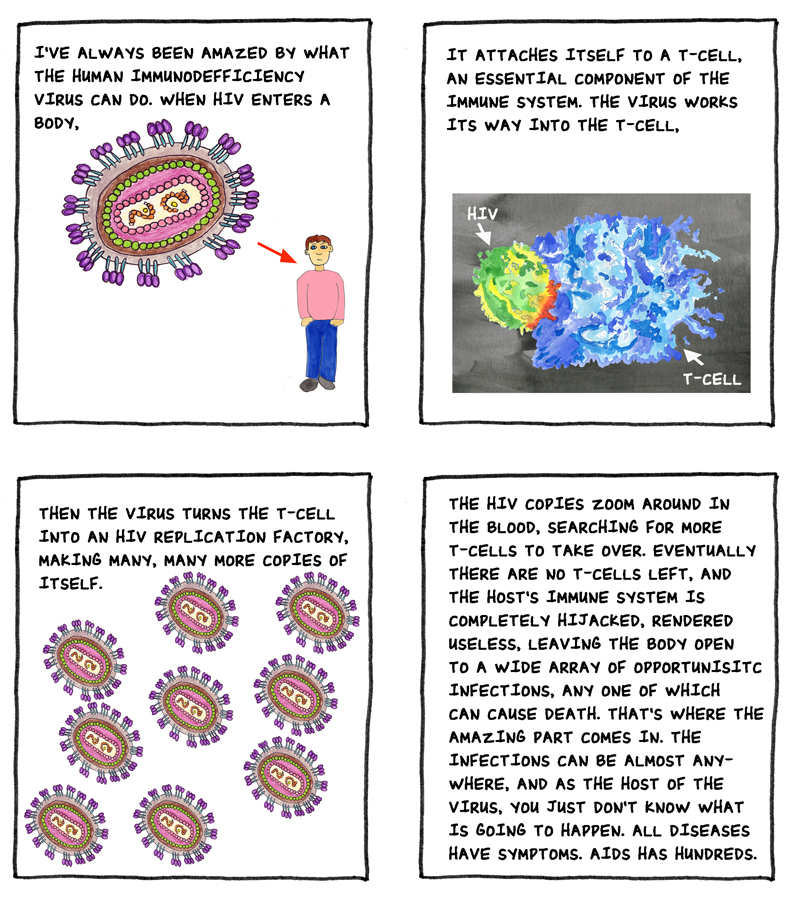
For this posting, I thought I would carry on the theme of Rikke Platz Cortsen’s recent blog article ‘From now on everything is just going to get worse’ by taking a further look at the subject of HIV in graphic novels. HIV is a viral infection which, if untreated, destroys the body’s natural immune system, leaving the person vulnerable to opportunistic infections. Since its discovery in the early 1980s the illness has been associated with stigma and as such is very relevant to our forthcoming conference Graphic Medicine: Visualizing the Stigma of Illness. Indeed, MK Czerwiec, who has first hand experience of caring for patients with HIV and AIDS from her time working in an HIV unit will be talking on the subject in her presentation ‘Taking Turns: AIDS, Oral History, and Comics’.
I work part time in Genitourinary medicine and so come into contact with people who are being treated for HIV infection, although I cannot claim any expertise: they are generally treated by the specialist while I tend to people who have other sexually transmitted conditions. HIV treatment has come a long way in the past 20 years and most people who are diagnosed and treated early in their infection can now expect to live a normal lifespan. A breakthrough came around 1996 with the introduction of HAART (highly active antiretroviral therapy) which turned HIV infection into a chronic manageable viral illness rather than a terminal disease; provided, that is, that one can afford the treatment, has health insurance or access to state provided care, the tragedy being that the majority of the world’s HIV patients fall outside this demographic. Since that time the mortality rate in the UK has fallen dramatically, while numbers of people living with HIV have continued to rise.
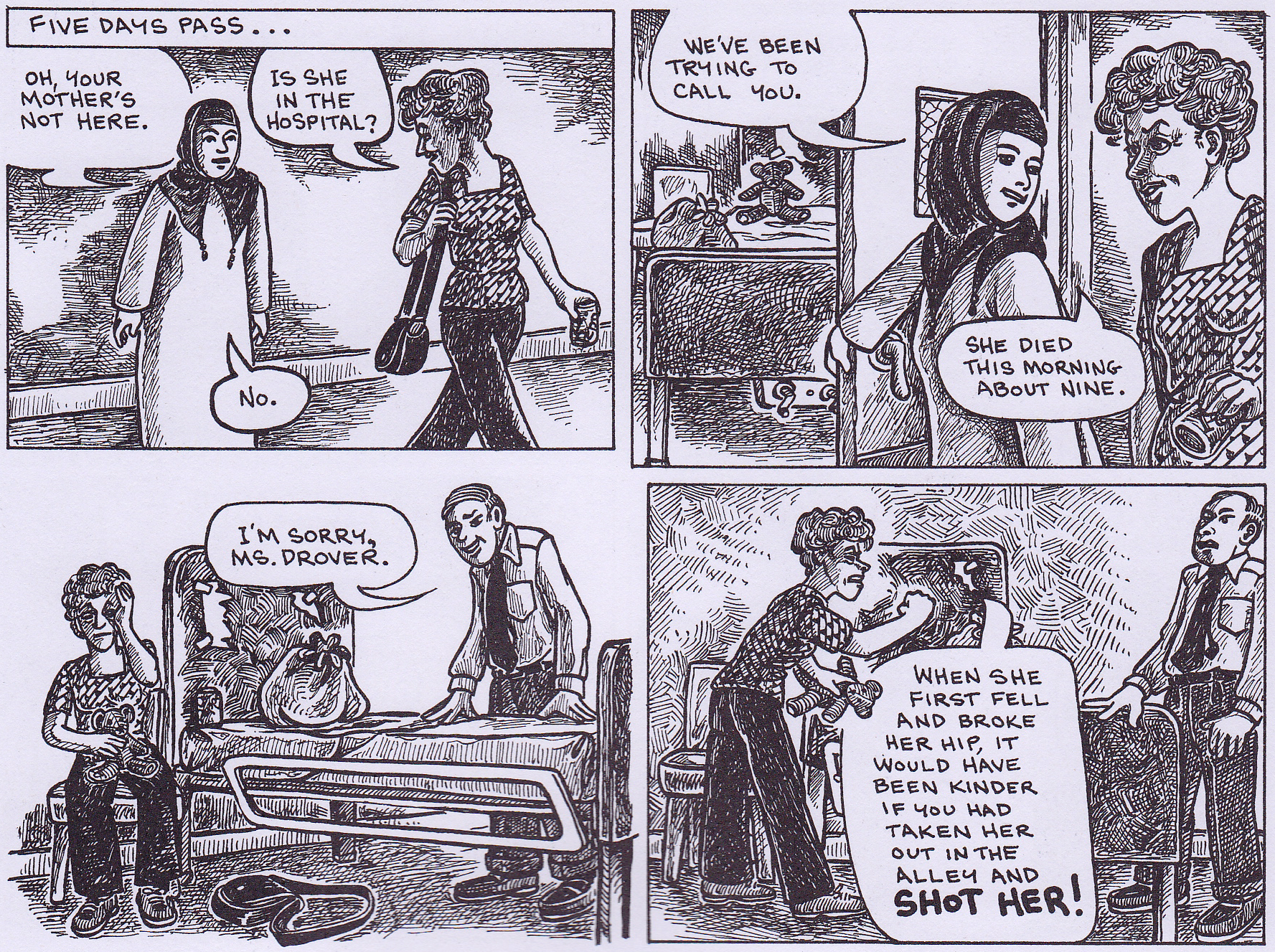
I started medical school in 1984 when AIDS had just hit the news, and an awareness raising campaign was underway in the media. Although the original medical acronym GRID (Gay-related immune deficiency) had been dropped, I still recall lurid headlines alluding to the ‘Gay Plague’ and remember the outspoken Chief Constable of Greater Manchester Police James Anderton, a Christian, referring to people with AIDS as ‘swirling about in a human cesspit of their own making’. My first job was on a haematology ward, where I witnessed several patients die of AIDS related infections.
There is a stigma attached to HIV infection because its transmission has, from the beginning, generally been associated with routes that seem to incur moral judgement: sex between men; intravenous drug abuse; and prostitution. The facts that the virus can be transmitted heterosexually or that many people with haemophillia died because HIV infected blood products were used in their treatment seems not to figure large in the public imagination. In areas where heterosexual transmission is the most common route, such as sub Saharan Africa, it seems the infection tends to be associated with the stigma of promiscuity, in women, at least.
There is an interesting online article about HIV and stigma here in which UN Secretary-General Ban Ki Moon (2008) is quoted as saying:
“Stigma remains the single most important barrier to public action. It is a main reason why too many people are afraid to see a doctor to determine whether they have the disease, or to seek treatment if so. It helps make AIDS the silent killer, because people fear the social disgrace of speaking about it, or taking easily available precautions. Stigma is a chief reason why the AIDS epidemic continues to devastate societies around the world.“
From the 1980s onwards, the comics community seems to have played a significant role in heightening awareness of both the dangers of contracting HIV and of the plight of those suffering the infection. This may have been partly because the LGBT community is well represented within the comics community, with comics artists starting to lose friends, colleagues and lovers to the infection, and partly because comics was seen as an effective medium by which to transmit the information. An early proponent of the medium was Madonna: Ethan Persoff, on his website Comics With Problems has a copy of a comic commissioned by the star which was handed out at one of her concerts in 1987. The same year saw the publication in the UK of Strip Aids a fund-raising comic and exhibition for the London Lighthouse created by Don Melia which featured work by almost 90 comics artists and writers including Steve Bell, Posy Simmons and Alan Moore.

- Robbins, T. Sienkiewicz, W. and Triptow, R. (1988) ‘Strip Aids USA’ San Francisco: Last Gasp. Click image for larger version.
This was followed a year later by Strip Aids USA edited by Trina Robbins, Bill Sienkiewicz, Robert Triptow (1988 Last Gasp) a collection of comics art to benefit people with AIDS. The money raised went to the Shanti Project which provided education about the psychosocial impact of AIDS on individuals and directs them to service providers. It comprised an eclectic collection of strips, cartoons and comic art by such luminaries as Harvey Pekar, Joyce Brabner, Bill Griffith, Alison Bechdel, Hernandez Brothers, Will Eisner, Gary Trudeau, and Spain.

- Hancock, M. et al (1991) ‘1+1’ and ‘1+1 Users Guide’. London: The Comic Company. Click image for larger version.
1991 saw the publication of 1+1 by the Comics Company, financed by the Terrence Higgins trust and the National Aids Trust. This comic featured work by Corrine Pearlman, Woodrow Phoenix, David Hine and Myra Hancock resulting from a two year collaboration of artists, drama workers and groups of young people. The strips were inspired by the workshops, discussions and firsthand accounts of people with HIV. Some of the strips were designed to be used as part of a workshop and the issue was accompanied by a companion comic, the 1+1 Users Guide. Reading the comic now, twenty years after it was produced, some of the strips, such as David Hine’s ‘Dreaming of the Twenty First Century’ strike me as particularly poignant. His two characters, a heterosexual couple called Al and Gabi are coming to terms with the fact that they have AIDS. Al, who contracted HIV from his occasional drug use when younger and unwittingly gave it to Gabi, dreams of New Years Eve 1999 to the soundtrack of Prince’s 1982 single) and wakes to the realization that both he and Gabi are unlikely to see the turn of the century.
Comics have been used as HIV education in many countries, as a Google search will reveal. Indeed one of the speakers in our conference, Brick, produced one entitled My Sister Too for Unicef about ‘Slim’ – an African nickname for AIDS. In 1994 Neil Gaiman Dave McKean and Todd Klein produced Death Talks About Life, (dedicated to Don Melia) in which the eponymous character from the Sandman series, explains in detail about how HIV can and cannot be contracted and gives advice about cleaning needles and practicing safer sex. She engages the help of occult investigator John Constantine from Hellblazer to explain about correct condom application (with the help of a banana).
Seven Miles a Second (1996) chronicles the life of David Wojnarowicz – an artist and writer who had been hustling on the street since the age of nine and who died in 1992 a year after developing AIDS. Wojnarowicz started the project with his friend James Romberger in 1988 but it didn’t see publication until four years after his death, Romberger having finished the work. It’s a raw piece of social surrealism, where dreams and hallucinations meld with reality, set in the dives of New York, where commercial sex workers live desperate, marginal lives full of violence and pain and prepubescent boys are used by middle aged family men. Narration becomes a stream of consciousness monologue, cataloguing the insults, discrimination and downright sadism that people with AIDS faced in a conservative society. In the year Wojnarowicz was writing he says that NYC alone had thirty three thousand people homeless and dying of AIDS on its streets. He rages with incandescent fury against the bigoted society that would happily see him die for his life choices, and as his body deteriorates, begins to resent his friends who try to offer him words of comfort:
I’m sick of being sick and it aggravates me to speak to people who have a degree of normalcy to their lives. I can’t deal with another “but you look good”. (1996:56)
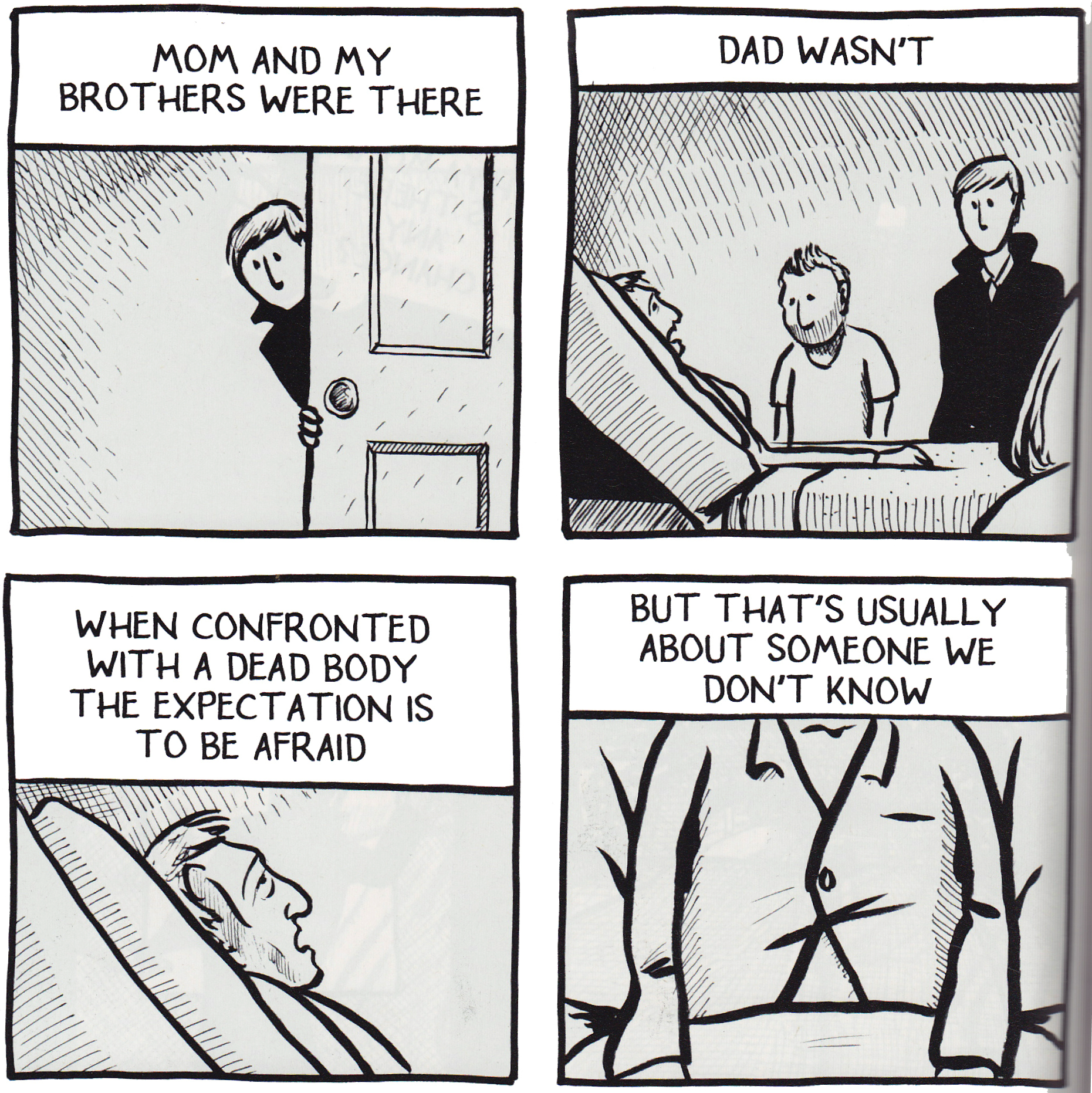
An altogether more gentle and tender portrait of a man dying from AIDS related illness is found in Judd Winick’s Pedro and Me. Pedro Zamora is a young Cuban émigré, living in America. Attractive, gay and seeking excitement he becomes sexually active at a young age and contracts HIV. Devastated, he decides to spread the word to other vulnerable young people by public speaking. He tours the States, educating others about safe sex and how to avoid AIDS. Judd Winick is a cartoonist. After graduating from art college he found that his anticipated career had not taken off quite as he hoped. He auditioned for, and was accepted onto MTV’s reality programme The Real World. He considers himself a liberal, but the news that he will share a house with (in fact a bedroom with) a man with AIDS forces him to confront his own attitudes and overcome his own anxieties. In the house he not only meets the man who will change his life, Pedro, but also his future wife, Pam. Pedro’s declining health brings together those around him and his attitude and selflessness touches everyone. Even Bill Clinton (featured in the story) was moved to help his plight.
This book is packed with information and would be a great debate opener on the subject of HIV. It discusses sexual practices and the disease openly without being as graphically explicit as Seven Miles a Second. I have to admit I prefer the dirty raw verisimilitude of Wojnarowicz’s unrestrained testimony, penned by someone who was actually dying from the illness and knew it, rather than Winick’s posthumous eulogy to his friend, which could be seen as slightly sentimental in places.
Wojnarowicz and Zamora died a few years before the introduction of HAART. Although not without its own problems and side effects, and the fact that its effectiveness depends on early diagnosis and treatment, this new therapy dramatically increases the life expectancy of people living with HIV. One might expect this to alter the nature of new stories about HIV.
Blue Pills, by Swiss artist Frederick Peeters, chronicles his relationship with Cati, a wild and vivacious girl he meets at a New Years Party. They connect and become lovers. Before long Cati tells Fred that she and her three-year-old son are both HIV positive. He is filled with a mixture of passion, pity and desire, but he does his best to act cool. Although disconcerted, he wants the relationship to work, and so it does. The book charts Fred’s evolving relationship with Cati’s son, cataloguing his periods of illness, his stays in hospital and the routine of his medication – the blue pills of the title.
One of the most engaging aspects of the book is the relationship between the couple and their laconic, overworked doctor. Judging by his rant against doctors in the opening pages of the book, Fred doesn’t normally think much of the medical profession. However, he describes Dr R as a “life raft”. The doctor doesn’t take himself too seriously, he has moods and off days. He is, therefore, human.
Maybe because the prognosis for HIV infection has changed so markedly, or maybe because the story is not told through the body of a sick person, there is little drama compared to other works in the same genre. It is low key, gently philosophical and more to do with love and anxiety than HIV per se, a meditation on the psychological suffering caused by being labeled and the arbitrariness of chance in the process of infection (Cati blames herself, Fred blames the world for her suffering). Like other graphic novels, I found it offered a new perspective on areas of the patient experience that I had never considered; the sort of non-propositional knowledge that comes from living through a treatment regime, rather than from reading textbooks. Using lots of visual metaphor, Blue Pills is a sort of graphic diary, a snapshot from the life of someone whose partner has HIV. There is no ultimate “resolution” to the story, just the suggestion of continuation. In this way Peeters destroys the teleology of the AIDS narrative as it is has been considered in the past: ending in death. It is a story about being well, getting on with life whilst living with an implicit medical “condition”, as part of what Arthur Frank calls ‘the remission society’ (1997: 8-13).
As the treatment of HIV becomes more effective and, economic factors notwithstanding, the prognosis changes and the number of people living with, not dying from, HIV increases we will no doubt see new works emerging in which the serological status of the protagonist is more of an incidental consideration rather than the central theme of the work. It will be interesting, in years to come, to look back at these works and consider how the stories changed in parallel to the changing availability of treatment, in the affluent west, at least. In the majority world, the old stories might take longer to change.
Ian Williams is the co-director of Graphic Medicine: Visualizing the Stigma of Illness, taking place at Leeds Art Gallery on the 17th of November as part of Comics Forum 2011. He is a comic artist (as Thom Ferrier) and speciality doctor in genitourinary medicine. See more of his work at www.thomferrier.com and www.graphicmedicine.org.
References
Ban Ki-moon (2008, 6th August), ‘The stigma factor’ op-ed. Washington: The Washington Times
Czerwiec, MK. (2011) Taking Turns: A Medical Tragicomic www.comicnurse.com (accessed October 2011)
Frank, A. (1997) The Wounded Storyteller. Chicago: University of Chicago
Gaiman, N, McKean, D and Klein, T. (1994) Death Talks About Life. New York: DC Comics
Hancock, M. et al (1991) 1+1 and 1+1 Users Guide. London: The Comic Company
Medua, D (ed) 1987 Strip Aids. London: Strip Aids.
Peeters, F (2008) Blue Pills. London: Jonathan Cape
Robbins, T. Sienkiewicz, W. and Triptow, R. (1988) Strip Aids USA. San Francisco: Last Gasp.
Winick, J (2000) Pedro and Me. New York: Henry Holt
Wojnarowicz, D. and Romberger, J. (1996) Seven Miles A Second. New York: DC Comics
You can read more editions of Graphic Medicine in the Comics Forum website archive.
Comics Forum 2011 is supported by Thought Bubble, the University of Chichester, the Henry Moore Institute, Dr Mel Gibson, Routledge, Arts Council England, Intellect and Molakoe Graphic Design.






 Comics Forum