RSS

Category Archives: Comics Forum 2011

Graphic Medicine #1: Of Comics, Disease and Stigma by Ian Williams

Hello and welcome to the Graphic Medicine component of the Comics Forum blog. My name is Ian Williams, I’m a comics artist, writer and doctor and I run the website graphicmedicine.org. With my colleagues Columba Quigley and Maria Vaccarella, I am organizing day 2 of the 2011 Though Bubble Comics Forum – Graphic Medicine: Visualizing the Stigma of Illness. In future weeks Columba will be contributing to the blog, as will our transatlantic collaborator MK Czewiec, aka ‘Comics Nurse’ who will be flying over to take part in the conference.

We are hoping the conference will be attended by comics scholars, healthcare professionals comics artists and, well, anyone with an interest in the interface between comics and healthcare. This should be a truly interdisciplinary meeting which will follow on from the outstanding success of our conference in London last year and the second international conference on Comics and Medicine: The Sequential Art of Illness which will be taking place in Northwestern University, Chicago as this piece is posted: the 9th to the 11th of June.

Thanks in part to the Health Humanities movement many medical schools now encourage the reading of classic literature to gain insight into the human condition. The medium of comics (referred to in the plural) is beginning to attract attention from healthcare scholars, as evidenced by an expanding body of academic literature on the subject and conferences held which examine specifically the interaction between comics and healthcare.

Among the growing number of works of graphic fiction, titles dealing directly with the patient experience of illness or caring for others with an illness are to be found. Indeed, the sheer volume of published works containing subject matter relevant to healthcare professionals seems to invite some sort of critical examination from a healthcare studies viewpoint. Some works, such as David B’s Epileptic (2006) or Charles Burns’ Black Hole (2005) are already hailed as classics. These works constitute an important resource, opening a window into the lives of those affected by illness. Comics, as a popular mass medium, also reflects society’s conception of healthcare at any one time, and as a vehicle for radical ideas, comics will also inform the cultural image of healthcare professionals.

All diseases cause stigma. While healthcare professionals and carers might strive to treat the physical or psychological effects of illness, stigma, a cultural effect, is often ignored. Stigma can be borne by the family, relatives, associates and even the carers of the sufferer, as well as the afflicted individual. While talking about it weakens its effect, stigma is a source of shame, bigotry and injustice and can, in some cases cause far more suffering than the disease or condition itself. It is a neglected area of study and comics, with its radical history and sophisticated mixture of text and graphics, allowing the articulation of subtle and complex insights into human behaviour and thought, might prove an ideal medium through which to examine the subject.

I started writing about comics and medicine, an area of study I christened ‘graphic medicine’ while writing the dissertation for my MA in Medical Humanities. I found so many graphic novels and comics with medical content I set up graphicmedicine.org to list them and briefly review them, to act as a resource for the healthcare and comics communities. Fairly soon, enthusiasts and scholars from all over the world started to contact me. One of the first was Prof Michael Green from Penn State Medical School dept of Medical Humanities. Michael was already at that time teaching a class on comics to his medical students and getting them to make strips about their experiences. Around this time, at the Association of Medical Humanities Annual Conference in Durham I met two scholars- Dr Maria Vaccarella, a post doctoral fellow at Kings College, and Dr Columba Quigley, MD who was taking an MA in Literature and Medicine at Kings. Maria and Columba were both studying comics too. We talked and during those few days the idea for our London conference was born. We contacted Michael, who brought in his colleagues Susan Squier and Kimberley Myers from Penn State, and joined by our UK colleagues Giskin Day and Bob Tanner, the conference took shape. Brian Fies, Paul Gravett and Marc Zaffran were invited as keynote speakers and Darryl Cunningham and Phillipa Perry came along to talk about their work.
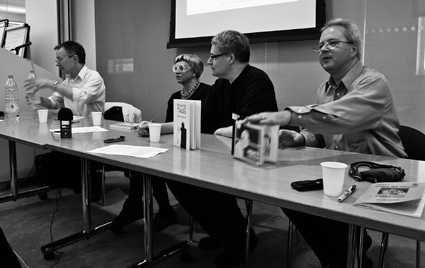
We had expected maybe 40 delegates, but on the day we were full to capacity, with 75. What we hadn’t quite expected was the tremendous buzz of excitement as comics artists rubbed shoulders with educationalists, scholars, journalists and healthcare professionals. Delegates flew in from all over the world. Among them being one MK Czerwiec, a nurse who had been documenting her care of HIV patients in comics form for many years. MK went on to lead the organization of the 2nd conference in her home town of Chicago, with keynote speakers Scott McCloud, Phoebe Gloeckner and David Small.

We hope you will consider replying to our call for papers, and coming along on the 17th of November to what should be great day of interdisciplinary discussion and debate.

Ian Williams is the co-director of Graphic Medicine: Visualizing the Stigma of Illness, taking place at Leeds Art Gallery on the 17th of November as part of Comics Forum 2011.
 

Sculpture and Comic Art #1: An expanded Call for Papers by Kirstie Gregory

The Henry Moore Institute is a world-recognised centre for the study of sculpture in the heart of Leeds. An award-winning exhibitions venue, research centre, library and sculpture archive, the Institute hosts a year-round programme of exhibitions, conferences and lectures, as well as developing research and publications, to expand the understanding and scholarship of historical and contemporary sculpture. The Institute is part of The Henry Moore Foundation, which was set up by Moore in 1977 to encourage appreciation of the visual arts, especially sculpture.

The ‘Sculpture & Comic Art’ Call for Papers and conference, part of the wider Comics Forum 3 day event, has been developed by the Henry Moore Institute’s Research Programme. The Research Programme is central to the activities of the Institute, aiming to encourage research into sculpture both within its walls and without, acting as a hub to develop a network of people with a particular interest in sculpture.

As historical and theoretical interest in comic art continues to grow, the Institute plans to explore the relationship between sculpture and comic art, looking at how formal and thematic concerns migrate, and have migrated across the last hundred years or so, between these practices. By using the phrase ‘comic art’ we mean to be inclusive of cartoons, comics, comix and graphic novels, and although examples of very early sequential visual art such as Trajan’s Column and the Bayeaux Tapestry are of interest, our focus is more linked to developments and connections which have emerged since the late nineteenth century, perhaps beginning around the time of Rodolphe Töpffer (1799-1846), an artist synonymous with the beginnings of modern comics.

Comic figuration is a regular influence on much modern and contemporary sculpture – allowing the body to be reinvented and restaged in new and fantastical ways beyond anatomical norms, and allowing sculptors to use a visual shorthand embracing exaggerated silhouettes, strange dramatic perspectives and subtle to exaggerated caricature. In addition to caricature, and its sort-of opposite, the ‘simplified reality’ style explained succinctly by Scott McCloud in Understanding Comics, comic art has also perhaps given sculptors and installation artists (such as Tom Friedman and Jake and Dinos Chapman) inspiration and ‘licence’ to push the boundaries of their work into the grotesque and ultra-violent.

By the same token we can also find the direct appropriation of comic and cartoon characters (often animals or superheroes) in recent installational practices, including those of Paul McCarthy, Maurizio Cattelan, Mark Dion and Thomas Schütte. This is always a choice by the artist heavy with significance, however intentions and outcomes are massively various, with contemporary artists Philippe Parreno and Pierre Huyghe highlighting issues of ownership and identity in their collaborative project ‘No Ghost Just a Shell’, for which an anonymous Manga character was bought from a Japanese design agency and given a new ‘life’, or Claes Oldenburg in the 1960s turning the shape of Mickey Mouse’s head into a Mouse Museum, literally elevating comic figuration into the realm of high art, as well as commenting on consumer culture and the allure of the collectible.

Such co-options are, in turn, echoed in sculpture’s intriguing place in many comics and graphic novels, where it is often given special powers and dynamic plot-determining roles within the visual sequential narratives constructed. From Tintin and Asterix to Jason Lutes’ Berlin: City of Stones, and Marjane Satrapi’s Persepolis, the sculptural object is frequently employed as a potent or poignant visual device to heighten tension, turn the plot or embody a character’s emotions. Sculpture has also been caricatured within comic art since the earliest cartoon strips and tensions between high and low art emphasised.

The role of narrative (sculptural and sequential) is significant, within and between the ‘gutter’ and the gallery – the way we move through a story or installation, book or gallery, the choices the reader or viewer makes, or thinks they make, and the creative manipulations of writers, illustrators, sculptors and curators. Also tied into this are issues of spatial boundaries and the links and significance when creators from both genres break with convention and lead their audiences down new narrative paths. Comic writers and artists who have worked with unusual narrative and spatial techniques must be plentiful, and examples which spring to mind initially include Chris Ware’s disturbing, disjointed narrative in Jimmy Corrigan, the Smartest Kid on Earth and what Paul Gravett describes as “the quaking panel borders” in Raymond Briggs’ When the Wind Blows, representing “the impact of the bomb”.[1]

Finally, as sculptors have turned to comic art, so artists who began their practice in two dimensions (such as Robert Crumb, Paul McDevitt, David Shrigley and Chris Ware) have turned to three-dimensions. What does examining this shift and the works produced tell us about the links/lacunae between the mediums and the reasons and choices behind these different forms? This move from 2D to 3D is also relevant to issues of the power and popularity of the small-scale figurine, and the collectible’s standing as a three-dimensional demonstration of characters originally articulated in two dimensions, whether on the page or in animated film. The attraction of the figurine is applicable to both the comic and the sculptural spheres as is the wider subject of collecting.

In future blog entries I hope to focus more closely on some of these subjects – but please note these ‘categories’ are not exclusive and we very much welcome papers which approach the relationship between sculpture and comic art from different perspectives.

Kirstie Gregory is the co-convenor of Sculpture and Comic Art, taking place at Leeds Art Gallery on the 16th of November as part of Comics Forum 2011.

[1] – Gravett, Paul, Graphic Novels: Stories to Change Your Life, London: Aurum Press Limited, 2005. p.149.


Introduction

Hello and welcome to the Comics Forum blog. This is the best place to keep up to date with all the latest news and information about Comics Forum, the academic side of Leeds’ sequential art festival, Thought Bubble.

Comics Forum was established in 2009 as ‘Possibilities and Perspectives: A Conference on Comics’, which ran at the Alea Casino in parallel with the Thought Bubble convention on the 21st of November. Last year’s event took place at Leeds Art Gallery and ran from the 18th to the 19th of November. It comprised two conferences: ‘Women in Comics II’ and ‘Theory and Practice: A Conference on Comics’. 2011’s Comics Forum is scheduled for the 16th to the 18th of November and will pull together ‘Sculpture and Comic Art’, ‘Graphic Medicine’ and ‘Materiality and Virtuality: A Conference on Comics’. The call for papers is out today and is available here.

The aim of Comics Forum is to encourage productive dialogues between scholars, creators and professionals working on comics. We have a broad and inclusive approach, and try to showcase as many different speakers and ideas as possible in the time available. The intellectual level is high and the event can be challenging at times, but we think it’s important to push for the type of rigorous, well-researched material that comics deserve.

This site has been established in that spirit. In addition to releasing information about Comics Forum, we’ll be using it to provide an archive of material relating to previous years’ events, and to present articles from a wide range of guest writers. We’ll also be hosting ongoing columns. Kirstie Gregory from the Henry Moore Institute will write on Sculpture and Comic Art, while Ian Williams, Columba Quigley and M K Czerviec (Comic Nurse) will discuss Graphic Medicine. The intentions here are: a) to give an idea of the numerous voices speaking on comics in different styles, from different angles and with different interests, b) to get people rethinking their readings of the medium and challenging themselves to consider alternative viewpoints, and c) to stimulate debate and discussion on a wide range of topics relating to comics, both on the blog itself and at the events.

I very much hope you’ll enjoy the site and take the time to read the articles and commentaries provided by our writers, who are among the top thinkers on the medium of comics. If you have any questions, suggestions, comments, complaints or compliments don’t hesitate to get in touch by email at comicsforum@hotmail.co.uk or in the comments sections on each of the blog posts. You can keep updated with the site by email by clicking the subscription link on the right hand side of the page, or by RSS by clicking the orange icon at the top right.

Best wishes to all our readers.

Ian Hague, Director of Comics Forum