RSS

Category Archives: Comics Forum Archives

Graphic Medicine #4: Hospice Comics by MK Czerwiec (Comic Nurse)

The theme of this year’s Graphic Medicine Comics Forum is “Visualizing the Stigma of Illness.” Stigma in illness often arises simply from close association with death. Dying is frequently an integral plot element in medically themed graphic novels and memoir, but it frequently happens “off-panel” thereby avoiding challenging visual representations of death and dying. There are notable exceptions to this, of course, such as Lisa’s Story: The Other Shoe by Tom Batiuk (Kent State University Press, 2007).
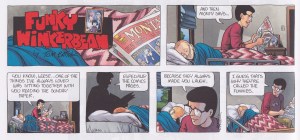
‘Lisa’s Story: The Other Shoe’ by Tom Batiuk, p.218. Image used with the permission of the creator, who holds the copyright. Click image for larger version.

Three notable graphic memoirs published in 2011 visually portray dying and death. To this hospice nurse, these three representations of family hospice experiences struck me as refreshingly honest. They portray the kinds of experiences I’ve witnessed professionally but not previously seen presented in graphic narrative, and they stayed with me. Each is intimate, honest, and, I’m guessing, was challenging to produce, as in each book, the creator is presenting the death of their parent.

In Seeds by British artist Ross Macintosh, (published by Com.x) Mackintosh’s father is dying of cancer.

‘Seeds’ by Ross Macintosh, p.56. Image used with the permission of the creator. Click image for larger version.

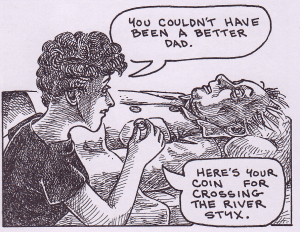
Ross is summoned during the night. His father has died.

‘Seeds’ by Ross Macintosh, p.62. Image used with the permission of the creator. Click image for larger version.
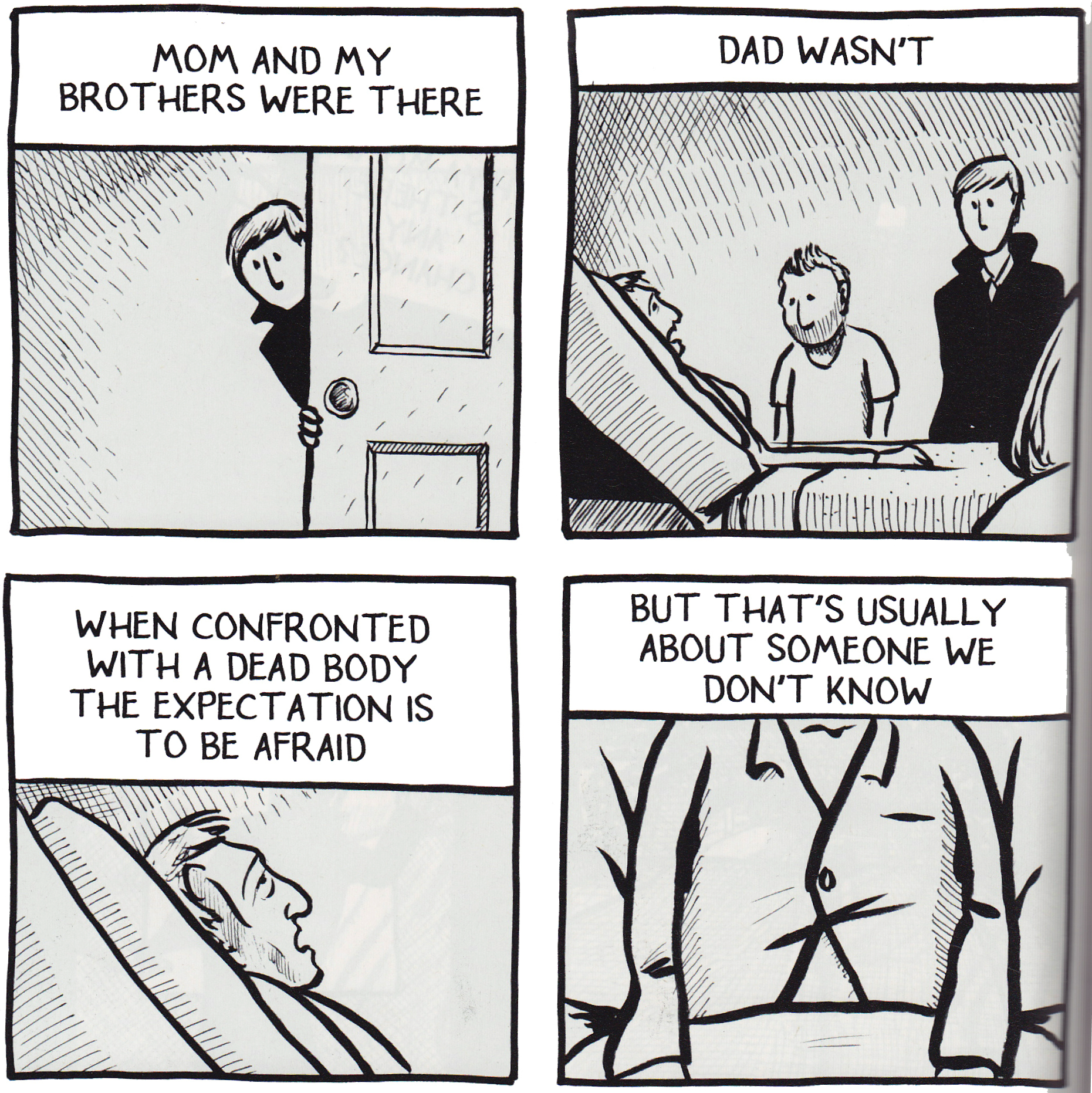
Depicting a character, particularly one’s own parent, after death, is not something the norm in graphic texts about illness, and Mackintosh does this beautifully in Seeds. The simple graphic sensibility of the book is in stark contrast to the emotional complexity of the content. In addition to drawing his own dad moments after death, Mackintosh confronts in the text of this section the existential nothingness that is death, avoiding religiosity and spirituality. Further in the panel shown above, for example, he compares his dad’s body to a cut toenail – an artifact of life that no longer carries meaning. I found this treatment of death bold and refreshing.

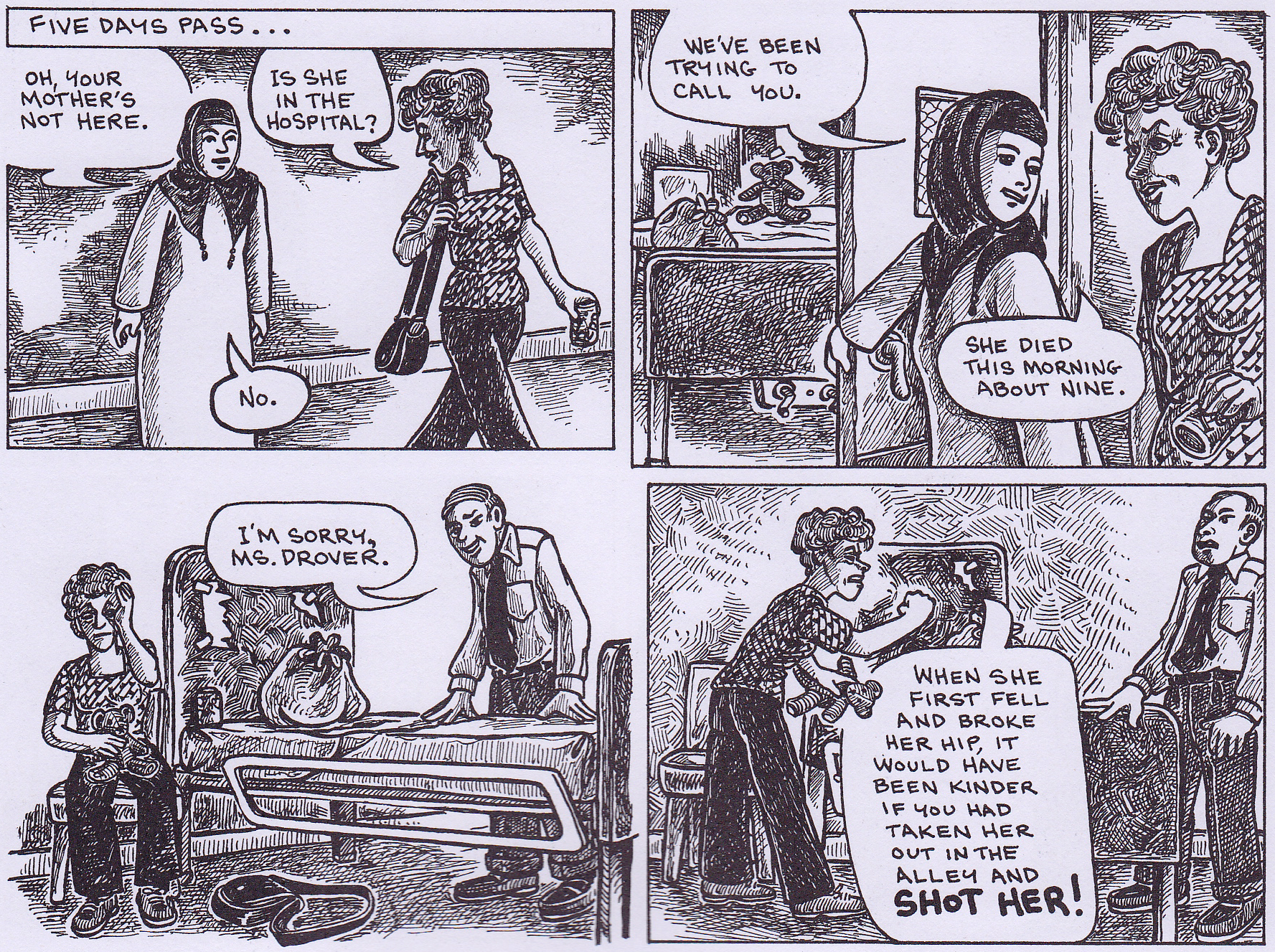
In Special Exits by American underground comics artist Joyce Farmer, (Fantagraphics) the protagonist character (meant to represent Farmer) is not present for the death of her mother, because the nursing home staff failed to make contact with her in time.

‘Special Exits’ by Joyce Farmer, p.150. Image used with the permission of the creator. Click image for larger version.
When it is Farmer’s father’s time to be in hospice, she seems committed to being with him, and showing us, every arduous step along the way.
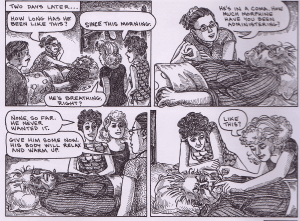
‘Special Exits’ by Joyce Farmer, p.195. Image used with the permission of the creator. Click image for larger version.
‘Special Exits’ by Joyce Farmer, p.196. Image used with the permission of the creator. Click image for larger version.
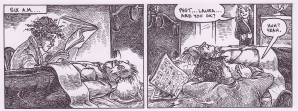
She is not present for the actual death again, but is with her father moments after.

‘Special Exits’ by Joyce Farmer, p.196. Image used with the permission of the creator. Click image for larger version.

In Tangles, Vancouver artist, writer and editor Sarah Leavitt (UK publisher Johnathan Cape) presents her mother’s struggle with and death due to Alzheimer’s disease. Like Macintosh and Farmer, she represents this difficult experience with unflinching honesty. Again, here a last visit before death:

‘Tangles’ by Sarah Leavitt, p.121. Image used with the permission of the creator. Click image for larger version.

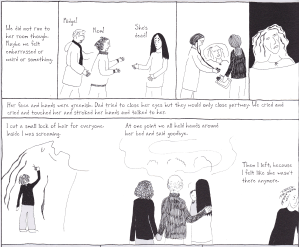
And a visit immediately after death:

‘Tangles’ by Sarah Leavitt, p.122. Image used with the permission of the creator. Click image for larger version.
‘Seeds’ by Ross Macintosh, p.61. Image used with the permission of the creator. Click image for larger version.

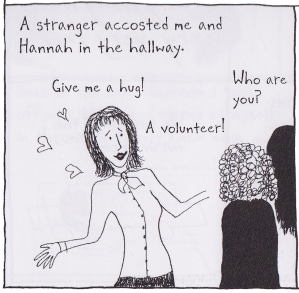
Interestingly, each of these texts also point out things caregivers did that were remembered as less-than-helpful during a difficult time. For Farmer, it was the nurse not reaching her in time preventing Farmer from being present for her mother’s death. For Ross, it was the way in which a hospital staff member chose to inform him of his father’s death.And for Leavitt, less-than-helpful volunteers appeared shortly after her mother passed away.

‘Tangles’ by Sarah Leavitt, p.122. Image used with the permission of the creator. Click image for larger version.

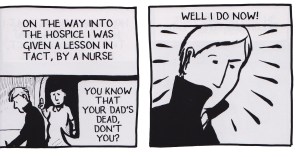
These unhelpful persons seem an integral part of the narrative of each death, burned into the memory of the storyteller for the obvious contrast they represent to what is needed by families at a time of loss.

It is my hope that these three texts released in 2011 represent a shift toward visually representing family experiences of dying and death. The results are twofold – for the person experiencing the very personal loss, creating the graphic narrative can serve to integrate the experience of a loved one’s death into their ongoing life story. The narrative can also serve as a remembrance to and for those who experienced the loss. Addressing both of these points, Mackintosh told Deborah Vankin in an interview for the Los Angeles Times:

 I created the comic for myself, as a way of removing pictures and phrases from the maelstrom in my head. The secondary purpose was a subconscious need to express to my mom and brothers that the awful events didn’t just happen quietly.

For those of us who are readers of the texts, they help us to begin to think about the deaths we have encountered or will encounter, and give us models for how to (and perhaps how not to) approach them.

Margaret Edson wrote in her Pulitzer Prize winning play W;t:

We are discussing life and death, and not in the abstract, either… Now is not the time for verbal swordplay, for unlikely flights of imagination and wildly shifting perspectives, for metaphysical conceit, for wit… Now is a time for simplicity. Now is a time for, dare I say it, kindness.

MK Czerwiec RN, MA worked as an AIDS nurse from 1994-2000. When antiretrovirals enabled her Chicago AIDS ward to be closed, she started making comics under the pseudonym Comic Nurse. Czerwiec then earned an MA in Medical Humanities and Bioethics. She teaches “Drawing Medicine” at Northwestern Medical School and is working on an illustrated oral history of the AIDS crisis, “Taking Turns: A Medical Tragicomic.”

All image copyright belongs to the creators.

You can read previous editions of Graphic Medicine in the Comics Forum Website Archive.

Comics Forum 2011 is supported by Thought Bubble, the University of Chichester, the Henry Moore Institute, Dr Mel Gibson, Routledge, Intellect and Molakoe Graphic Design.
 

Ah! Nana: The Forgotten French Feminist Comics Magazine by Catriona MacLeod

The process of female integration into French-language comic strip (or bande dessinée) creation in the twentieth century was slow, with women linked to this domain much more likely to inhabit the role of illustrator for children’s books. In the late 1970s, however, as Claire Bretécher and Annie Goetzinger made their mark as pioneering but exceptional female creators in the Francophone medium, a new publication appeared with the potential to expedite the slow inclusion of women artists into the bande dessinée by providing an unprecedented vehicle both for semi-established and previously unpublished female creators to present their work. The journal Ah! Nana did not fulfil this potential, however, and after falling foul of strict censorship laws and the restrictive economic sanctions that accompanied them, folded after only nine issues.

Ah! Nana was certainly short-lived, producing its first issue in October 1976 and its last in September 1978, however, as the only journal in French history created entirely by women featuring regular bandes dessinées – although male artists were occasionally invited to contribute – it constitutes an innovative experiment in the development of the adult Francophone BD. In spite of this, it has, like so many other female-led artistic endeavours, been largely ignored in chronologies and encyclopaedias of the Francophone medium. Patrick Gaumer’s 2004 Larousse de la BD does not mention it at all, whilst the 2003 BD Guide devotes one short paragraph of its 1525 pages to the journal, simply noting its creation by women, the name of its editor Janique Dionnet [1], and the fact that it was eventually censored.

Read the rest of this entry »


Tags: , , ,

Comics Forum 2011: Registration Open

Registration for Comics Forum 2011 is now open. The registration form for this year’s event is available to download here or from the Comics Forum 2011 page.

The full programme will be available shortly; details are still being finalised. Preliminary running times are as follows:

16/11/2011 (1000-1645): Sculpture and Comic Art

Evening: Keynote session (included in ticket price)

17/11/2011 (1000-1645): Graphic Medicine: Visualizing the Stigma of Illness

Evening: Conference dinner (not included in ticket price)

18/11/2011 (1000-1645): Materiality and Virtuality: A Conference on Comics

Evening: Keynote session (included in ticket price)

Tickets will be priced as follows:

1 day ticket: £10

3 day ticket: £30

5 day ticket: £40 (includes two-day pass to Thought Bubble convention)

Conference accommodation will be provided at a reduced rate by the Leeds Marriott Hotel. Prices are as follows:

3 night stay: £99 per night single & £109 per night double / twin BB

5 night stay: £90 per night single & £100 per night double / twin BB

Click here to be taken to a booking form with the relevant discount code already filled in.

Details are subject to change; more information will be made available on the Comics Forum 2011 webpage as we get it.

Comics Forum 2011 is supported by Thought Bubble, the University of Chichester, the Henry Moore Institute, Dr Mel Gibson, Routledge, Intellect and Molakoe Graphic Design.

IH


Affiliated Conferences

Today I’m delighted to announce the latest initiative in Comics Forum’s ongoing efforts to promote and develop comics scholarship in the UK and around the world: our new affiliated conferences programme.

Under this programme, the Comics Forum website will host documentation, promotional materials and papers from other conferences and events on comics, thereby providing an online archive of scholarship available to download for free.

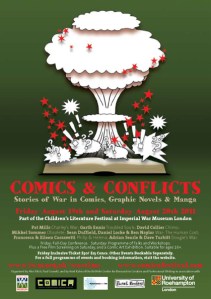
To launch the programme, we’ve teamed up with Ariel Khan, Paul Gravett and Alex Fitch of the Comics & Conflicts conference taking place at the Imperial War Museum on Friday the 19th and Saturday the 20th of August. You can find out more about the conference in this article by Paul Gravett. Full details and ticket prices are available here. Once the events have been wrapped up, we’ll be providing an online archive of the conference papers for download from our new Comics & Conflicts page, accessible here and through the links at the top and side of the site. The conference poster is already available to download, and the programme will be up shortly. Be sure to head along to the conference if you can, and keep an eye on the blog for updates regarding the availability of new papers!

We are actively seeking to expand the affiliated conference programme and develop it as a useful ongoing resource for scholars, readers and creators of comics. If you are involved in organising a conference or similar event and would like to feature the conference papers and other materials for open access download via the Comics Forum website, please email us at comicsforum@hotmail.co.uk and let us know!

Similarly, if you were a speaker at a previous Comics Forum and would like your paper to be made available in our digital archives, do get in touch.

[UPDATE 19/08/2011: The Comics & Conflicts programme is now available from the conference page.]

Ian Hague

Director of Comics Forum


Graphic Medicine #3: ‘The Epilepsies of the War’ in David B’s Black Paths by Maria Vaccarella

Three newspapers and eleven books arranged on a bed in the shape of a man. Though familiar with David B.’s brave visual metaphors, at first I struggled to make sense of this image from Black Paths, his 2007 graphic novel published in English last month. I had often browsed in amazement through his outstanding embodied depictions of epilepsy in his best known work Epileptic, and was now confronted with a disembodied protagonist, Lauriano, a former soldier, a cunning bandit, a crafty seducer, and an experimental writer, reduced here to a display of printed pages on a blanket. And among them, a newspaper entitled Incidents de la nuit, just like David B.’s collection of oneiric graphic tales…

The more I looked at the panel, the more I felt an invitation to read through those books and newspapers, in order to evoke Lauriano’s presence and access his complex psychology, just as his lonely lover Mina had been doing in the novel. This blog post is an account of my personal exploration of Lauriano’s ‘portrait in newsprint’. I hope it will help set the atmosphere for 2011 Thought Bubble Comics Forum’s conference on day 2 about Graphic Medicine: Visualizing the Stigma of Illness, which I am organizing with my colleagues Ian Williams, Columba Quigley and M.K. Czerwiec.

Based on the historical, yet surreal, interwar siege of Fiume in Croatia, violence and literary echoes permeate the pages of Black Paths: an anthropomorphic bunch of scattered books could actually symbolize the whole graphic novel. Italian writer Gabriele D’Annunzio’s project of establishing an aesthetic republic in Fiume – a whole new concept of avant-garde state – relied on a collective post-war frenzy, whose inner incoherence and violent manifestations are well explored in the book. A meaningful moment – no matter whether historical or fictional – is when D’Annunzio and his collaborators think of summoning all the madmen from Italian asylums to appoint them as political advisors: a paradoxical utopia, reminiscent of Jean-Christophe’s project of leading a ‘revolt of the handicapped’ in Epileptic.

While the historical character of the artist ruler is relegated to the background of Black Paths, the fictional character of Lauriano emerges prominently among the endless urban fighting and the shared frantic rhetoric of Fiume. But rather than a traditional hero, Lauriano is a man on the run, from rival gangs and from himself, and the reader strives to follow him through the pages while collecting fragments of his story. An explanation finally comes from the sceptical account of his friends to Mina: Lauriano is obsessed with his dead comrades’ ghosts, he is affected by shellshock, the much stigmatized “male hysteria”. David B.’s style hits its highest point, as he carves out the imaginative visual projections of his protagonist’s mental distress: disproportioned bodies and spirits fill panels to the brim, often morphing into animals, a vivid reminder of resurfacing brutal instincts and primal fears in men at war. You could see the shadow of Septimus Smith, the highly iconic shellshocked soldier in Mrs Dalloway, behind Lauriano’s back. The author’s crafty balancing of the blue-gray palette in the trench panels conveys the feeling of relished solitude in the midst of a brutal conflict, reminding me of Giuseppe Ungaretti’s poem Vigil, in which he explores his innermost feelings during a night spent beside the slaughtered corpse of a comrade in a trench.

At the launch of Black Paths in London, Paul Gravett asked David B. the question that had been puzzling me, since I first heard of this new graphic novel: ‘What is the relationship between the violence depicted in Epileptic and the violence depicted in Black Paths?’ To which, David B. replied by pointing out that in Black Paths, he had illustrated ‘the epilepsies of the war’. He referenced here a longstanding representational trope in Western literature: epilepsy as a signifier of chaos or as a metaphor of social upheaval. I couldn’t help thinking of Elsa Morante’s History (1974), an unconventional historical novel about World War II in Italy, seen through the eyes of the humblest people, above all a primary school teacher, Ida, and her young son, Useppe, who both have epilepsy. The illness is ultimately a powerful metaphor for Morante’s distrustful view of the history of humanity, ‘a scandal which has gone on for 10000 years’ (as the cover subtitle to the first edition stated). A further proof of this is one of the novel’s working titles, Il grande male (the Italian for grand mal/tonic-clonic seizure), which more literally means “the great evil” and which might refer to the world war and/or to totalitarianism as well. Or, as literary critic Lucia Re wrote, ‘a metaphor of History itself as an endlessly destructive mechanism, whose seemingly gratuitous and arbitrary yet faultlessly consistent logic selects the most innocent victims as targets of its violence.’ (1993, 365)

David B. articulated one of the most compelling graphic accounts of illness-related stigma in Epileptic, and this creative experience resounds in crucial moments of Black Paths. Though mainly focused on the controversial aesthetic drives in totalitarian ideologies, Black Paths also conveys the profound sense of loneliness and incommunicability at the core of many mental illness experiences, which complicates their socio-cultural perception and any attempt at effectively eradicating the stigma often attached to them.

Dr Maria Vaccarella is a Research Fellow at the Centre for the Humanities and Health, King’s College London. Her main research field is narrative medicine and she has worked on medical-themed graphic novels, particularly on epilepsy and breast cancer. She is particularly interested in graphic depictions of illness embodiment and in how graphic illness narratives are being used in medical and patient education.

Comics Forum 2011 is supported by Thought Bubble, the University of Chichester, the Henry Moore Institute, Dr Mel Gibson, Routledge, Intellect and Molakoe Graphic Design.