RSS

Category Archives: Graphic Medicine

Graphic Medicine #3: ‘The Epilepsies of the War’ in David B’s Black Paths by Maria Vaccarella

Three newspapers and eleven books arranged on a bed in the shape of a man. Though familiar with David B.’s brave visual metaphors, at first I struggled to make sense of this image from Black Paths, his 2007 graphic novel published in English last month. I had often browsed in amazement through his outstanding embodied depictions of epilepsy in his best known work Epileptic, and was now confronted with a disembodied protagonist, Lauriano, a former soldier, a cunning bandit, a crafty seducer, and an experimental writer, reduced here to a display of printed pages on a blanket. And among them, a newspaper entitled Incidents de la nuit, just like David B.’s collection of oneiric graphic tales…

The more I looked at the panel, the more I felt an invitation to read through those books and newspapers, in order to evoke Lauriano’s presence and access his complex psychology, just as his lonely lover Mina had been doing in the novel. This blog post is an account of my personal exploration of Lauriano’s ‘portrait in newsprint’. I hope it will help set the atmosphere for 2011 Thought Bubble Comics Forum’s conference on day 2 about Graphic Medicine: Visualizing the Stigma of Illness, which I am organizing with my colleagues Ian Williams, Columba Quigley and M.K. Czerwiec.

Based on the historical, yet surreal, interwar siege of Fiume in Croatia, violence and literary echoes permeate the pages of Black Paths: an anthropomorphic bunch of scattered books could actually symbolize the whole graphic novel. Italian writer Gabriele D’Annunzio’s project of establishing an aesthetic republic in Fiume – a whole new concept of avant-garde state – relied on a collective post-war frenzy, whose inner incoherence and violent manifestations are well explored in the book. A meaningful moment – no matter whether historical or fictional – is when D’Annunzio and his collaborators think of summoning all the madmen from Italian asylums to appoint them as political advisors: a paradoxical utopia, reminiscent of Jean-Christophe’s project of leading a ‘revolt of the handicapped’ in Epileptic.

While the historical character of the artist ruler is relegated to the background of Black Paths, the fictional character of Lauriano emerges prominently among the endless urban fighting and the shared frantic rhetoric of Fiume. But rather than a traditional hero, Lauriano is a man on the run, from rival gangs and from himself, and the reader strives to follow him through the pages while collecting fragments of his story. An explanation finally comes from the sceptical account of his friends to Mina: Lauriano is obsessed with his dead comrades’ ghosts, he is affected by shellshock, the much stigmatized “male hysteria”. David B.’s style hits its highest point, as he carves out the imaginative visual projections of his protagonist’s mental distress: disproportioned bodies and spirits fill panels to the brim, often morphing into animals, a vivid reminder of resurfacing brutal instincts and primal fears in men at war. You could see the shadow of Septimus Smith, the highly iconic shellshocked soldier in Mrs Dalloway, behind Lauriano’s back. The author’s crafty balancing of the blue-gray palette in the trench panels conveys the feeling of relished solitude in the midst of a brutal conflict, reminding me of Giuseppe Ungaretti’s poem Vigil, in which he explores his innermost feelings during a night spent beside the slaughtered corpse of a comrade in a trench.

At the launch of Black Paths in London, Paul Gravett asked David B. the question that had been puzzling me, since I first heard of this new graphic novel: ‘What is the relationship between the violence depicted in Epileptic and the violence depicted in Black Paths?’ To which, David B. replied by pointing out that in Black Paths, he had illustrated ‘the epilepsies of the war’. He referenced here a longstanding representational trope in Western literature: epilepsy as a signifier of chaos or as a metaphor of social upheaval. I couldn’t help thinking of Elsa Morante’s History (1974), an unconventional historical novel about World War II in Italy, seen through the eyes of the humblest people, above all a primary school teacher, Ida, and her young son, Useppe, who both have epilepsy. The illness is ultimately a powerful metaphor for Morante’s distrustful view of the history of humanity, ‘a scandal which has gone on for 10000 years’ (as the cover subtitle to the first edition stated). A further proof of this is one of the novel’s working titles, Il grande male (the Italian for grand mal/tonic-clonic seizure), which more literally means “the great evil” and which might refer to the world war and/or to totalitarianism as well. Or, as literary critic Lucia Re wrote, ‘a metaphor of History itself as an endlessly destructive mechanism, whose seemingly gratuitous and arbitrary yet faultlessly consistent logic selects the most innocent victims as targets of its violence.’ (1993, 365)

David B. articulated one of the most compelling graphic accounts of illness-related stigma in Epileptic, and this creative experience resounds in crucial moments of Black Paths. Though mainly focused on the controversial aesthetic drives in totalitarian ideologies, Black Paths also conveys the profound sense of loneliness and incommunicability at the core of many mental illness experiences, which complicates their socio-cultural perception and any attempt at effectively eradicating the stigma often attached to them.

Dr Maria Vaccarella is a Research Fellow at the Centre for the Humanities and Health, King’s College London. Her main research field is narrative medicine and she has worked on medical-themed graphic novels, particularly on epilepsy and breast cancer. She is particularly interested in graphic depictions of illness embodiment and in how graphic illness narratives are being used in medical and patient education.

Comics Forum 2011 is supported by Thought Bubble, the University of Chichester, the Henry Moore Institute, Dr Mel Gibson, Routledge, Intellect and Molakoe Graphic Design.
 

Graphic Medicine #2 by MK Czerwiec (Comic Nurse)

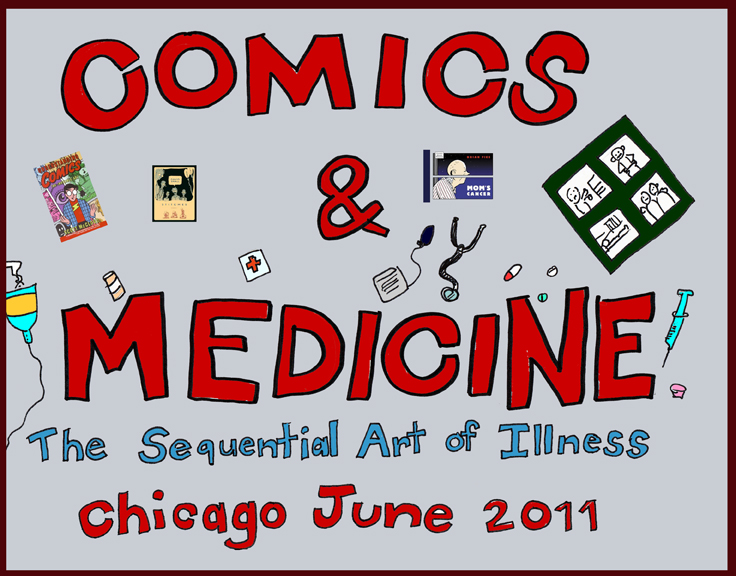
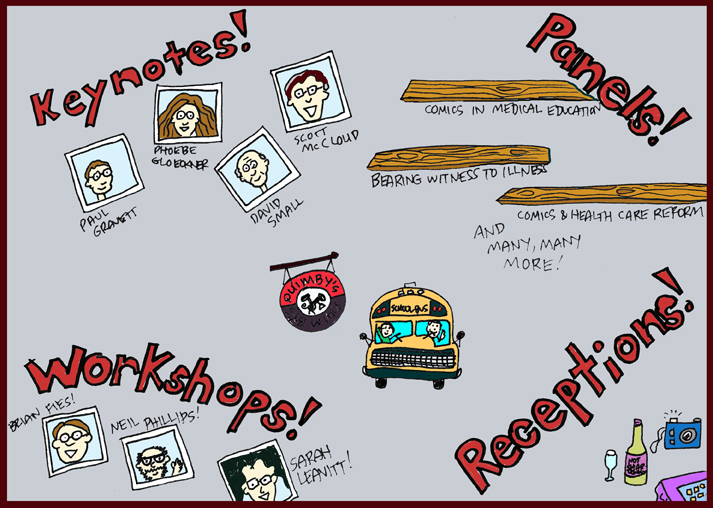
The 17 November Graphic Medicine forum at Thought Bubble follows on the heels of the second international conference on Graphic Medicine in June in Chicago.

What we learned at our conference in Chicago is that there is a surprising amount of fascinating work being done, around the world, involving the use of comics in medicine.

Graphic Medicine.org creator Ian Williams (aka Thom Ferrier) covered a portion of what was presented in his excellent post about the Chicago 2011 Comics & Medicine conference on the BMJ blog site. No one person could attend all the sessions at the conference, an unfortunate necessity of a great conference on a great topic.

This meant every attendee had a unique experience of the conference but had to miss much more than they might have liked.

Fortunately, we have some good quality audio recordings from the conference. I’ve enjoyed the opportunity to relive some of the lectures through them.

I’d like to focus on Stitches creator David Small’s keynote address at the Chicago conference, which I found so thought provoking and creatively inspiring I decided to transcribe it.

I first read David Small’s masterful graphic memoir, Stitches (2009, W.W. Norton) when a friend who knew David’s work, and also knew I was teaching medically-themed graphic narrative, sent me a copy. Stitches is David’s first graphic memoir, and follows his fifty-book long career as an illustrator. David has won the top awards of children’s book illustration, including the Caldecott Award and the Caldecott Medal. He has also been awarded The Christopher Medal. His illustrations have appeared in The New Yorker and The New York Times.

Jules Feiffer said of Stitches, “Like the boy in this autobiographical novel, my first reading of Stitches left me speechless and in awe. David Small presents us with a profound and moving gift of graphic literature that has the look of a movie and reads like a poem.”

David opened his keynote talk by showing us this brief film on YouTube as an introduction.

This video gives you a bit of an introduction to the plot of the book, which basically is that David was given cancer as a child by his father, a radiologist, who, following the protocol of the day, repeatedly irradiated young David for chronic sinus infections.

The book also brilliantly displays the dysfunction of David’s childhood home, in which he had no voice – figuratively, and, as a result of the surgery for his neck cancer, eventually also literally. David retreated to his drawing, which, in combination with adolescent and adult psychotherapy, saved his life.

David said shortly after the video presentation that, “I didn’t really understand why I was invited to this conference. I know you’re all doctors, or have something to do with medicine, some interest, but the whole idea of comics in medicine seemed a little far out. Until we got here last night. It all became immediately clear looking at the art, the range of subjects, the range of approaches to illness and doctoring by both victims of things, patients, and practitioners.”

The art exhibit David refers to here contains enlarged pieces of artwork taken from seventeen texts discussed at the conference. Statements from the creators of each graphic narrative hung with their piece. As David points out, enlarging the comics to 18×24 and putting the content under spotlights in this way had an even more powerful impact than, I think, even the conference organizers anticipated.

David then went on to make three specific points that arose from making his book that should be of special attention to people in the medical profession. “First of all,” he said, “I think it bears examination, the whole idea of doctors who treat their own families.”

“Second category: the omnipotence factor in doctoring.” David cites two examples in Stitches where the arrogance of the doctors around him, first and foremost being his own father, clearly caused him great harm.

David’s third point was about his psychoanalyst, who appears in Stitches as a white rabbit. David credits his analyst with turning around the life of a very angry, very sad young man. David believes that his psychoanalysis was successful for two reasons, because the therapist was willing to cross professional boundaries — to do such things as take young David shopping because, “my parents had never taught me how to buy anything” and second because David’s therapist had loved him. Being loved by his therapist taught David how to love himself – and this enabled David to complete this very challenging memoir years later.

As far as the creative process that brought Stitches to life on the page, David said, “I’ll tell you how I went about it. I didn’t go about it.” He went on to describe his desire to write a memoir, and the process of writing one story from his childhood, what he thought was the only thing he remembered. It was a text version of the sequence pictured in the art exhibit, in which six-year-old David is wandering in a forbidden area of a hospital after hours and stumbles upon a fetus in a jar. He imagines that the tiny fetus crawls out of the jar and begins chasing him. He gave this story, as prose, to his editor. She was thrilled, and for ten years afterwards, asked how his memoir was coming. He would say it was coming well, but in reality was not working on it at all. “I knew I couldn’t face it. I knew I couldn’t face it as a prose piece. Drawing, for me, is like falling off a log. Writing, for me, is very hard. I start a paragraph, and all of a sudden I become Flaubert, going over every word, changing. Words, no. Pictures, always.” But David didn’t see how his memoirs could work in pictures.

But then he took a trip to Paris, and visited a friend whose son Pierre was working on his first graphic novel. “I had seen a few graphic novels, but I didn’t have any ideas that had Batman in them, so I’d dismissed them. Plus they looked like a whole hell of a lot of pictures to draw. I remember looking over Pierre’s shoulder, thinking, ‘Yup, that’s a whole hell of a lot of little pictures, and I’m never going to do that.’” Then Pierre gave him a few graphic novels that he thought would have more resonance for David. He was given Léon La Came by Sylvain Chomet and Nicholas DeCrècy, Mitchum by Blutch, Notes for a War Story by Gipi, and Blue Pills by Frederik Peeters. “Pierre knew I was an appreciator of fine art and fine storytelling, and he really handed me the right books.”

David then described the routine that eventually led to Stitches. He would work in his studio all day on his children’s illustration projects. Then he would come home, “make myself a martini, and start working on my memories in panels. It turned out to be a lot of fun, because I got to be the film maker that I’ve never had the chance to be.”

As he was bringing back to life his unpleasant childhood through his drawings, the project became more difficult. “It became chaos. Because life is chaos, memories are chaos.” He went on to say, “You eventually have to turn your life into a story arc, and realize you’re making a piece of fiction out of something when your whole intention was to tell the truth and nothing but the truth. That was my intention. I finally came to a point where I understood that what I really needed to get to was verisimilitude and not absolute truth. Because absolute truth would be fifteen hundred pages and extremely boring.”

Fortunately, David produced the exceptionally un-boring Stitches. It is an astonishing work and a great contribution to Graphic Medicine.

MK Czerwiec (sir-wick) worked as an AIDS nurse from 1994-2000. When antiretrovirals enabled her Chicago AIDS ward to be closed, she started making comics under the pseudonym Comic Nurse. Czerwiec then earned an MA in Medical Humanities and Bioethics. She teaches “Drawing Medicine” at Northwestern Medical School and is working on an illustrated oral history of the AIDS crisis, “Taking Turns: A Medical Tragicomic.”


Graphic Medicine #1: Of Comics, Disease and Stigma by Ian Williams

Hello and welcome to the Graphic Medicine component of the Comics Forum blog. My name is Ian Williams, I’m a comics artist, writer and doctor and I run the website graphicmedicine.org. With my colleagues Columba Quigley and Maria Vaccarella, I am organizing day 2 of the 2011 Though Bubble Comics Forum – Graphic Medicine: Visualizing the Stigma of Illness. In future weeks Columba will be contributing to the blog, as will our transatlantic collaborator MK Czewiec, aka ‘Comics Nurse’ who will be flying over to take part in the conference.

We are hoping the conference will be attended by comics scholars, healthcare professionals comics artists and, well, anyone with an interest in the interface between comics and healthcare. This should be a truly interdisciplinary meeting which will follow on from the outstanding success of our conference in London last year and the second international conference on Comics and Medicine: The Sequential Art of Illness which will be taking place in Northwestern University, Chicago as this piece is posted: the 9th to the 11th of June.

Thanks in part to the Health Humanities movement many medical schools now encourage the reading of classic literature to gain insight into the human condition. The medium of comics (referred to in the plural) is beginning to attract attention from healthcare scholars, as evidenced by an expanding body of academic literature on the subject and conferences held which examine specifically the interaction between comics and healthcare.

Among the growing number of works of graphic fiction, titles dealing directly with the patient experience of illness or caring for others with an illness are to be found. Indeed, the sheer volume of published works containing subject matter relevant to healthcare professionals seems to invite some sort of critical examination from a healthcare studies viewpoint. Some works, such as David B’s Epileptic (2006) or Charles Burns’ Black Hole (2005) are already hailed as classics. These works constitute an important resource, opening a window into the lives of those affected by illness. Comics, as a popular mass medium, also reflects society’s conception of healthcare at any one time, and as a vehicle for radical ideas, comics will also inform the cultural image of healthcare professionals.

All diseases cause stigma. While healthcare professionals and carers might strive to treat the physical or psychological effects of illness, stigma, a cultural effect, is often ignored. Stigma can be borne by the family, relatives, associates and even the carers of the sufferer, as well as the afflicted individual. While talking about it weakens its effect, stigma is a source of shame, bigotry and injustice and can, in some cases cause far more suffering than the disease or condition itself. It is a neglected area of study and comics, with its radical history and sophisticated mixture of text and graphics, allowing the articulation of subtle and complex insights into human behaviour and thought, might prove an ideal medium through which to examine the subject.

I started writing about comics and medicine, an area of study I christened ‘graphic medicine’ while writing the dissertation for my MA in Medical Humanities. I found so many graphic novels and comics with medical content I set up graphicmedicine.org to list them and briefly review them, to act as a resource for the healthcare and comics communities. Fairly soon, enthusiasts and scholars from all over the world started to contact me. One of the first was Prof Michael Green from Penn State Medical School dept of Medical Humanities. Michael was already at that time teaching a class on comics to his medical students and getting them to make strips about their experiences. Around this time, at the Association of Medical Humanities Annual Conference in Durham I met two scholars- Dr Maria Vaccarella, a post doctoral fellow at Kings College, and Dr Columba Quigley, MD who was taking an MA in Literature and Medicine at Kings. Maria and Columba were both studying comics too. We talked and during those few days the idea for our London conference was born. We contacted Michael, who brought in his colleagues Susan Squier and Kimberley Myers from Penn State, and joined by our UK colleagues Giskin Day and Bob Tanner, the conference took shape. Brian Fies, Paul Gravett and Marc Zaffran were invited as keynote speakers and Darryl Cunningham and Phillipa Perry came along to talk about their work.

We had expected maybe 40 delegates, but on the day we were full to capacity, with 75. What we hadn’t quite expected was the tremendous buzz of excitement as comics artists rubbed shoulders with educationalists, scholars, journalists and healthcare professionals. Delegates flew in from all over the world. Among them being one MK Czerwiec, a nurse who had been documenting her care of HIV patients in comics form for many years. MK went on to lead the organization of the 2nd conference in her home town of Chicago, with keynote speakers Scott McCloud, Phoebe Gloeckner and David Small.

We hope you will consider replying to our call for papers, and coming along on the 17th of November to what should be great day of interdisciplinary discussion and debate.

Ian Williams is the co-director of Graphic Medicine: Visualizing the Stigma of Illness, taking place at Leeds Art Gallery on the 17th of November as part of Comics Forum 2011.


Introduction

Hello and welcome to the Comics Forum blog. This is the best place to keep up to date with all the latest news and information about Comics Forum, the academic side of Leeds’ sequential art festival, Thought Bubble.

Comics Forum was established in 2009 as ‘Possibilities and Perspectives: A Conference on Comics’, which ran at the Alea Casino in parallel with the Thought Bubble convention on the 21st of November. Last year’s event took place at Leeds Art Gallery and ran from the 18th to the 19th of November. It comprised two conferences: ‘Women in Comics II’ and ‘Theory and Practice: A Conference on Comics’. 2011’s Comics Forum is scheduled for the 16th to the 18th of November and will pull together ‘Sculpture and Comic Art’, ‘Graphic Medicine’ and ‘Materiality and Virtuality: A Conference on Comics’. The call for papers is out today and is available here.

The aim of Comics Forum is to encourage productive dialogues between scholars, creators and professionals working on comics. We have a broad and inclusive approach, and try to showcase as many different speakers and ideas as possible in the time available. The intellectual level is high and the event can be challenging at times, but we think it’s important to push for the type of rigorous, well-researched material that comics deserve.

This site has been established in that spirit. In addition to releasing information about Comics Forum, we’ll be using it to provide an archive of material relating to previous years’ events, and to present articles from a wide range of guest writers. We’ll also be hosting ongoing columns. Kirstie Gregory from the Henry Moore Institute will write on Sculpture and Comic Art, while Ian Williams, Columba Quigley and M K Czerviec (Comic Nurse) will discuss Graphic Medicine. The intentions here are: a) to give an idea of the numerous voices speaking on comics in different styles, from different angles and with different interests, b) to get people rethinking their readings of the medium and challenging themselves to consider alternative viewpoints, and c) to stimulate debate and discussion on a wide range of topics relating to comics, both on the blog itself and at the events.

I very much hope you’ll enjoy the site and take the time to read the articles and commentaries provided by our writers, who are among the top thinkers on the medium of comics. If you have any questions, suggestions, comments, complaints or compliments don’t hesitate to get in touch by email at comicsforum@hotmail.co.uk or in the comments sections on each of the blog posts. You can keep updated with the site by email by clicking the subscription link on the right hand side of the page, or by RSS by clicking the orange icon at the top right.

Best wishes to all our readers.

Ian Hague, Director of Comics Forum