RSS

Category Archives: Thought Bubble

Comics Forum 2012: Poster and Keynotes

Click image for full size poster.

I’m delighted to announce four excellent keynote speakers for Comics Forum 2012, and release our conference poster – ably designed once again by Ben Gaskell of Molakoe Graphic Design. Click here for the poster in PDF format – please circulate!

Coming up on the 15th of November (day 1) we have Simone Lia, author of Fluffy and Please God, Find Me a Husband! appearing in conversation with Helen Iball from the University of Leeds, who is also running Laydeez Do Comics Leeds (launching on the 26th of November!).

On the 16th of November (day 2) we’ll be hearing from Charlie Adlard, artist on The Walking Dead and 2000AD, who will be in conversation with Hugo Frey from the University of Chichester.

We also have a packed lineup of top speakers from around the world coming to Leeds to speak about a wide variety of subjects. See the Comics Forum 2012 page for details of all our speakers, paper titles and info on how to register. Tickets start from just £10!

Comics Forum 2012 is supported by Thought Bubble, Arts Council England, the University of Chichester, Dr Mel Gibson and Molakoe Graphic Design.


Comics Forum 2012: Registration Open

Registration for Comics Forum 2012 is now open. The conference will take place at Leeds Central Library on the 15th and 16th of November, and is themed around ‘Multiculturalism and Representation’. We have a fantastic line up of speakers from around the world coming to speak on a huge range of topics (see below for a full list).

Tickets are priced as follows:

1 day pass (15th or 16th): £10

2 day pass (15th and 16th): £20

4 day pass (Comics Forum 2012 & a two day Thought Bubble convention pass): £30 (save £10 on the cost if bought separately)

To register, email comicsforum@hotmail.co.uk and let us know how many tickets you want. Payment will be taken in cash on the day. Booking early is strongly recommended. Ticket prices include light refreshments but not lunch.

The full list of speakers and titles is as follows (this list is subject to change):

Maaheen Ahmed: The mutability of the line and its tendency towards monstrosity: Otherness of and within comics Maria-Sabina Draga Alexandru: Narrative Exploration against Mentality Issues: Indirect Education for Multiculturalism in Tintin Anya Benson: A Door to Anywhere: The Multicultural Visions of Doraemon Jacob Birken: Set Pieces. Is eclectic imagery in Manga “Othering” or practised Polyculturalism?  Frank Bramlett: The role of culture in comics of the quotidian Michael A. Chaney: Graphic Adaptations of Black Style: Converting Zora Neal Hurston’s Narrational Dialect into Comics Corey K. Creekmur: Multiculturalism Meets the Counterculture: Racial Difference in Underground Comix Umar Ditta: Controversial representations of cultures and relations between cultures Harriet E. H. Earle: Multiculturalism Vs Melting Pot in 9/11 Charity Comics Elisabeth (Lisa) El Refaie: Shape-shifting as a metaphor for multiculturalism in Gene Luen Yang’s American Born Chinese Cameron Fletcher: Spiderman: Manhattan to Mumbai; Crossing more than timelines to make a Global Icon a Glocal Hero Michael Forbes: Truth, Baldwin, & American National Symbols William H. Foster III: The Changing Image of African American Women in Comics Lina Ghaibeh: Covering Wonder Woman’s nakedness: on the modification of comics imported to the Arab world Mel Gibson: ‘We don’t need no steenkin’ badgers!’ Talbot’s Grandville, anthropomorphism and multiculturalism Lily Glasner: Have you no manners? A Little Girl’s Gift to Her Majesty Simon Grennan: Empowerment requires power: absence, equilibrium and the capacity to influence in comics representations of cultural difference Brenna Clarke Gray & Peter Wilkins: An Innocent at Home: Scott Pilgrim and its Canadian Multicultural Context Sarah D. Harris: The Monster Within and Without: Spanish Comics, Monstrosity, Religion, and Alterity Paul Harrison: Land of Denial – Egypt in Comics Ian Horton: Colonialist Heroes and Monstrous Others: Stereotype and Narrative Form in British Adventure Comic Books Harriet Kennedy: The confused nationalisms of Bojoual: le huron-kébékois Alex Link: Negotiating Multicultural Transnationalism and Assimilative Globalization in Marjane Satrapi’s Persepolis and Taiyo Matsumoto’s Tekkonkinkreet Anna Madill: Caucasian, Japanese, or What? Visual Representation of Race in Boys’ Love Manga Paul M. Malone: Multikulti Manga in Germany; or, Why Frau Merkel Should Read More Comics Andy Mason: The Presidential Penis and Other Scandalous South African Satires: Race, ethnicity and representation in South African comics and political cartooning, from the early 20th century to the present Ana Merino: The Impact of the Latino Identities on the Alternative Landscape of Comics: Thirty Years of Love and Rockets Dana Mihăilescu: Oy, Gevalt, Meydele! The Lower East Side as Mishmash of Jewish Women’s Multicultural Images in Leela Corman’s Unterzakhn Joseph North: Volti nascosti: cultural diversity in the Italian fumetto Hannah O’Connor: Sapphic Supervillains and Dynamic Dykes: Lesbian Heroism and (In)Visibility in Mainstream Graphic Literature Pre- and Post-9/11 Emma Oki: Representations of Asian Americans in Selected Works by Adrian Tomine Mihaela Precup: The Image of the Foreigner in Communist Romanian Comics Ethan Rubin: Robots are People Too: Webcomics and the Social Standing of “Everyday AI” Rebecca Scherr: Framing Subjects: the politics of representation in Joe Sacco’s Footnotes in Gaza Staci Strobl & Mary L. Tabakow: Representations of Asian Guest Workers, Expatriates, and Male/Femaie Omani Nationals in Royal Omani Police Comic Strips John G. Swogger: Palauan Storyboard: Comics and narrative context in archaeological fieldwork Marina Cavalcante Vieira: Migration and city image in light of Chicago School Sociology theories: assimilation and melting pot cities in the earlier Batman and Superman Asta Vrečko: ‘No one thinks of winter when the grass is green’ Keina Yoshida: Graphic fiction, visual narratives and international criminal justice

Comics Forum 2012 is supported by Thought Bubble, Arts Council England, the University of Chichester, Dr Mel Gibson and Molakoe Graphic Design.


Comics Forum Online: Year One Review and Comics Forum 2012 Call for Papers

One year ago today, comicsforum.org launched with this introductory post. Today I’m pleased to present a look back at the past year of articles by major comics scholars from around the world, and a look ahead to what’s coming next for Comics Forum, including our annual conference.

Read the rest of this entry »


Call for Papers: Rummaging Around in Alan Moore’s Shorts

Guest Editor: Maggie Gray

One sign of the rude health of comic book studies is the growing body of scholarship that focuses on, encompasses, or takes as its starting point, the work of acclaimed and prolific British comics writer Alan Moore. However, while Moore scholarship has moved on from an almost exclusive focus on landmark comic Watchmen to encompass overlooked or less popular works like A Small Killing or Tom Strong, and even unfinished epic Big Numbers, it still concentrates overwhelmingly on what Charles Hatfield calls ‘comics in the long form’, major ongoing serialised comics and self-contained graphic novels. [1]

Yet this means that the wealth of Moore’s ‘short form’ works has been overlooked. These include the underground and newspaper strips, cartoons and illustrations with which he began his career as a freelance cartoonist; the back-up features in 2000AD and Marvel UK anthologies where he claims he learnt the craft of comics writing; one-off collaborations with figures like Peter Bagge, Bryan Talbot, Hunt Emerson, Richard Corben, and Harvey Pekar; contributions to fanzines, benefit anthologies, annuals and spin-offs; and even diffuse work in other media (short prose stories, poems, essays and articles, pin-up art, CD covers etc.).

Looking more closely at such works not only enables us to plug gaps in Moore scholarship and flesh out our understanding of his career, ideas and practice, but also to challenge the privileging of the long form in comics scholarship in general.

In this spirit, we are looking for succinct contributions of 1,000-1,500 words, for a series of Comics Forum blog articles on Moore’s shorts to be published throughout September 2012 on the Comics Forum website (http://comicsforum.org).

If you are interested in contributing, please email a brief abstract (c.100-200 words) and a short biography of yourself (c.50-100 words) to Maggie Gray at: comicsforum@hotmail.co.uk. The deadline for abstracts is June 1st 2012, and you will receive notification of acceptance or rejection by June 18th.

Click here for a copy of this call for papers in PDF format.

Comics Forum is supported by: Thought Bubble, Dr Mel Gibson, the University of Chichester, Arts Council England and Molakoe Graphic Design.

[1] – Hatfield, C., 2005. Alternative Comics: An Emerging Literature. Jackson: University Press of Mississippi, pp.4-6.

 

Tags: ,

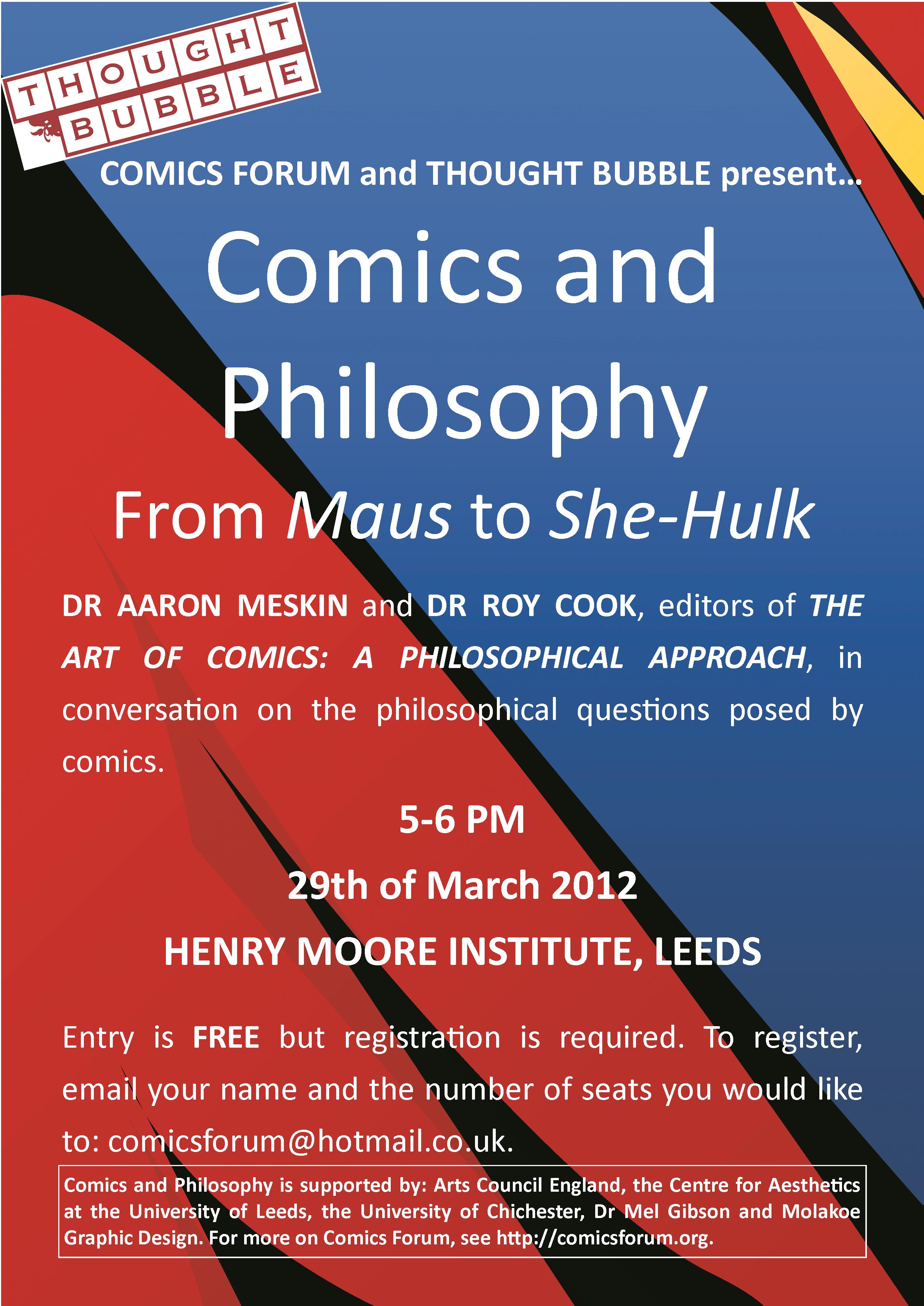
Comics and Philosophy: From Maus to She-Hulk

To register for this event, email comicsforum@hotmail.co.uk.

For a PDF of this poster click here.