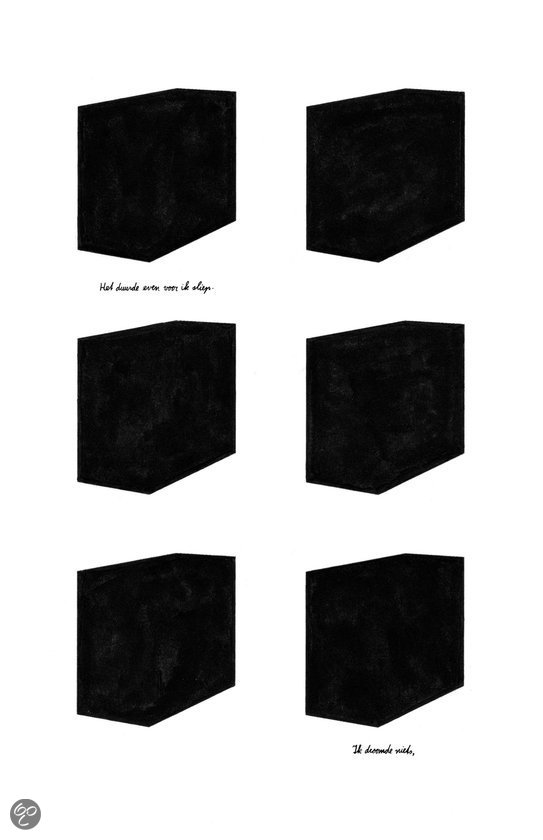
Few things are more fascinating in comics than those panels in which nothing is shown; panels left blank or, on the contrary, saturated with black (or any other colour, for that matter); panels in which the subtle distinction of the line gives way to an (almost) undifferentiated monochrome. These (seemingly) empty panels do not only continue to intrigue (and delight) all readers from 7 to 77, but have also attracted the attention of many a theorist.
In Bande Dessinée et Narration (2011) for instance, the book in which Thierry Groensteen picks up the thread of his earlier reflections (Groensteen 1999), the temporary interruption of the narrative flow is a key element of the argumentation and helps, paradoxically, to describe the narrational structure of graphic narratives. To spare myself the laborious (and often frustrating) task of translating French phrases into understandable English, the reflections in this post will mostly be based on ‘The Monstrator, the Recitant and the Shadow of the Narrator’ (2010), an earlier article in which Groensteen summarizes his position.
Strongly influenced by André Gaudreault’s (1988) reflections on film narration, Groensteen distinguishes three fundamental narratorial instances that shape the story in graphic narratives. There is the monstrator, “the instance responsible for the putting into drawing [mise en dessin] of the story” (Groensteen 2010, 4); the recitant, the instance ‘responsible’ for the textual ennunciation and finally the narrator, “the ultimate authority that is responsible for the selection and organisation of all the information that makes up the storytelling” (Groensteen 2010, 14). In line with the theory of filmic narration (Gaudreault 1988; Chatman 1990) Groensteen’s narrator is an impersonal, covert instance; an organisational principle that coordinates the functioning of monstrator and recitant and thus ensures the coherence of the story.
In a section on the interaction of the recitant and the monstrator Groensteen touches upon the phenomenon of ‘empty’ panels. He writes (and I’ll have to quote at some length):
One might be tempted to believe that, whereas the recitant can choose to speak or to remain silent according to the needs of the moment, in principle the monstrator, however, can never remain in the background. Indeed, from the moment that the monstrator underplays its role, the image-based part of the storytelling breaks off and narrative continuity collapses. Nonetheless, it is possible for the monstrator to remain silent. […] The monstrator is also backgrounded when it produces a blind image, a frame that is entirely white, or black, so as to signal the loss of consciousness and, by association, of sight (the character falls asleep, faints, or is knocked out), or a refusal to show the surrounding world. (Groensteen 2010, 11)
The possibility to (temporarily) suppress one of the narrational ‘tracks’ in graphic narratives without disrupting the narrative sequence is truly interesting. But, unlike Groensteen’s description, the use of an ‘empty’ or ‘blind’ panel does not necessarily suspend the graphic continuity. In fact, Groensteen confuses two fundamentally different uses of the same graphic technique. It is however important, as I will show, to distinguish ‘empty’ panels that show that there is nothing to see from ‘empty’ panels that do not show at all.
In the first (and largest) category the ‘blind’ panels (re)present an event in the story world (an intradiegetic event); in most cases, as Groensteen notes, the loss of consciousness or sight of one or several of the protagonists. The graphic narration is not interrupted in this case, but the monstrator – to use Groensteen’s terminology – continues to show from an internal or an external perspective what there is to see, namely nothing. This also means that the adjective “empty” can only refer to the graphic surface of the panel, to the absence of a drawing and not to its (diegetic) contents. That these panels are not really empty becomes particularly clear in those cases where the depiction of a pair of bright eyes in an otherwise black panel signals the presence of a character.
In Ray Fawkes’ One Soul (2011), for example, a black panel represents the death of one of the eighteen protagonists the story follows simultaneously. The black panel does not represent the ending of that particular narrative thread, it is rather the narration of an ending (or an absence); the continuous affirmation (page after page) of that protagonist’s (and, further in the book, of the other protagonists’) death. The diegetic function of the ‘empty’ panels is reaffirmed in the last pages of the book, in which the black comes to symbolize an eternal and universal soul.
Although this first category seems, narratologicaly speaking, rather banal, its use often has a remarkable effect on the level of the artifact.[1] Tim Enthoven, for example, uses the black panel in his graphic novel binnenskamers [2] (2011) to continue the graphic narration on another level. In this graphic novel most panels are drawn as transparent, three dimensional volumes (and not as the more common two dimensional windows) in which the protagonist (Tim) lives. This graphic device effectively conveys Tim’s feeling of isolation. The (seemingly) consequent external perspective of the graphic narration positions the reader as a kind of voyeur, on the outside looking in. Because of this external position, the reader’s view is blocked by the darkness in the room when the protagonist turns off the light. In this case the blackness of the panel thus literally represents the darkness inside the room (external perspective) and not the protagonist’s loss of sight (internal perspective). On the level of the graphic artifact the darkening of the room hides the convergence lines and strangely flattens the three dimensional volume. The flattening, in turn, initiates an intriguing shadow play, in which the otherwise rigid outlines of the cubicle become elastic and graphically support the verbal narration which conveys the protagonist’s thoughts, feelings and fantasies (internal perspective).
The ‘blind’ panels of the second category on the other hand do represent an interruption of the graphic narration. In this case there is (supposedly) something to show but the monstrator refuses to/is not willing to/is not able to … depict it. In this category the panels are both graphically and diegetically empty. The most famous example of this particular use of the ‘empty’ panel – an example Groensteen (2010, 11-12) also discusses – is the fourth page of Gustave Doré’s (1854) Histoire pittoresque, dramatique et caricaturale de la Sainte Russie: d’après les chroniqueurs et historiens Nestor, Nikan, Sylvestre, Karamsin, Ségu, etc. On the page in question the reader discovers a series of five empty frames and a narratorial text (at the bottom of the page) explaining why the panels have been left blank. The narrator writes that this chapter of his history of Russia consists of a series of “equally colourless events” and that he, in order not to annoy his reader so early in his book, had decided to leave those out. His editor, the narrator continues, did however insist that he would leave the necessary space, “to prove that a skillful historian can soften everything without leaving anything out” (Groensteen 2010, 11). It has to be noted, firstly, that the nature of the ‘empty’ panels is revealed by the accompanying text. It is thus only by reading the text that the reader realizes that the graphic narration has been interrupted. This particular page shows, secondly, that Groensteen’s narrational model neglects an interesting (and important) narrational level. Although the monstrator is ‘silenced’ in this part of the story, another (graphic) instance seems to delimit the diegetic space by drawing the panels. This suggests, to my sense, that the fundamental narrator in comics might be an overt instance (instead of a covert instance) (cf. Surdiacourt 2012) It is precisely the simultaneous inactivity of the monstrator and the activity of the fundamental narrator that creates the self-conscious atmosphere of this page, by showing that nothing is shown.
References
Seymour Chatman (1990) Coming to Terms. The Rhetoric of Narrative in Fiction and Film. Ithaca: Cornell UP.
Gustave Doré (1854) Histoire pittoresque, dramatique et caricaturale de la Sainte Russie : d’après les chroniqueurs et historiens Nestor, Nikan, Sylvestre, Karamsin, Ségu, etc. Paris: Bry.
Tim Enthoven (2011) binnenskamers. Antwerpen/Amsterdam: Bries/De Harmonie.
Ray Fawkes (2011) One Soul. Portland: Oni Press.
André Gaudreault (1999) Du littéraire au filmique. Système du récit. Paris/Québec: Armand Collin/Nota Bene.
Thierry Groensteen (2011) Bande dessinée et narration. Système de la bande dessinée 2. Paris : PUF.
Thierry Groensteen (2010) “The Monstrator, the Recitant and the Shadow of the Narrator.” In: European Comic Art 3 (1): 1-21.
Steven Surdiacourt (forthcoming (2012) “Can You Hear Me Drawing? ‘Voice’ and the Graphic Novel.” In: Sibylle Baumbach, Beatrice Michaelis & Ansgar Nünning: Travelling concepts and metaphors in the humanities. Trier: Wissenschaftlicher Verlag Trier.
Ed Tan (1996) Emotion and the Structure of Narrative Film. Film as an Emotion Machine. Mahwah: Erlbaum.
Ed Tan (2000) “Emotion, Art and the Humanities.” In: M. Lewis and J.M. Haviland-Jones (Eds.), Handbook of Emotions, 2nd. Ed., pp. 116-136. New York : Guilford Press.
Steven Surdiacourt is a doctoral fellow of FWO-Flanders at the University of Leuven (Belgium). His PhD research is devoted to the description of storytelling in graphic narratives. He is a member of the editorial board of Image [&] Narrative.
[1] – The conceptual pair ‘story effect’ and ‘artifact effect’ was inspired by Ed Tan’s (1996 & 2000) distinction between ‘fiction emotion’ and ‘artifact emotion’.
[2] – The title could be loosely translated as inside.
You can read read other editions of our Image [&] Narrative column here.