The Adventures of Tintin: The Secret of the Unicorn, a movie directed by Steven Spielberg and produced by Peter Jackson, is scheduled for release before the end of 2011. The film reportedly combines the stories from three books in the world-famous comics series by Belgian cartoonist Hergé (Georges Remi): The Crab with the Golden Claws, The Secret of the Unicorn and Red Rackham’s Treasure. Most movie-goers will have no idea about the historical context in which these three stories were first drawn and published. All were originally serialized by the cartoonist in Le Soir, a newspaper then controlled by the Nazis during their occupation of Belgium. And in the same newspaper, in between the first of these stories and the other two (which constitute a diptych), Hergé drew and published The Shooting Star, whose original version was clearly an antisemitic libel. This was at a time when the Nazis were preparing to kill the Jews in Belgium. Leafing through those old newspapers is a sobering experience, as one reads positive reviews of antisemitic movies and public speeches, and official notification of administrative measures designed to identify and isolate Jews in preparation for the genocide. Today Hergé is mostly celebrated as a creative comics genius, but historical facts like this should encourage us to delve deeper into the relationships between the form, the content and the context of his comics.
Author Archives: Comics Forum
Sculpture and Comic Art #2: Chris Ware: Cabinets, Cardboard and Joseph Cornell by Kirstie Gregory
The first connection I made between the work of Chris Ware and the field of sculpture was probably the simplest, or most literal. In one of the saddest extended stories in a book full of extended, pitiful episodes, the young Jimmy Corrigan almost makes friends with a cheerful Italian boy, pays a visits to his house, and meets his father, “who seemed so kindly, thoughtful and gentle… In short, unlike any grown-up I’d ever met before”. [1] Jimmy is enchanted by the family, particularly the father and his iron-toy workshop, and entranced by a previously undiscovered skill – he learns to fashion a miniature horse from beeswax – before being ignominiously removed from the house by his grim and joyless father. Despite this, Jimmy waits hopefully for his new friend to bring him the finished sculpted toy, imagining he can use it to impress and ‘win’ a girl he admires. The horse turns out to be tragic, a lumpish half-a-horse, much to the amusement of the other boys, and (as Ware twists the dagger into his hero’s heart), the adored female object of his affections. The pathetic non-sculpture is over the course of a few pages a symbol of friendship, a talisman of hope, the creative spirit incarnate, an amulet which wards off harsh reality, and ultimately, a broken dream – certainly a powerful narrative device.
Chris Ware’s body of work is a gift to the subject of comics and sculpture. I have not read any direct quotation from Ware regarding the influence of Joseph Cornell on his 3-D work, but I cannot imagine this is an original comparison. There are both formal and thematic connections, a notable drive for experimentation, as well as a marked interest and influence back and forth between popular culture and fine art, the junk shop and the art object, the toy shop and the vitrine. The example of Cornell’s work which perhaps has the strongest affinity with one of Ware’s is Untitled (Medici Slot Machine), 1942. I have no knowledge that Ware has seen this work, but it would sit very well alongside his Acme Book Dispenser, 1990. In addition, both small assemblages could be effectively evoked by the poetic manner in which Cornell describes the relationship between his boxes and their ‘penny arcade’ inspirations:
One might assemble, assort, and arrange into a cabinet – the contraption kind of the amusement resorts with endless ingenuity of effect, worked by coin and plunger, or brightly coloured pinballs – travelling inclined runways – starting in motion compartment after compartment with a symphony of mechanical magic of sight and sound borrowed from the motion picture art – into childhood – into fantasy – through the streets of New York – through tropical skies. [2]
Another interesting connection was brought to my attention in the same exhibition catalogue essay by Carter Ratcliff, with the author’s observation that “each of Cornell’s works is joined by its image-chains to other works”, resulting, writes Ratcliff, from the artist’s “obsessive desire for series.” [3] Of course the necessity for thinking and working in series is not specific to Ware among comic artists, rather it indicates a broader connection between Cornell, sequential art, framing devices and also, more tangentially perhaps, a link to issues of collecting and the collectible. This commitment to sequence and series is most strongly represented in Cornell’s ‘grid-boxes’ – works whose integral structure is a ‘grid’ of smaller boxes within the main framing mechanism, these internal grids, or panels, are sometimes left blank, sometimes carefully display a tiny object – truly a ‘missing link’ between comics and sculpture.
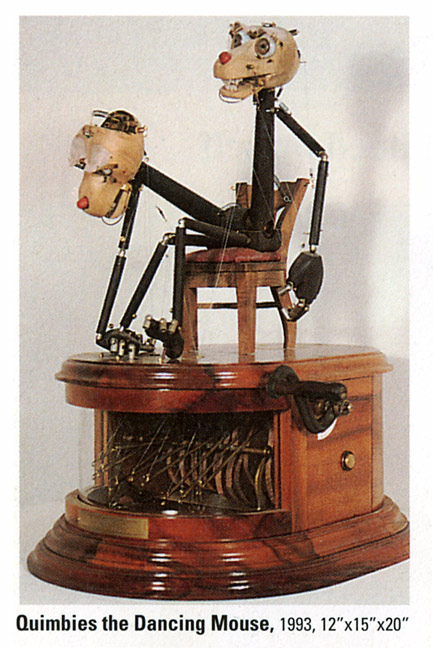
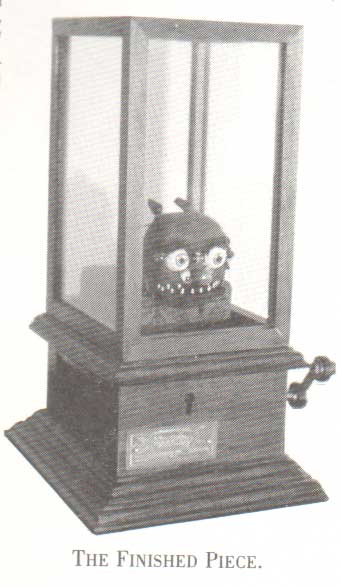
To turn from form to function, although I am wary of comparing Ware’s work with the majority of kinetic sculpture, as regards both appearance and intention, there is one Paul McCarthy kinetic installation, Bavarian Kick, 1986-1993, which has something of both the tin-toy appearance and unsettling weirdness of Ware’s Quimbies the Mouse, 1993, and Sparky the Singing Cat, 1990. All three works’ central protagonists are distinctly odd and unashamedly cartoonish, both in appearance and action, as if the maker is trying to solve the impossible puzzles of art and life by dispensing with pretensions and sophistication and adopting a haphazard Frankenstein approach. Curator Katia Schurl’s catalogue text summarises McCarthy’s wider concerns, “often it is the effect of taboos and clichés that McCarthy exploits, e.g. to expose the American Dream as hypocrisy or denigrate supposed middle-class values such as family or respect for authority.” [4] Ware does not quite ‘expose’ or ‘denigrate’, but with characters such as Jimmy Corrigan, Rusty Brown and Big Tex he certainly questions the facades and mores which people and families construct, the wisdom of elders and the essential fragilities of social connections. I would otherwise shy away from further connections with kinetic art as a genre – Ware’s moveable sculptures have far more in common with hand-crafted children’s toys, and would be more at home in an eccentric toy-shop than a white-cube art gallery.
A final sculptural piece which I would like to refer to is Ware’s Potato Man’s House, 1989. This construction (and the natural framing device provided by the house structure) seems particularly attractive to comics artists – perhaps as it can both develop a narrative and reveal multiple viewpoints at once – two others who have used the house as the fundamentals of a sculpture are Canadian Seth, and his models for his fictional city, and London based comic artist Karrie Fransman, whose Behind the Mirror model featured in the 2010 exhibition at London Print Studio, That’s Novel: Lifting Comics from the Page. Daniel Raeburn has drawn attention to Art Spiegelman’s observation that:
‘story’ descended from the mediaeval Latin ‘historia’, which meant ‘picture’ as well as the horizontal division of a building. Latin users derived this conflation from the mediaeval practice of placing a picture in each window of a building, especially in churches. A storey was literally a row of coloured pictures. [5]
As well as unique sculptural works, Ware has produced, or been involved in the production of, some highly desirable collectibles. He does however display disgust and cynicism for this side of the comics ‘industry’ through his character Rusty Brown – the epitome of the worst kind of collector, immoral and pathetic, and a clever warning to any potential Ware fanatics. Rusty is succinctly summed up by writer Andrew Arnold as “a nasty collector of pop-culture detritus.” [6] Rusty routinely cheats his only friend out of memorabilia and has apparently ruined his own life through this single-minded addiction to plastic pretend people. Curiously, and again in common with Cornell, Ware is himself a committed collector, however, not of box-fresh memorabilia, and perhaps this is the important point. In an interview with Beth Nissen, Ware apparently passionately declares:
I collect old sheet music, old instruments – especially banjos, phonographic cylinders, old comic strips, toys. And old photo albums – I find them in thrift shops and junk shops, and I think to myself, Why would anyone do that? Throw something this fantastic away? [7]
Both Ware and Cornell, judging from the latter’s similar recollections of solo forages around the thrift shops of New York, are actually collectors of what most people would throw away, and if not throw away, then certainly not revere; they see new possibilities and beauty in commercially worthless items, whereas Rusty Brown and his ilk elevate the materially (and spiritually) cheaply produced to skyscraper prices.
One cannot but notice in the appearance of Jimmy Corrigan: The Smartest Kid on Earth (in its graphic novel format), Ware’s awareness of the book as moveable, portable object – it must be manipulated in order to be read, as well as, and this is regular habit of Ware’s, containing more than one cut-out model which the reader could potentially cut-out and keep. As well as being conscious of comic book as object, and as potential co-producer of cut-out object, Ware is confident and well-practised in manipulating traditional publishing techniques, in his own words he describes how “you can look at a comic as you would look at a structure that you could turn around in your mind and see all sides of at once,” [8] as well as describing comics as “a map of the fourth dimension”. [9] He is remarkably aware of the potency and potential of space and time passing, temporal space – putting oneself in space, a story receiving space, imagery in limited space – concerns perhaps most evocatively brought into focus in the following observation, again from Raeburn:
Ware appended to his first novel a corrigendum in which he noted that the four or five hours it takes to read his first book is the same amount of time that he ever spent with his father. The book itself, he concluded, encloses the same quantity of physical matter as the urn holding his father’s ashes. [10]
Kirstie Gregory is the co-convenor of Sculpture and Comic Art, taking place at Leeds Art Gallery on the 16th of November as part of Comics Forum 2011.
[1] – Chris Ware, Jimmy Corrigan: the Smartest Kid on Earth, Pantheon Books, 2000.
[2] – Carter Ratcliff, “Joseph Cornell: Mechanic of the Ineffable”, in Kynaston Shine (ed), Joseph Cornell, The museum of Modern Art, New York, 1980, p.46.
[3] – Ibid, pp. 47-48.
[4] – Katia Schurl in Moving Parts: Forms of the Kinetic, Peter Pakesch and Guido Magnaguagno (eds), Verlag der Buchhandlung, Walter König, Cologne, 2004, p.68.
[5] – Daniel Raeburn, Chris Ware, Laurence King Publishing Limited, 2007, p. 26.
[6] – Andrew Arnold, “The Depressing Joy of Chris Ware”, time.com, 27 November 2001 [http://www.time.com/time/columnist/arnold/article/0,9565,185722,00.html]. Accessed June 24 2011.
[7] – Beth Nissen, “Transcript: An Interview with Chris Ware”, cnn.com, 3 October 2000. [http://edition.cnn.com/2000/books/news/10/03/chris.ware.qanda/]. Accessed June 24 2011.
[8] – Daniel Raeburn, Chris Ware, p.25.
[9] – Ibid, p. 21.
[10] – Ibid, p.15.
The Reinterpretation of the superhero in Seagle and Kristiansen’s ‘It’s a bird’ by Esther Claudio Moreno
Steven T. Seagle’s It’s a bird is a comic that reflects on the figure of Superman and on the author’s life to pose a question: Do we need heroes? Through a personal story, Seagle provides the reader with a brilliant, meaningful and moving work, a cathartic experience that transforms him into the hero of his own epic.
With superb mastery and sobriety, the autobiography combines the deconstruction – a typical (but not exclusive) device of postmodern art – with traditional epic. One of the characteristics of postmodernity is the deconstruction of “meta-narratives” and myths. In It’s a bird we witness the deconstruction of, arguably, the greatest myth in comics –Superman, the symbol (among other things) of the American Spirit: “You’re as much America as jazz, baseball or comic books”(p. 41), Seagle says, and throughout the comic the validity of the superhero is challenged as the representation of the American way of life, as the personification of masculinity, of the exemplary citizen, of the immigrant who longs for the land of liberty, of “the metaphysical ideals – truth, infinity, faith…” (p. 42), etc. Superman presents himself as the self-made man, the winner, the embodiment of the American dream, and Seagle cleverly destroys it.
Graphic Medicine #1: Of Comics, Disease and Stigma by Ian Williams
Hello and welcome to the Graphic Medicine component of the Comics Forum blog. My name is Ian Williams, I’m a comics artist, writer and doctor and I run the website graphicmedicine.org. With my colleagues Columba Quigley and Maria Vaccarella, I am organizing day 2 of the 2011 Though Bubble Comics Forum – Graphic Medicine: Visualizing the Stigma of Illness. In future weeks Columba will be contributing to the blog, as will our transatlantic collaborator MK Czewiec, aka ‘Comics Nurse’ who will be flying over to take part in the conference.
We are hoping the conference will be attended by comics scholars, healthcare professionals comics artists and, well, anyone with an interest in the interface between comics and healthcare. This should be a truly interdisciplinary meeting which will follow on from the outstanding success of our conference in London last year and the second international conference on Comics and Medicine: The Sequential Art of Illness which will be taking place in Northwestern University, Chicago as this piece is posted: the 9th to the 11th of June.
Thanks in part to the Health Humanities movement many medical schools now encourage the reading of classic literature to gain insight into the human condition. The medium of comics (referred to in the plural) is beginning to attract attention from healthcare scholars, as evidenced by an expanding body of academic literature on the subject and conferences held which examine specifically the interaction between comics and healthcare.
Among the growing number of works of graphic fiction, titles dealing directly with the patient experience of illness or caring for others with an illness are to be found. Indeed, the sheer volume of published works containing subject matter relevant to healthcare professionals seems to invite some sort of critical examination from a healthcare studies viewpoint. Some works, such as David B’s Epileptic (2006) or Charles Burns’ Black Hole (2005) are already hailed as classics. These works constitute an important resource, opening a window into the lives of those affected by illness. Comics, as a popular mass medium, also reflects society’s conception of healthcare at any one time, and as a vehicle for radical ideas, comics will also inform the cultural image of healthcare professionals.
All diseases cause stigma. While healthcare professionals and carers might strive to treat the physical or psychological effects of illness, stigma, a cultural effect, is often ignored. Stigma can be borne by the family, relatives, associates and even the carers of the sufferer, as well as the afflicted individual. While talking about it weakens its effect, stigma is a source of shame, bigotry and injustice and can, in some cases cause far more suffering than the disease or condition itself. It is a neglected area of study and comics, with its radical history and sophisticated mixture of text and graphics, allowing the articulation of subtle and complex insights into human behaviour and thought, might prove an ideal medium through which to examine the subject.
I started writing about comics and medicine, an area of study I christened ‘graphic medicine’ while writing the dissertation for my MA in Medical Humanities. I found so many graphic novels and comics with medical content I set up graphicmedicine.org to list them and briefly review them, to act as a resource for the healthcare and comics communities. Fairly soon, enthusiasts and scholars from all over the world started to contact me. One of the first was Prof Michael Green from Penn State Medical School dept of Medical Humanities. Michael was already at that time teaching a class on comics to his medical students and getting them to make strips about their experiences. Around this time, at the Association of Medical Humanities Annual Conference in Durham I met two scholars- Dr Maria Vaccarella, a post doctoral fellow at Kings College, and Dr Columba Quigley, MD who was taking an MA in Literature and Medicine at Kings. Maria and Columba were both studying comics too. We talked and during those few days the idea for our London conference was born. We contacted Michael, who brought in his colleagues Susan Squier and Kimberley Myers from Penn State, and joined by our UK colleagues Giskin Day and Bob Tanner, the conference took shape. Brian Fies, Paul Gravett and Marc Zaffran were invited as keynote speakers and Darryl Cunningham and Phillipa Perry came along to talk about their work.
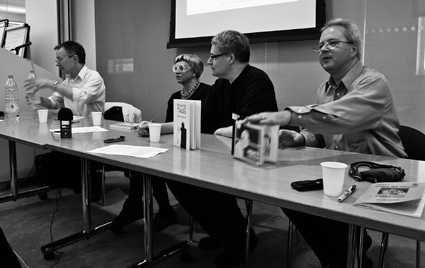
We had expected maybe 40 delegates, but on the day we were full to capacity, with 75. What we hadn’t quite expected was the tremendous buzz of excitement as comics artists rubbed shoulders with educationalists, scholars, journalists and healthcare professionals. Delegates flew in from all over the world. Among them being one MK Czerwiec, a nurse who had been documenting her care of HIV patients in comics form for many years. MK went on to lead the organization of the 2nd conference in her home town of Chicago, with keynote speakers Scott McCloud, Phoebe Gloeckner and David Small.
We hope you will consider replying to our call for papers, and coming along on the 17th of November to what should be great day of interdisciplinary discussion and debate.
Ian Williams is the co-director of Graphic Medicine: Visualizing the Stigma of Illness, taking place at Leeds Art Gallery on the 17th of November as part of Comics Forum 2011.
Comics Scholarship 2.0 by Ernesto Priego
At the cusp of second decade of the 21st century, if the word “webcomics” still sounds strange to some, it is clear the reason is not the prefix web. It is the word “comics” that is problematic for several reasons. In spite of their ubiquity in the mainstream cultural landscape, comic books are still the object of a widespread prejudice that has two main expressions. One is the debatable disqualification of any texts addressed or appealing to children as lacking “seriousness”. The “infancy/maturity” binary set is a recurring topos of comics scholarship, explained amongst other reasons by the field’s struggle to convince the general public that “comics are not just for kids”. Echoing Bart Beaty’s assessment of “contemporary comics scholarship” (2004) , Craig Hight writes:
 Comics Forum