RSS

Category Archives: Guest Writers

A Space of One’s Own

How and Where Comics Cultures Flourish

by Amy Louise Maynard


In a Twitter thread composed in mid-June this year, creator Darryl Ayo (Little Garden) decried what he considered to be the lack of cultural spaces for independent and/or small press comics, both online and offline. According to Ayo, the demise of Google Reader and the decline of Tumblr meant that it was harder for independent creators to have a virtual ‘hub’ where their work could be found, shared and discussed:

Indie comics has a culture problem: specifically, that indie comics attaches itself to other cultures to survive. Whether it’s being driven out of the direct market shops or hitching its collective wagon too tightly to 2000-2008 era internet websites [sic]. Indie comics has the following culture problem: it attempts to survive as a symbiotic subculture but doesn’t insist on its own boundaries (Ayo, 2017).

In regards to physical spaces, Ayo pointed out that serial comics produced through the direct market system still had hubs for consumers; the comics store:

One thing that is appealing about “mainstream” comics, i.e. the North American direct market, is that there remain dedicated cultural spaces. There is a self-sustaining cultural space to go to and to be and to experience that culture. Yes, it’s a commerce space. But it fits (Ayo, 2017).
Read the rest of this entry »

 
Leave a comment

Posted by on 2017/10/26 in Guest Writers


Tags: , , , , , , , , , , , , ,

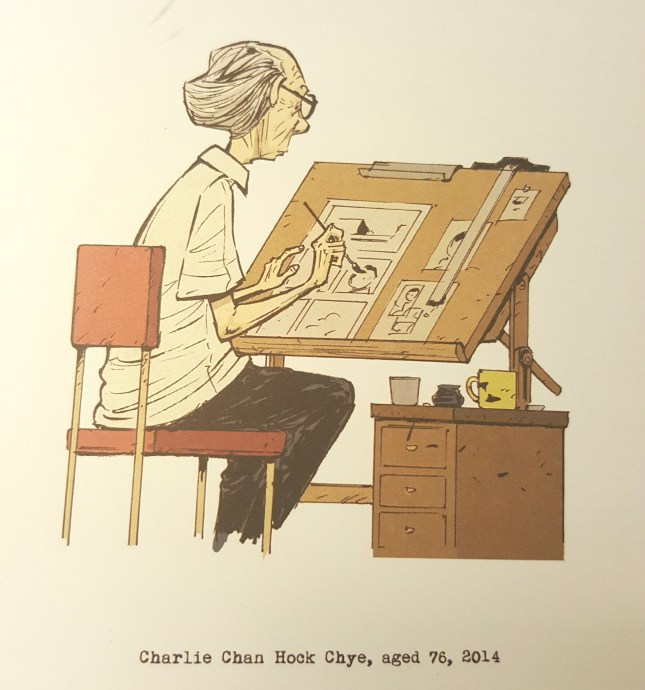
Who is Charlie Chan Hock Chye?

Verisimilitude and (The Act of) Reading

by Yiru Lim


Figure 1

Figure 1

Source: The Art of Charlie Chan Hock Chye, p. 307. Copyright © 2015 by Sonny Liew. Published in Singapore by Epigram Books http://www.epigrambooks.sg

Singapore’s official version of history is primarily enshrined in the memoirs of Mr Lee Kuan Yew, Singapore’s first Prime Minister. Titled The Singapore Story: Memoirs of Lee Kuan Yew, the memoirs were originally published in two volumes in 1998 and 2000 and a memorial edition was released by Marshall Cavendish in 2015, the year of Mr Lee’s passing. Revisionist accounts that stand in opposition to this seminal publication attempt to fill what they see as a void in Singapore’s history: the voice of the opposition, especially in the narratives concerning nation building and independence. They exist in a myriad of forms and genres—film, scholarly publications, prose, poetry—and they seek to debunk existing narratives and proffer more balanced perspectives of history.

Some recent examples include academic publications like Comet in Our Sky (2015), that speaks of the alleged communist Lim Chin Siong and his role in securing Singapore’s independence; Tan Pin Pin’s documentary film To Singapore, With Love (2013); Jeremy Tiang’s State of Emergency: A Novel (2017); and Sonny Liew’s graphic novel The Art of Charlie Chan Hock Chye (2015). Tan’s film has been banned from being screened in Singapore while the latter two have had their grants revoked by the National Arts Council of Singapore (NAC) (Ho, 2017, Today Online 2015 & 2014). Although Liew’s graphic novel did not receive government approval, it has taken the literary world by storm. It became the first graphic novel to win the Singapore Literature Prize in 2016 and has garnered Liew six Eisner nominations and three Eisner Awards this year (Martin, 2017).

Read the rest of this entry »


Tags: , , , , , , , , , , ,

Queering the Western? Questions of Genre, Gender, and Normativity in Rikke Villadsen’s Et Knald Til (2014)

By Charlotte Johanne Fabricius


How can one queer a comics genre – especially one rooted in patriarchal tradition, rife with male gaze and stereotypical gender roles? I consider ‘queering’ to be not only an inclusion of nonnormative gender and/or sexual identities, but a broader strategy of ‘making strange’[i]. Furthermore, I consider the comics medium to be an especially interesting site in which to investigate such ‘strangeness.’ This idea has previously been offered by, amongst other, Ramzi Fawaz, who, in The New Mutants (2016), draws upon queer theorist Eve Kosofsky Sedgwick’s idea of queerness as “gaps, overlaps, dissonances and resonances”, which manifest themselves as “formal gaps, overlaps, dissonances, and resonances of comic book visuality.”[ii] I speak of queering as not only a ‘making unfamiliar’, but also of ‘making possible’ different futures and logics than presented in traditional version of a genre. In the following, I investigate one such attempt, the comic Et Knald Til (Another Bang), which has been characterised by publishers as an ‘erotic Western’.

Et Knald Til[iii] is written and drawn by Rikke Villadsen, published in 2014 by the Danish Publishing House Aben Maler, and nominated for a Ping Prize for Best Danish Comic Book in 2014. It tells the story of a quintessential Western town, inhabited by cowboys and loose women. An outlaw with a price on his head comes to town, kills the men who try to stand in his way, solicits a prostitute – who explodes after their intercourse – and has a drink at the saloon before retiring to a room in the same establishment. Parallel to these goings-on is the story of a young woman in the town who dreams of being a man, so she can leave the town to go adventuring. When the outlaw arrives, she steals his horse and the clothes of one of his victims and sets out. When she starts menstruating, however, the horse recognises her sex and throws her off, leaving her to an uncertain fate. The story concludes with the outlaw waking up in his room only to discover that he has been transformed into a woman identical to the one whose story the reader has been following.

Read the rest of this entry »

 
Leave a comment

Posted by on 2017/04/03 in Gender, Guest Writers, Women


Tags: , , , , , ,

Les Aventures du professeur Nimbus

Tightrope Walker During the Occupation – Part 4/4[1]

by Antoine Sausverd

Translated by Annick Pellegrin

Edited by Harriet Earle

Original publication: Sausverd, Antoine. « Les Aventures du professeur Nimbus : Funambule sous l’occupation. » La Crypte tonique septembre – octobre 2013: 13-18. Print.[2]

Condemnation in absentia

Les Aventures du professeur Nimbus by Daix came to an end on 17 August 1944 with Le Matin that fell apart in the besieged capital.[3]

Daix went into hiding and fled from Paris. His residence was searched. An arrest warrant was issued against him on 12 July 1945 for acts prejudicial to the security of the State. Daix, not having been apprehended, was judged in absentia at the court of justice of the Seine department on 8 January 1946. The exposé that led to this condemnation summarised the charges: Daix was a “collaborateur notoire” [notorious collaborator]. The tribunal reproached Daix for his denunciation of cartoon animators, and his involvement in 1942 in the “organe pro-allemand” [pro-German organisation] La Voix ouvrière made matters worse for him. But his drawings of Nimbus would be judged as not containing political propaganda.

Read the rest of this entry »


Tags: , , , , , ,

Les Aventures du professeur Nimbus:

Tightrope Walker During the Occupation – Part 3/4[1]

by Antoine Sausverd

Translated by Annick Pellegrin

Edited by Harriet Earle

Original publication: Sausverd, Antoine. « Les Aventures du professeur Nimbus : Funambule sous l’occupation. » La Crypte tonique septembre – octobre 2013: 13-18. Print.[2]

“Pour les besoins de la propagande nationale” [For the Sake of National Propaganda]

In the summer of 1942, the Germans asked Daix to use the famous character professeur Nimbus to contribute to a propaganda operation. Daix then used this opportunity to take up his demands against Opera Mundi. On 4 August 1942 he wrote to the president of the Commissariat général aux questions juives [General Commissariat for Jewish Questions] (CGQJ): “Ma création graphique, le « Professeur Nimbus », m’est demandée afin d’être utilisée pour les besoins de la propagande nationale. Malheureusement et malgré mes efforts, je n’ai pu me libérer d’un contrat draconien signé en 1934 avec Opera Mundi (agence juive) et concernant Nimbus.” [My graphic creation, professeur Nimbus, has been requested from me in order to be used for the sake of national propaganda. Unfortunately and despite my efforts, I have not been able to get rid of a draconian contract signed in 1934 with Opera Mundi (Jewish agency) concerning Nimbus.] Daix attached to his mail an overview of the situation and documents, hoping “qu’une intervention de votre organisme me fera obtenir gain de cause.” [that an intervention on the part of your agency would help me to succeed].[3]

Read the rest of this entry »


Tags: , , , , , ,