Comics and related forms have engaged with themes of welfare since at least as early as 1751, when Hogarth’s prints Beer Street and Gin Lane presented satirical comments on alcohol legislation and public health. Since then, depictions of welfare-related concerns have proliferated in comics ranging from small scale graphic pathographies through to large scale public communication campaigns. The rise of Graphic Medicine as a field of scholarship has given visibility to titles exploring health, disability and wellbeing, but comics are equally entwined with issues of welfare concerning literacy, representation and community. Beyond the content of the comics, the ways they are made, by a community of workers, draws our attention to the welfare of creators and the sustainability of the art form and its connected industries and audiences.
Comics Forum 2026 will explore the theme of welfare, broadly conceived, in relation to any form of comics (i.e. including bande dessinée, manga etc.). Proposals are welcome from academics and comics creators. Topics may include:
Proposals of up to 250 words in length are now being accepted at this link. The deadline for submissions is the 31st of August and you will be notified of acceptance by or before the 12th of September. Please include a short (100 word) biography of your speaker(s) with your proposal. We look forward to welcoming you to Leeds!
by Nicoletta Mandolini, Alessia Mangiavillano, Giorgio Busi Rizzi and Eva Van de Wiele
From Monday 12 July to Thursday 15 July, the third edition of the AIPI (Associazione Internazionale Professori di Italiano) Summer School took place in Ghent. For the first time, the Summer School was dedicated to the study of comics. The edition was sponsored by AIPI; the Italian Cultural Institute of Brussels; the Dante Alighieri Society of Ghent; and the research groups COMICS and SnIF.
‘Fluid Images – Fluid Text’ was the title of an interdisciplinary conference that took place at Cardiff University (Wales) on 23-24 January 2020. The conference, organised by Dr Tilmann Altenberg (School of Modern Languages) and Dr Lisa El Refaie (School of English, Communication and Philosophy), hosted eighteen speakers from twelve institutions spread across seven different countries, featuring a wide range of backgrounds and approaches. The conference received financial support from Institute of Modern Languages Research (London), University Council of Modern Languages, Cardiff Comics Storytelling Network, Cardiff School of Modern Languages and Cardiff School of English, Communication and Philosophy.
The aim was to investigate from a transdisciplinary perspective three different and interlinked dimensions underpinning comics’ mobility: time, space and artistic media. The chronological dimension covers a broad field including the relationships between comics and history and the transformations investing their editorial and reading practices. Translation is the key word to understand how comics have been able to transcend national borders, by means of transmission in different languages and cultures. The last dimension leads us to comics’ adaptation in other media, investigating their relationships with different forms of artistic expression.
Medieval history is very much in vogue at the present time. Driven by representations of the period in various forms of popular culture, there appears to be a great appetite for all things medieval. From television (Vikings, The Name of the Rose, Knightfall) to film (The Green Knight, The King, Outlaw King) to video games (A Plague Tale: Innocence, Kingdom Come: Deliverance, Medieval Dynasty), representations of the medieval world are hard to avoid.[1] And that is before we get to the more medieval-influenced forms of media that perhaps drive interest in the medieval even more than apparently “real” representations of the past. Where Game of Thrones led the way, The Witcher is now appealing to a mass global audience.[2] The forthcoming Lord of the Rings television series, films like Nimona and games like Godfall will similarly bring different varieties of medieval aesthetics to modern audiences across the globe.[3]
Another medium, perhaps more niche than the above, is that of the graphic novel. Comics set in both the medieval past and medieval-inspired worlds have gained increasing popularity in recent years, and it can be argued that these are as important as the above examples in terms of influencing modern perceptions and understanding of our medieval past. One potential reason why this is not as well-recognised is that many medieval comics are not available in English. While there do exist prominent examples of English-language medieval comics by noted authors and special releases timed to coincide with historical anniversaries (such as Crécy, Templar, Nevsky: A Hero of the People, On Dangerous Ground: Bannockburn 1314 and Agincourt 1415: A Graphic Novel), this output pales into relative insignificance when compared with that produced in continental Europe.[4] The remainder of this post will therefore consider the range of medieval comics produced for the European market, with a focus on Spain and particularly France. While some broader context for these works is provided, the main focus will be on comics of the last decade to allow consideration of increased interest in the medieval period as reflected in the comic medium.
Singapore’s official version of history is primarily enshrined in the memoirs of Mr Lee Kuan Yew, Singapore’s first Prime Minister. Titled The Singapore Story: Memoirs of Lee Kuan Yew, the memoirs were originally published in two volumes in 1998 and 2000 and a memorial edition was released by Marshall Cavendish in 2015, the year of Mr Lee’s passing. Revisionist accounts that stand in opposition to this seminal publication attempt to fill what they see as a void in Singapore’s history: the voice of the opposition, especially in the narratives concerning nation building and independence. They exist in a myriad of forms and genres—film, scholarly publications, prose, poetry—and they seek to debunk existing narratives and proffer more balanced perspectives of history.
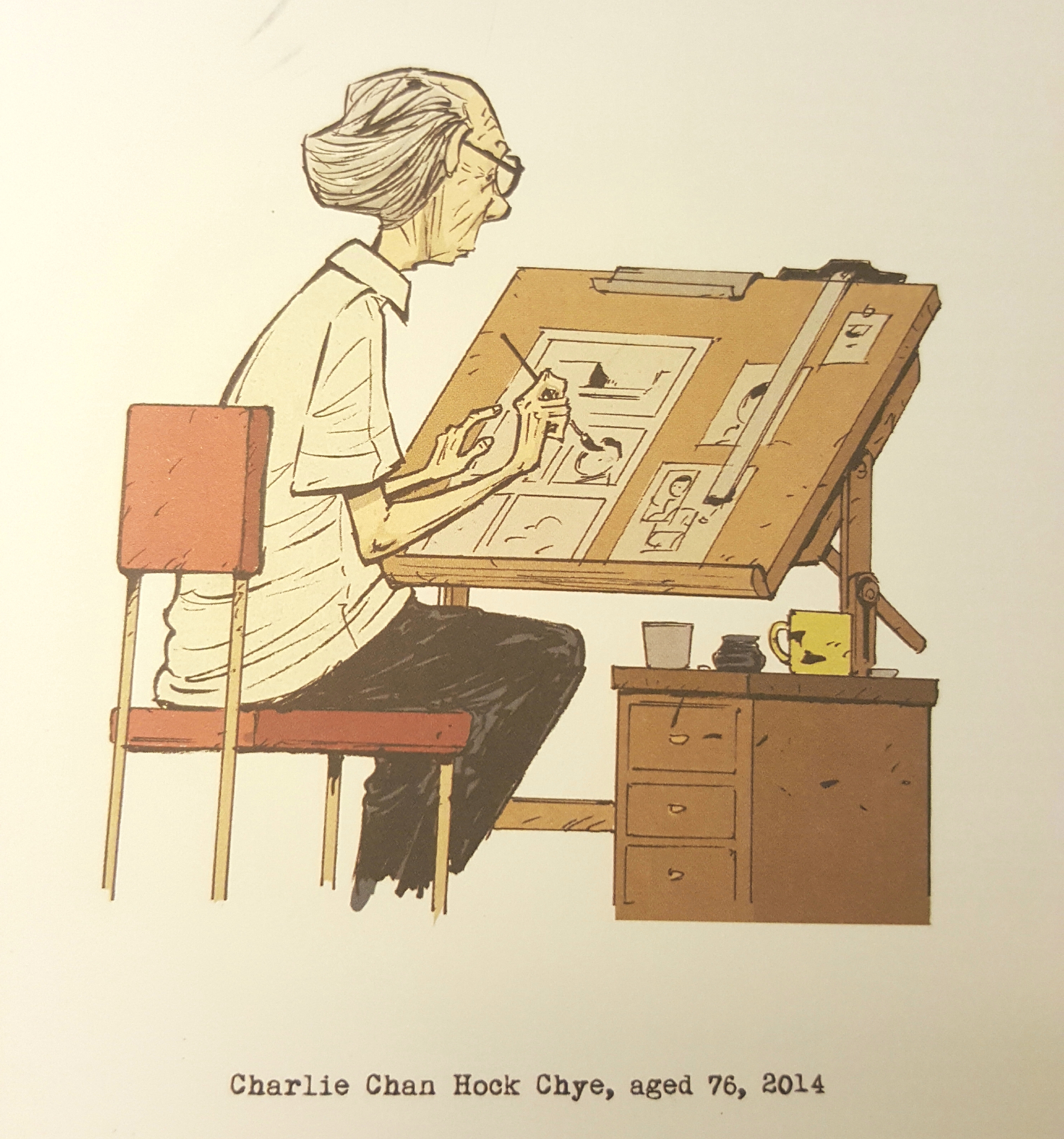
Some recent examples include academic publications like Comet in Our Sky (2015), that speaks of the alleged communist Lim Chin Siong and his role in securing Singapore’s independence; Tan Pin Pin’s documentary film To Singapore, With Love (2013); Jeremy Tiang’s State of Emergency: A Novel (2017); and Sonny Liew’s graphic novel The Art of Charlie Chan Hock Chye (2015). Tan’s film has been banned from being screened in Singapore while the latter two have had their grants revoked by the National Arts Council of Singapore (NAC) (Ho, 2017, Today Online 2015 & 2014). Although Liew’s graphic novel did not receive government approval, it has taken the literary world by storm. It became the first graphic novel to win the Singapore Literature Prize in 2016 and has garnered Liew six Eisner nominations and three Eisner Awards this year (Martin, 2017).


AIPI Summer School 2021 Ricerca a fumetti (Researching comics: genres, form(s), variations) 1/2
by Nicoletta Mandolini, Alessia Mangiavillano, Giorgio Busi Rizzi and Eva Van de Wiele
From Monday 12 July to Thursday 15 July, the third edition of the AIPI (Associazione Internazionale Professori di Italiano) Summer School took place in Ghent. For the first time, the Summer School was dedicated to the study of comics. The edition was sponsored by AIPI; the Italian Cultural Institute of Brussels; the Dante Alighieri Society of Ghent; and the research groups COMICS and SnIF.
Read the rest of this entry »Share this:
Posted by Annick Pellegrin on 2021/09/15 in Conference reports
Tags: A Contract with God, adaptation, Alberto Giolotti, Alexander Calder, authorship, autofiction, Belgium, City of Glass, collages, comics, David Mazzucchelli, discontinuity, Enki Bilal, film, Finnegans Wake, fumetti, Gene Roddenberry, Gianni Colombo, graphic journalism, Graphic Novels, Henry Jenkins, imagination, Italy, James Joyce, Kafka, Kobane Calling, La Guerre des tranchées, Le Château, Le Voyage, Lev Manovich, literature, Lovecraft, Marvel, mass media, merchandising, metafiction, Mickey Mouse, Mobile sur deux plans, Olivier Deprez, Paul Auster, Paul Karasik, Pierre Fresnault-Deruelle, political engagement, radio, Reinhard Kleist, representation of realities, Robert Crumb, Roland Barthes, SnIF, social commentary, stagnation, Star Trek, Strutturazione fluida, subjectivity, Summer Schools, television, Tezuka Osamu, transmediality, transtextual narratives, Trilogie Nikopol, Umberto Eco, Will Eisner, Zerocalcare