RSS

Author Archives: Comics Forum

Sculpture and Comic Art #4: Framing Motion: Sculpture, the Body and Implied Movement by Paul Atkinson

This is a formal companion piece to Kirstie Gregory’s excellent investigation of the incorporation of comic icons and themes in contemporary sculpture.

To examine the relationship between two art forms it is important to look for fields in common before turning to an analysis of their differences. There is no question that there is a fundamental difference between comics and figurative sculpture in their articulation of the relationship between form and matter and in the obvious fact that one is in two dimensions and the other three, but if we examine both on a slightly more abstract plane, that of movement, there is much that draws the mediums together. Movement might seem to be an odd place to ground a comparison for most figurative sculpture does not move – unlike kinetic sculpture in which there is always movement between parts – and a comic book character is unable to traverse a panel irrespective of the powers they are said to possess. It is, however, this very lack of actual movement that serves as a conceptual link between sculpture and comics. The figures may not move in space but there is nevertheless an implication that they could move, that they are about to move, or indeed that they have reached a point of rest. In each case the figure is not static but rather trapped forever in the act of moving – a distinction that is elided in Zeno’s paradoxes.

Read the rest of this entry »


Graphic Medicine #4: Hospice Comics by MK Czerwiec (Comic Nurse)

The theme of this year’s Graphic Medicine Comics Forum is “Visualizing the Stigma of Illness.” Stigma in illness often arises simply from close association with death. Dying is frequently an integral plot element in medically themed graphic novels and memoir, but it frequently happens “off-panel” thereby avoiding challenging visual representations of death and dying. There are notable exceptions to this, of course, such as Lisa’s Story: The Other Shoe by Tom Batiuk (Kent State University Press, 2007).
‘Lisa’s Story: The Other Shoe’ by Tom Batiuk, p.218. Image used with the permission of the creator, who holds the copyright. Click image for larger version.

Three notable graphic memoirs published in 2011 visually portray dying and death. To this hospice nurse, these three representations of family hospice experiences struck me as refreshingly honest. They portray the kinds of experiences I’ve witnessed professionally but not previously seen presented in graphic narrative, and they stayed with me. Each is intimate, honest, and, I’m guessing, was challenging to produce, as in each book, the creator is presenting the death of their parent.

In Seeds by British artist Ross Macintosh, (published by Com.x) Mackintosh’s father is dying of cancer.

‘Seeds’ by Ross Macintosh, p.56. Image used with the permission of the creator. Click image for larger version.

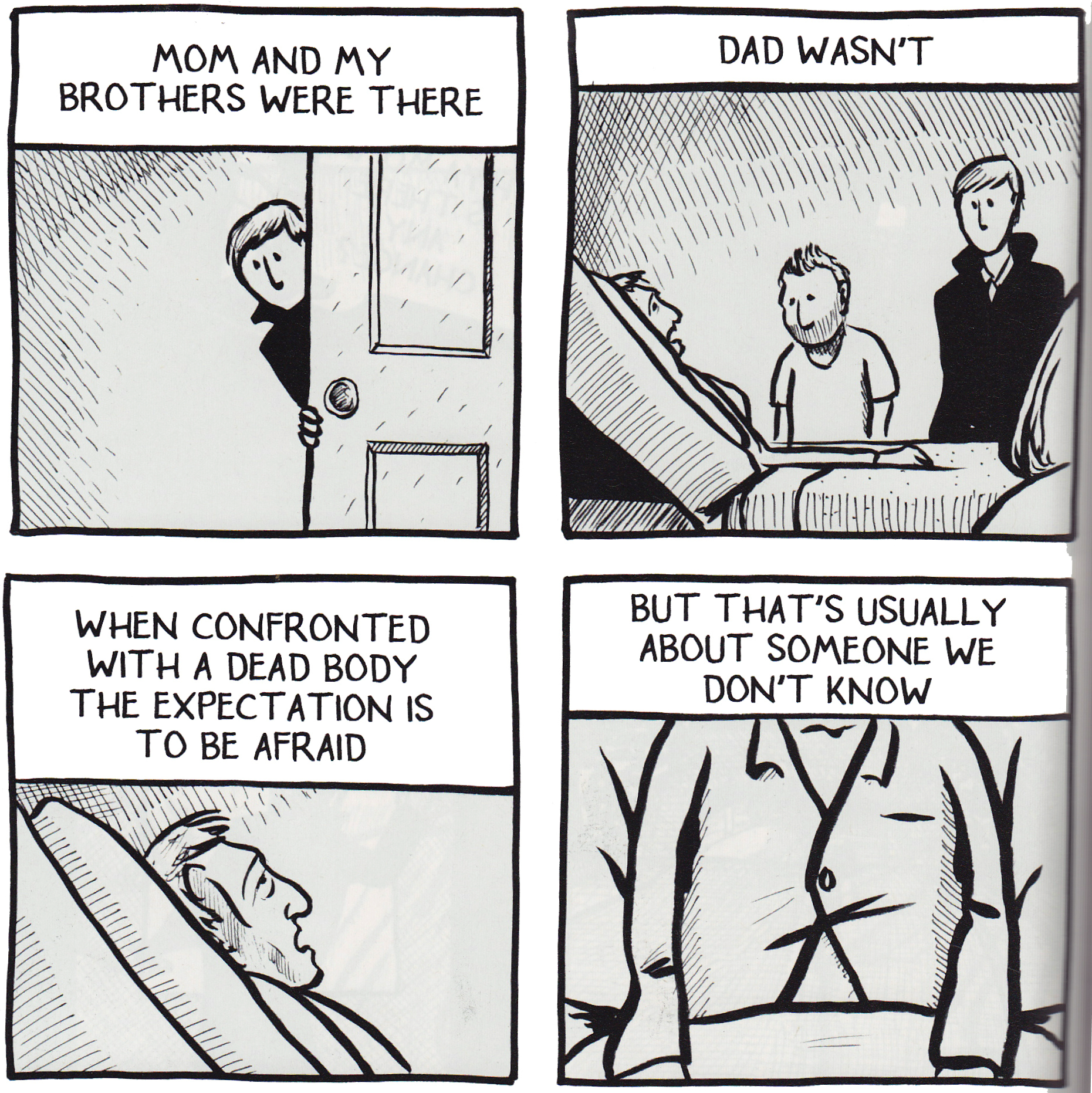
Ross is summoned during the night. His father has died.

‘Seeds’ by Ross Macintosh, p.62. Image used with the permission of the creator. Click image for larger version.

Depicting a character, particularly one’s own parent, after death, is not something the norm in graphic texts about illness, and Mackintosh does this beautifully in Seeds. The simple graphic sensibility of the book is in stark contrast to the emotional complexity of the content. In addition to drawing his own dad moments after death, Mackintosh confronts in the text of this section the existential nothingness that is death, avoiding religiosity and spirituality. Further in the panel shown above, for example, he compares his dad’s body to a cut toenail – an artifact of life that no longer carries meaning. I found this treatment of death bold and refreshing.

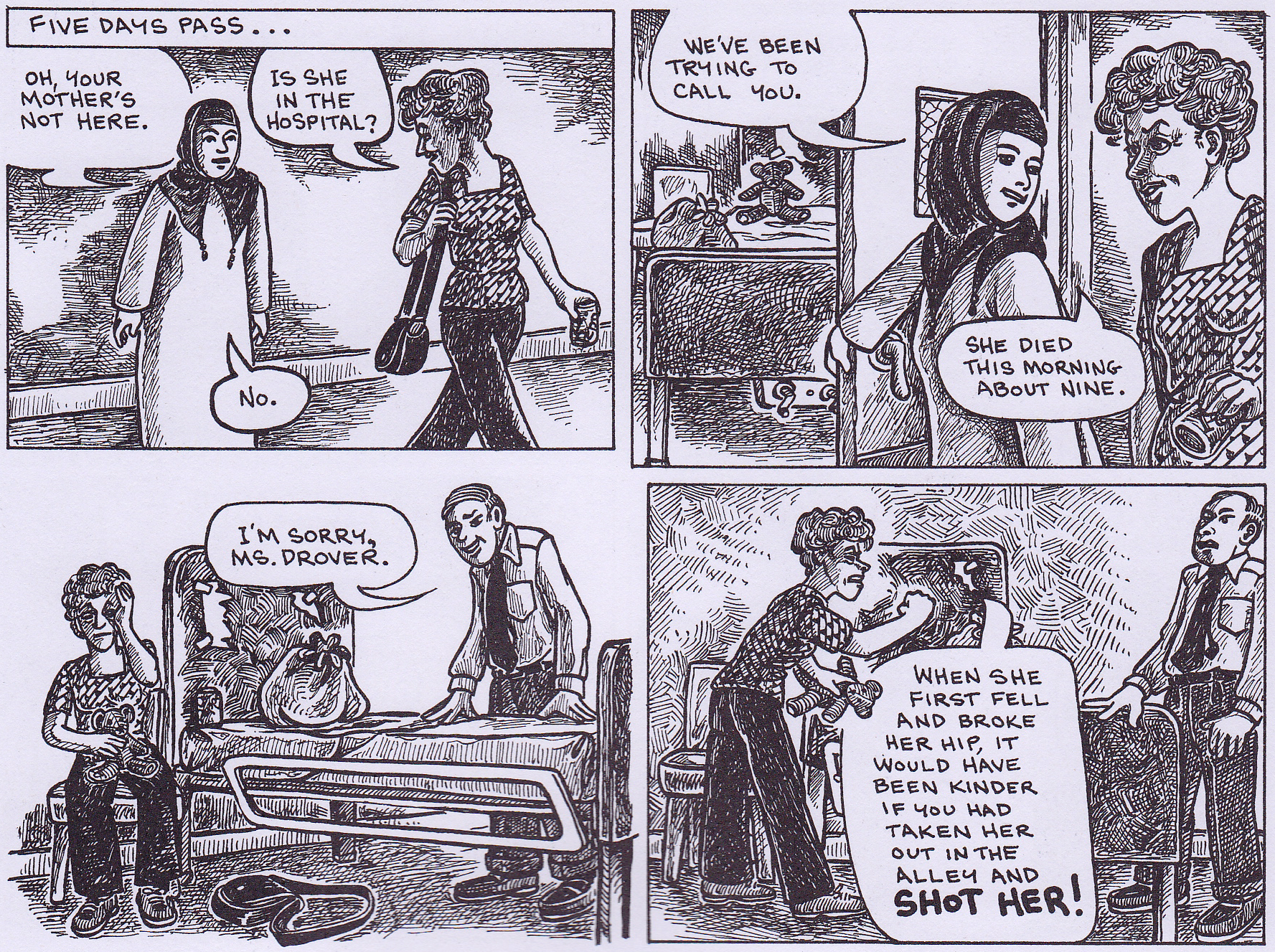
In Special Exits by American underground comics artist Joyce Farmer, (Fantagraphics) the protagonist character (meant to represent Farmer) is not present for the death of her mother, because the nursing home staff failed to make contact with her in time.

‘Special Exits’ by Joyce Farmer, p.150. Image used with the permission of the creator. Click image for larger version.

When it is Farmer’s father’s time to be in hospice, she seems committed to being with him, and showing us, every arduous step along the way.
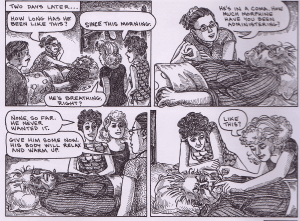
‘Special Exits’ by Joyce Farmer, p.195. Image used with the permission of the creator. Click image for larger version.
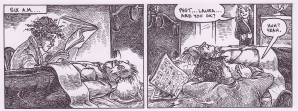
‘Special Exits’ by Joyce Farmer, p.196. Image used with the permission of the creator. Click image for larger version.

She is not present for the actual death again, but is with her father moments after.
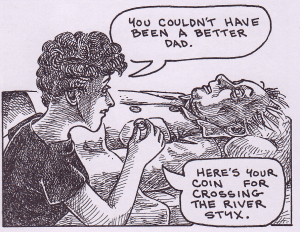
‘Special Exits’ by Joyce Farmer, p.196. Image used with the permission of the creator. Click image for larger version.

In Tangles, Vancouver artist, writer and editor Sarah Leavitt (UK publisher Johnathan Cape) presents her mother’s struggle with and death due to Alzheimer’s disease. Like Macintosh and Farmer, she represents this difficult experience with unflinching honesty. Again, here a last visit before death:

‘Tangles’ by Sarah Leavitt, p.121. Image used with the permission of the creator. Click image for larger version.

And a visit immediately after death:
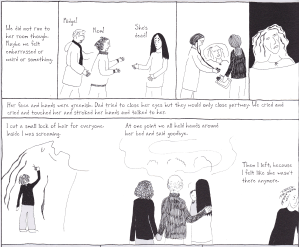
‘Tangles’ by Sarah Leavitt, p.122. Image used with the permission of the creator. Click image for larger version.
‘Seeds’ by Ross Macintosh, p.61. Image used with the permission of the creator. Click image for larger version.

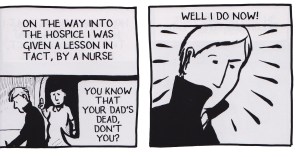
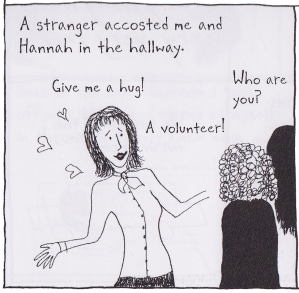
Interestingly, each of these texts also point out things caregivers did that were remembered as less-than-helpful during a difficult time. For Farmer, it was the nurse not reaching her in time preventing Farmer from being present for her mother’s death. For Ross, it was the way in which a hospital staff member chose to inform him of his father’s death.And for Leavitt, less-than-helpful volunteers appeared shortly after her mother passed away.
‘Tangles’ by Sarah Leavitt, p.122. Image used with the permission of the creator. Click image for larger version.

These unhelpful persons seem an integral part of the narrative of each death, burned into the memory of the storyteller for the obvious contrast they represent to what is needed by families at a time of loss.

It is my hope that these three texts released in 2011 represent a shift toward visually representing family experiences of dying and death. The results are twofold – for the person experiencing the very personal loss, creating the graphic narrative can serve to integrate the experience of a loved one’s death into their ongoing life story. The narrative can also serve as a remembrance to and for those who experienced the loss. Addressing both of these points, Mackintosh told Deborah Vankin in an interview for the Los Angeles Times:

 I created the comic for myself, as a way of removing pictures and phrases from the maelstrom in my head. The secondary purpose was a subconscious need to express to my mom and brothers that the awful events didn’t just happen quietly.

For those of us who are readers of the texts, they help us to begin to think about the deaths we have encountered or will encounter, and give us models for how to (and perhaps how not to) approach them.

Margaret Edson wrote in her Pulitzer Prize winning play W;t:

We are discussing life and death, and not in the abstract, either… Now is not the time for verbal swordplay, for unlikely flights of imagination and wildly shifting perspectives, for metaphysical conceit, for wit… Now is a time for simplicity. Now is a time for, dare I say it, kindness.

MK Czerwiec RN, MA worked as an AIDS nurse from 1994-2000. When antiretrovirals enabled her Chicago AIDS ward to be closed, she started making comics under the pseudonym Comic Nurse. Czerwiec then earned an MA in Medical Humanities and Bioethics. She teaches “Drawing Medicine” at Northwestern Medical School and is working on an illustrated oral history of the AIDS crisis, “Taking Turns: A Medical Tragicomic.”

All image copyright belongs to the creators.

You can read previous editions of Graphic Medicine in the Comics Forum Website Archive.

Comics Forum 2011 is supported by Thought Bubble, the University of Chichester, the Henry Moore Institute, Dr Mel Gibson, Routledge, Intellect and Molakoe Graphic Design.


Ah! Nana: The Forgotten French Feminist Comics Magazine by Catriona MacLeod

The process of female integration into French-language comic strip (or bande dessinée) creation in the twentieth century was slow, with women linked to this domain much more likely to inhabit the role of illustrator for children’s books. In the late 1970s, however, as Claire Bretécher and Annie Goetzinger made their mark as pioneering but exceptional female creators in the Francophone medium, a new publication appeared with the potential to expedite the slow inclusion of women artists into the bande dessinée by providing an unprecedented vehicle both for semi-established and previously unpublished female creators to present their work. The journal Ah! Nana did not fulfil this potential, however, and after falling foul of strict censorship laws and the restrictive economic sanctions that accompanied them, folded after only nine issues.

Ah! Nana was certainly short-lived, producing its first issue in October 1976 and its last in September 1978, however, as the only journal in French history created entirely by women featuring regular bandes dessinées – although male artists were occasionally invited to contribute – it constitutes an innovative experiment in the development of the adult Francophone BD. In spite of this, it has, like so many other female-led artistic endeavours, been largely ignored in chronologies and encyclopaedias of the Francophone medium. Patrick Gaumer’s 2004 Larousse de la BD does not mention it at all, whilst the 2003 BD Guide devotes one short paragraph of its 1525 pages to the journal, simply noting its creation by women, the name of its editor Janique Dionnet [1], and the fact that it was eventually censored.

Read the rest of this entry »


Tags: , , ,

Rabbit Stew by Ann Miller

Accounts of in-fighting at the French small comics press L’Association, prime mover in revolutionising the face of French comic art as from 1990, have circulated in the press and on the web for some time now, extending and amplifying the often inventively vituperative clashes amongst the immediate participants. There follows an attempt to track through some of the issues.

Attrition set in some time ago amongst the original members of the collective: David B., Killoffer, Mattt Konture, Jean-Christophe Menu, Stanislas and Lewis Trondheim.[1] David B. left in 2005, and Trondheim a year later, alleging, according to the weekly news magazine L’Express, ‘editorial disagreements’, in particular the desire of Menu to take the press in a more experimental and radical direction.[2] Star artist Joann Sfar announced at the same time that he would no longer publish with the Association. Bande dessinée websites abounded with rumours of conflict and acrimony.[3] By 2007, Menu was effectively in sole charge of the organisation. He is a complex character. Fellow artist Fabrice Neaud’s reference to Menu’s ‘sérieux et noblesse’ [serious-mindedness and nobility] [4] and theoretician and publisher Thierry Groensteen’s description of him as ‘la personnalité la plus emblématique de tout le renouveau créatif des années quatre-vingt-dix’ [the most emblematic figure of the whole creative renewal of the nineties] [5], as well as his declaration that ‘Menu EST la bande dessinée faite homme’ [Menu IS comic art made flesh] [6] can be set alongside a few less complimentary characterisations of Menu’s behaviour towards fellow members of the collective and towards employees. David B., who, in the final volume of L’Ascension du haut mal [Epileptic] [7], had portrayed Menu as the supportive figure who had first encouraged him to publish his work in the early 1990s, issued a communiqué earlier this year accusing his former colleague of ‘arrogance’.[8] More hyperbolically, Sfar has compared Menu to the dictators Ben Ali and Laurent Gbagbo.[9] At all events, even Menu’s most ardent admirers would probably hesitate to put him forward as a candidate for ‘employer of the year’. If Menu himself has proclaimed ‘Patron, je ne l’ai jamais été, et je ne le serai jamais’ [I have never been a boss, and never will be] [10], his detractors cast his managerial shortcomings in a less romantic light.[11]

Read the rest of this entry »

 
Leave a comment

Posted by on 2011/09/12 in Guest Writers


Tags: , , ,

Conference Review: The International Bande Dessinée Society’s Seventh International Conference by Matthew Screech

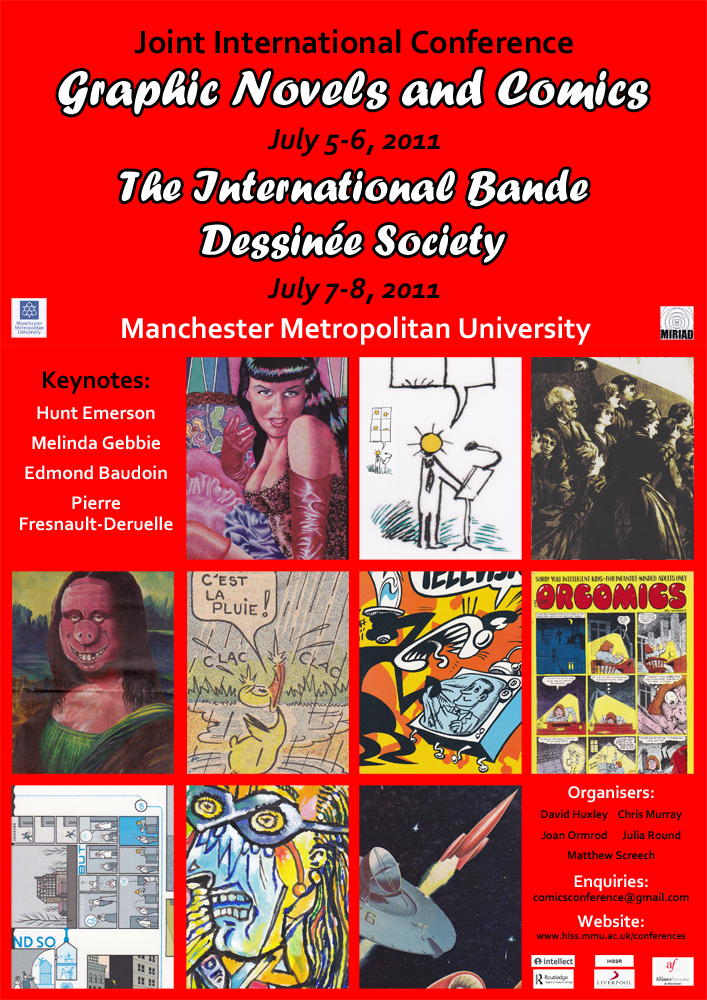
The Joint International Conference of Graphic Novels, Comics and the International Bande Dessinée Society’s Seventh International Conference

July 5-8 2011

Manchester Metropolitan University

The bande dessinée part of the joint conference took up the baton after two very stimulating days with GNAC and SIC. We too were pleased by the quantity and quality of papers and we ran parallel sessions. The morning of 7th July began with panels comprising two distinct strands: bandes dessinées and Francophone Africa, and BDs drawing upon the European Classics. The first strand began with Laurike in’t Veld’s insights into how the Rwandan genocide was represented in comics, and continued with Michel Bumatay’s study of Sub-Saharan African Francophone BDs. The focus on Africa continued with Mark Mckinney, who drew upon (post) colonial strips to argue that autobiography began in BDs earlier than is generally recognised. This was followed by Cathal Kilcline’s analysis of Boudjellal, who depicts an immigrant family in Toulon. The European Classics strand began with papers by Linda Rabea-Heyden and Matthew Screech on comic strip adaptations of canonical literary works: Goethe’s Faust and Voltaire’s Candide. Next came a re-examination of bande dessinée Classics with Bart Beaty, who closely scrutinised panels from Bravo’s re-make of the best-selling hero Spirou. Another strip to enter the pantheon of classics, Lieutenant Blueberry, was discussed by Martha Zan, who established its similarities with ss.

Read the rest of this entry »


Tags: , , , , , , , , , , , , , , , , , , , , , , , , , , , , , , , , , , , , , , , , , , , , , , , , , , , , , , , , , , , , , , , , , , , , , , , , , , , , , , , , , , , ,