Verisimilitude and (The Act of) Reading
by Yiru Lim
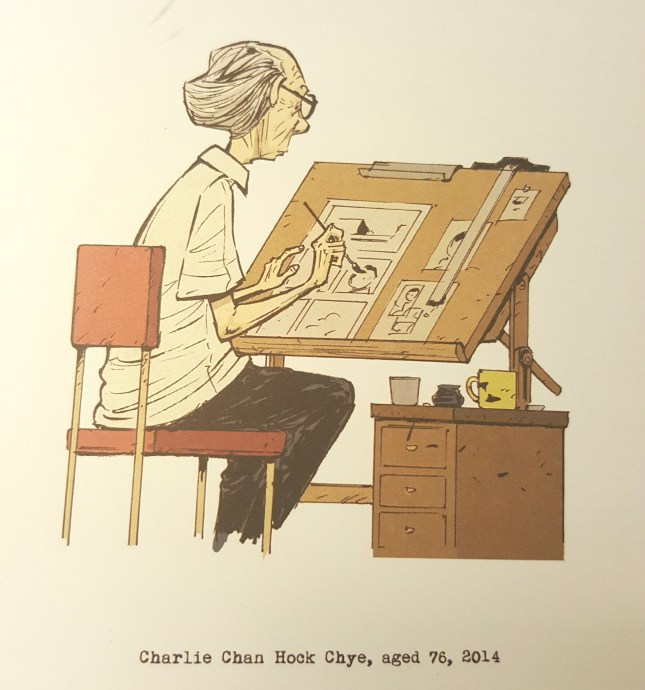
Figure 1
Source: The Art of Charlie Chan Hock Chye, p. 307. Copyright © 2015 by Sonny Liew. Published in Singapore by Epigram Books http://www.epigrambooks.sg
Singapore’s official version of history is primarily enshrined in the memoirs of Mr Lee Kuan Yew, Singapore’s first Prime Minister. Titled The Singapore Story: Memoirs of Lee Kuan Yew, the memoirs were originally published in two volumes in 1998 and 2000 and a memorial edition was released by Marshall Cavendish in 2015, the year of Mr Lee’s passing. Revisionist accounts that stand in opposition to this seminal publication attempt to fill what they see as a void in Singapore’s history: the voice of the opposition, especially in the narratives concerning nation building and independence. They exist in a myriad of forms and genres—film, scholarly publications, prose, poetry—and they seek to debunk existing narratives and proffer more balanced perspectives of history.
Some recent examples include academic publications like Comet in Our Sky (2015), that speaks of the alleged communist Lim Chin Siong and his role in securing Singapore’s independence; Tan Pin Pin’s documentary film To Singapore, With Love (2013); Jeremy Tiang’s State of Emergency: A Novel (2017); and Sonny Liew’s graphic novel The Art of Charlie Chan Hock Chye (2015). Tan’s film has been banned from being screened in Singapore while the latter two have had their grants revoked by the National Arts Council of Singapore (NAC) (Ho, 2017, Today Online 2015 & 2014). Although Liew’s graphic novel did not receive government approval, it has taken the literary world by storm. It became the first graphic novel to win the Singapore Literature Prize in 2016 and has garnered Liew six Eisner nominations and three Eisner Awards this year (Martin, 2017).
Read the rest of this entry »
Tags: archives, autobiography, biography, Charlie Chan Hock Chye, Eisner Awards, Graphic Novels, History, illusion of the real, limits of representation, Singapore, Sonny Liew, verisimilitude
The monthly manga magazine Garo (published by Seirindō 1964–2002) has gained a certain visibility outside of Japan throughout the past few years: more and more of its authors have been translated and recognized, exhibitions are being held [1] and articles released, even in non-specialized magazines.[2] While Garo authors and their work attract increasing attention outside of Japan, the magazine itself doesn’t seem to be a popular topic within manga studies despite – or precisely because of – its link to the so-called “alternative manga” (Asagawa 2015), the 1960s counterculture, the rise of a new readership and its role as an aesthetic forerunner during its first decade of existence. Bearing this in mind, this column will try to give an overview of the sources currently available on the magazine itself, identify those which can be used as proper academic references and demonstrate the possibilities afforded by studying the magazine itself, going beyond the focus on its authors.
Read the rest of this entry »
Tags: 9e Art, adult readership, alternative manga, antiwar orientations, autobiography, Ax, Béatrice Maréchal, Big Comics, Claude Leblanc, counterculture, dōjinshi, educational comics, Frederick Schodt, Garo, Garo Mandala, gekiga, government criticism, Hayashi Seiichi, Japan, Japanese manga, Japanese Society for Studies on Cartoons and Comics, Jean-Marie Bouissou, kamishibai, Kamui-den, kashihon, Kashihon manga Kenkyūkai, Kure Tomofusa, Kōbunsha, Le Monde, mainstream manga, manga, manga criticism, manga studies, Mangashugi, Media Studies, Mizuki Shigeru, Nagai Katsuichi, Ninja Bugeichō, Paul Gravett, post-war period, reverse-importing, Ryan Holmberg, Sai Comics, Sasaki Maki, seinen, Seirindō, Shirato Sanpei, Shōgakukan, Takita Yū, Tatsumi Yoshihiro, The Comics Journal, The Comics Journal Online, Tom Gill, Tsuge Yoshiharu, watakushi shōsetsu, Ōshima Nagisa
Brooklyn-based autobiographical cartoonist Julia Wertz published her first graphic novel, Drinking at the Movies, through Three Rivers Press, an imprint of Random House, during a brief period which she depicts in her second book, The Infinite Wait, as something of a minor boom in interest in comics from mainstream book publishers. However, once this period was over and the sales of Drinking at the Movies had proved lower than expected (in the words of Wertz’s publisher, ’these numbers would be great if it was with a smaller comics press, but since it’s with a major publisher whose standards are much higher…’) (Wertz 2012: 91), Wertz found herself dropped from her publisher. The Infinite Wait was published in 2012 by Koyama Press, a Canadian small press. Wertz is more comfortable with this arrangement, as evidenced by her autobiographical stories’ portrayals of events. Drawing herself writing to Annie Koyama, publisher of Koyama Press, she says ‘I just want to be with my people,’ (Wertz 2012: 93) the implication being that mainstream book publishers, despite their ability to pay her enough money to enable full-time cartooning, are not a home for the work of an alternative cartoonist. This article will explore the relationship between small presses and alternative comics, with Wertz’s two graphic novels and their publishing background as a case study, examining Wertz’s above implication that her work is best suited to being published with a small press.
Read the rest of this entry »
Tags: alternative comics, auteurism, autobiography, Julia Wertz, Small Press, small press comics, USA
The comic market in the Western world today is heterogeneous and complex. However, I suggest it can be divided into three main segments, or groups of readers (see also the American market commentaries Alexander 2014, Alverson 2013): the first segment are manga fans, many of which also like anime and other kinds of Japanese pop culture. The second segment are comic fans in a narrower sense, who, at least in America, read mostly superhero comic books, and other comics from the genres of science fiction and fantasy. These are the ‘fanboys and true believers’ that Matthew J. Pustz writes about in his book Comic Book Culture (Pustz 1999). Finally, the third segment is the general public. These readers are not fans, but only casual readers of comics – mostly so-called “graphic novels”, newspaper strips and collections thereof, and the occasional bestseller such as the latest Asterix album.
Read the rest of this entry »
Tags: Akira, Albin Michel, Archie, autobiography, Barefoot Gen, Bleach, censorship, Comics Buyer's Guide, Der Spiegel, Dragon Ball, economics, fandom, Fantasy Advertiser, First Comics, First Publishing, Frank Miller, Frederick Schodt, gekiga, Graphic Novels, Gōseki Kojima, I Saw It, Ittō Ogami, Japan, Japan Inc., Japanese manga, Katsuhiro Otomo, Kazuo Koike, Keiji Nakazawa, Kozure Ōkami, Lone Wolf and Cub, Lynn Varley, Macao, Mai the Psychic Girl, manga, Manga Nihon Keizai Nyūmon, Martin Skidmore, Matthew J. Pustz, medieval comics, Naruto, Negative Perceptions of Comics, Norman Rentrop, One Piece, Peter Odrich, Rraah!, Sailor Moon, Sexual Violence, Shōtarō Ishinomori, superheroes, Superman, The Legend of Kamui, Translations, University of California Press, USA, Weekly Manga Action
On September 11, 2001, Art Spiegelman, son of Auschwitz survivors and renowned author of the Pulitzer Prize-winning graphic novel Maus (1992), found himself on a “ringside seat” to the attacks on the WTC (Spiegelman, 2004: p. 2). This was it; the moment his parents had anticipated when they taught him “to always keep [his] bags packed” (Spiegelman, 2004 [1]). Personal life and world history collided once again on Ground Zero and, after years of writing and illustrating for The New Yorker – though never combining the two disciplines – the cartoonist returned to the medium that he considers to be ultimately his own: comix.[2]
Spiegelman’s second opus In the Shadow of No Towers (2004) contains ten large-scale cardboard pages, each with an eclectic collection of images and frames: comic figures from the dawn of the twentieth century feature prominently in the autobiographical story that is further built on references to popular culture, including the author’s familiar ‘disguise’ as a mouse. Produced in the two years right after the attacks, the shape of the towers is frequently mirrored in both single panels and in page structures. All together, the book provides a nearly surreal report of life in lower Manhattan; the neighbourhood in which the absence of the Twin Towers was ultimately present. Further, in order to do justice to “oversized skyscrapers and outsized events” (Spiegelman, 2004) the templates are extraordinary in size; each of them designed to precisely fill a full newsprint page, in colour.
Read the rest of this entry »
Tags: 9/11, Art Spiegelman, Auschwitz, autobiography, Chris Ware, In the Shadow of No Towers, Maus, Scott McCloud, USA, Will Eisner

 Comics Forum