The process of female integration into French-language comic strip (or bande dessinée) creation in the twentieth century was slow, with women linked to this domain much more likely to inhabit the role of illustrator for children’s books. In the late 1970s, however, as Claire Bretécher and Annie Goetzinger made their mark as pioneering but exceptional female creators in the Francophone medium, a new publication appeared with the potential to expedite the slow inclusion of women artists into the bande dessinée by providing an unprecedented vehicle both for semi-established and previously unpublished female creators to present their work. The journal Ah! Nana did not fulfil this potential, however, and after falling foul of strict censorship laws and the restrictive economic sanctions that accompanied them, folded after only nine issues.
Ah! Nana was certainly short-lived, producing its first issue in October 1976 and its last in September 1978, however, as the only journal in French history created entirely by women featuring regular bandes dessinées – although male artists were occasionally invited to contribute – it constitutes an innovative experiment in the development of the adult Francophone BD. In spite of this, it has, like so many other female-led artistic endeavours, been largely ignored in chronologies and encyclopaedias of the Francophone medium. Patrick Gaumer’s 2004 Larousse de la BD does not mention it at all, whilst the 2003 BD Guide devotes one short paragraph of its 1525 pages to the journal, simply noting its creation by women, the name of its editor Janique Dionnet [1], and the fact that it was eventually censored.
Read the rest of this entry »
Tags: Ah! Nana, bande dessinée, France, Franco-Belgian Comics
Accounts of in-fighting at the French small comics press L’Association, prime mover in revolutionising the face of French comic art as from 1990, have circulated in the press and on the web for some time now, extending and amplifying the often inventively vituperative clashes amongst the immediate participants. There follows an attempt to track through some of the issues.
Attrition set in some time ago amongst the original members of the collective: David B., Killoffer, Mattt Konture, Jean-Christophe Menu, Stanislas and Lewis Trondheim.[1] David B. left in 2005, and Trondheim a year later, alleging, according to the weekly news magazine L’Express, ‘editorial disagreements’, in particular the desire of Menu to take the press in a more experimental and radical direction.[2] Star artist Joann Sfar announced at the same time that he would no longer publish with the Association. Bande dessinée websites abounded with rumours of conflict and acrimony.[3] By 2007, Menu was effectively in sole charge of the organisation. He is a complex character. Fellow artist Fabrice Neaud’s reference to Menu’s ‘sérieux et noblesse’ [serious-mindedness and nobility] [4] and theoretician and publisher Thierry Groensteen’s description of him as ‘la personnalité la plus emblématique de tout le renouveau créatif des années quatre-vingt-dix’ [the most emblematic figure of the whole creative renewal of the nineties] [5], as well as his declaration that ‘Menu EST la bande dessinée faite homme’ [Menu IS comic art made flesh] [6] can be set alongside a few less complimentary characterisations of Menu’s behaviour towards fellow members of the collective and towards employees. David B., who, in the final volume of L’Ascension du haut mal [Epileptic] [7], had portrayed Menu as the supportive figure who had first encouraged him to publish his work in the early 1990s, issued a communiqué earlier this year accusing his former colleague of ‘arrogance’.[8] More hyperbolically, Sfar has compared Menu to the dictators Ben Ali and Laurent Gbagbo.[9] At all events, even Menu’s most ardent admirers would probably hesitate to put him forward as a candidate for ‘employer of the year’. If Menu himself has proclaimed ‘Patron, je ne l’ai jamais été, et je ne le serai jamais’ [I have never been a boss, and never will be] [10], his detractors cast his managerial shortcomings in a less romantic light.[11]
Read the rest of this entry »
Tags: bande dessinée, France, Franco-Belgian Comics, L'Association
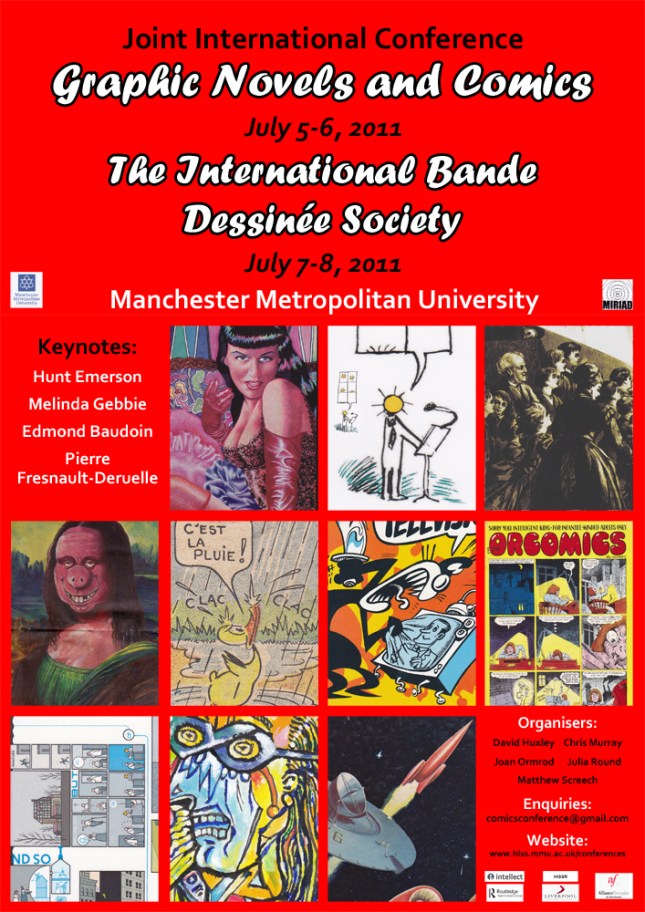
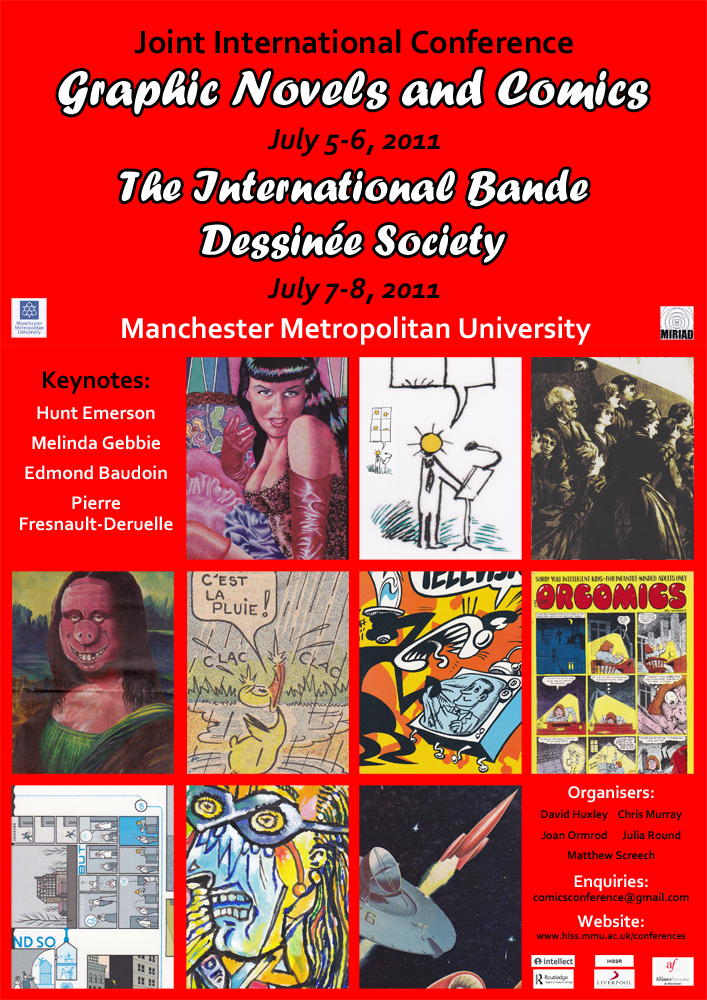
The Joint International Conference of Graphic Novels, Comics and the International Bande Dessinée Society’s Seventh International Conference
July 5-8 2011
Manchester Metropolitan University
The bande dessinée part of the joint conference took up the baton after two very stimulating days with GNAC and SIC. We too were pleased by the quantity and quality of papers and we ran parallel sessions. The morning of 7th July began with panels comprising two distinct strands: bandes dessinées and Francophone Africa, and BDs drawing upon the European Classics. The first strand began with Laurike in’t Veld’s insights into how the Rwandan genocide was represented in comics, and continued with Michel Bumatay’s study of Sub-Saharan African Francophone BDs. The focus on Africa continued with Mark Mckinney, who drew upon (post) colonial strips to argue that autobiography began in BDs earlier than is generally recognised. This was followed by Cathal Kilcline’s analysis of Boudjellal, who depicts an immigrant family in Toulon. The European Classics strand began with papers by Linda Rabea-Heyden and Matthew Screech on comic strip adaptations of canonical literary works: Goethe’s Faust and Voltaire’s Candide. Next came a re-examination of bande dessinée Classics with Bart Beaty, who closely scrutinised panels from Bravo’s re-make of the best-selling hero Spirou. Another strip to enter the pantheon of classics, Lieutenant Blueberry, was discussed by Martha Zan, who established its similarities with ss.
Read the rest of this entry »
Tags: Africa, Alberto Cipriani, Ann Miller, Annick Pellegrin, anti-comics feeling, architecture, autobiography, Émile Bravo, bande dessinée, Bart Beaty, body, Canada, Catriona Macleod, Charlotte Pylyser, China, Christophe Meunier, Clare Tufts, colonialism, Dali, detective BD, dramatic intensity, Edmond Baudoin, Etienne Davodeau, excess, Fernand Stefanich, Flanders, France, Gender, Germany, Goethe, Greice Schneider, Guy Delisle, Hélène Sirven, Hergé, Holland, immgration, Jimenez Lai, Jorge Catala-Carrasco, Klara Arnberg, Latin America, Laurence Grove, Laurike in’t Veld, Le Temple du Soleil, Les Sept Boules de Cristal, Lieutenant Blueberry, Linda Rabea-Heyden, Louvre, Manchester Metropolitan University, Manuel de la Fuente, Mark McKinney, Mary Toft, Matthew Screech, Mauro Marchesi, Michael D. Picone, Michel Bumatay, Michel Rabagliati, Michelle Bloom, Moebius, Morris, museum, narrative tension, Paracuellos, parody, Paul Malone, Pénélope Bagieu, Pierre Fresnault-Deruelle, post-feminism, Renata Pascoal, Rik Sanders, Rikke Platz Cortsen, Rwandan genocide, space, spaghetti Westerns, Spanish Civil War, Spirou, Steven Surdiacourt, Sub-Saharan African Francophone BD, Sweden, Sylvie Dardaillon, time, Tomas Nilson, UK, Voltaire, Western Comics, Women
The Adventures of Tintin: The Secret of the Unicorn, a movie directed by Steven Spielberg and produced by Peter Jackson, is scheduled for release before the end of 2011. The film reportedly combines the stories from three books in the world-famous comics series by Belgian cartoonist Hergé (Georges Remi): The Crab with the Golden Claws, The Secret of the Unicorn and Red Rackham’s Treasure. Most movie-goers will have no idea about the historical context in which these three stories were first drawn and published. All were originally serialized by the cartoonist in Le Soir, a newspaper then controlled by the Nazis during their occupation of Belgium. And in the same newspaper, in between the first of these stories and the other two (which constitute a diptych), Hergé drew and published The Shooting Star, whose original version was clearly an antisemitic libel. This was at a time when the Nazis were preparing to kill the Jews in Belgium. Leafing through those old newspapers is a sobering experience, as one reads positive reviews of antisemitic movies and public speeches, and official notification of administrative measures designed to identify and isolate Jews in preparation for the genocide. Today Hergé is mostly celebrated as a creative comics genius, but historical facts like this should encourage us to delve deeper into the relationships between the form, the content and the context of his comics.
Read the rest of this entry »
Tags: adaptation, Africa, Algeria, anti-Semitism, bande dessinée, Barly Baruti, Belgium, colonialism, Congo, Farid Boudjellal, France, Franco-Belgian Comics, Futuropolis, Hergé, History, imperialism, Le Soir, Mourad Boudjellal, Nazi occupation of Belgium, Peter Jackson, Soleil Productions, Steven Spielberg, The Adventures of Tintin, Tintin, USA

 Comics Forum