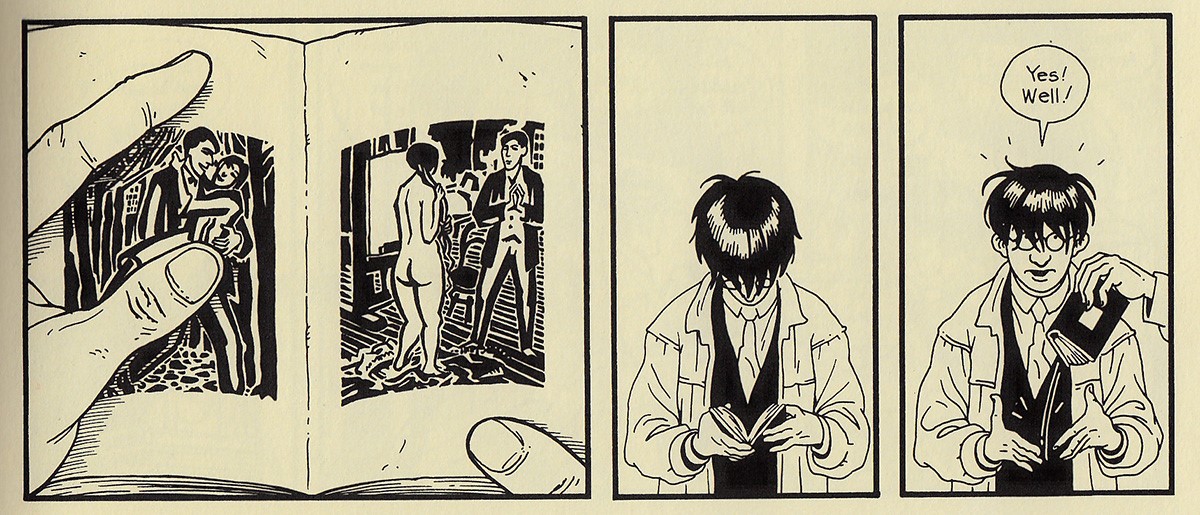
Jason Lutes’ stunning graphic novel, Berlin: City of Stones, captures a response to the woodcut novel that represents a common reaction by many readers who first open one of these books. In this case, the book Mein Stundenbuch (Passionate Journey) by Frans Masereel is targeted by the character Erich, who is having a heated discussion about objectivity and emotion with his friends. The panels display Erich as he pulls the book from his friend’s coat pocket. In a manner of disgust, Erich presents the book as an example of emotionalism. His attitude changes when he opens the pages and becomes engrossed in the pictures.
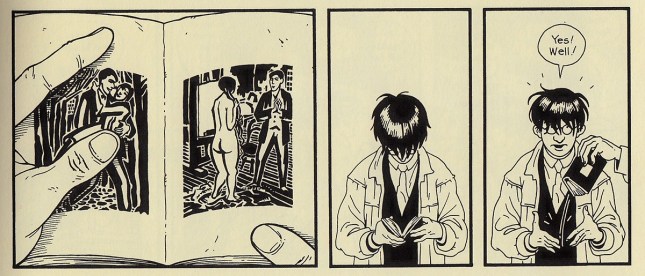
Fig. 1. Berlin: City of Stones. Book One. © Jason Lutes. Used by permission.
Read the rest of this entry »
Tags: Andrzej Klimowski, bande dessinée, Belgium, Berlin: City of Stones, Chris Lanier, Comix 2000, Danijel Žeželj, David Wisner, Die Idee, Ed Badajos, Erez Yakin, Eric Drooker, Frans Masereel, George Walker, Germany, Geschichte ohne Worte, Gods’ Man, Gon, Hans (Giovanni) Mardersteig, Hermann Hesse, James Reid, Jason Lutes, Jim Woodring, Jules Remedios Faye, Kurt Wolff, L'Association, Life of Christ in Woodcuts, Lynd Ward, Marc-Antoine Mathieu, Masashi Tanaka, Mattioli, Mea Culpa, Mein Stundenbuch, Michael Matthys, Otto Nückel, Passion eines Menschen, Peter Kalberkamp, Peter Kuper, Pilipino Food, Scott McCloud, Shaun Tan, Sonne, Squeak the Mouse, Storyteller Without Words: The Wood Engravings of Lynd Ward, The Arrival, The Silent City, Thomas Mann, Thomas Ott, Vincent Fortemps, Will Eisner, Winshluss, woodcut novels, wordless novels
Comic books are the art of fantasy, exaggeration and power. So it was not surprising that soon after the creation of the comic book medium in the United States in the mid 1930s an element of propaganda began to blend into the artwork.
The idea of comic book characters being utilized in propaganda was illustrated through the comic book character Superman. The creation of two Jewish teens from Cleveland, Superman fought for the essence of American culture and societal justice, starting in 1938. In a specially created two page comic story and accompanying article for Look Magazine in February 1940, Superman flew to Berlin then to Moscow to gather up their respective dictators, Hitler and Stalin, and flew them to Geneva, Switzerland and placed them on trial for crimes against humanity at the League of Nations headquarter. Given that the US was not in the war yet, this was a bold action. Hitler’s chief propagandist Josef Goebbels even responded to the article in Das Schwartze Korps where he noted the creators’ origins and how decadent American ideals were the reason why the West could never defeat the Nazi ideology.
Read the rest of this entry »
Tags: 9/11, Arabs, Bucky, Captain America, Chinese, Germany, How Boys and Girls can Help with the War, Human Torch, Jack Kirby, Japan, Joe Simon, Kid Patriot, Major Liberty, Mr. Liberty, Muslims, propaganda, Race/ethnicity, racism, Russia, Soviets, stereotypes, superheroes, Switzerland, the Patriot, Toro, USA, Vietnam War, War, Wonder Woman, WWI, WWII
Whether Comics Studies exists in Germany depends on our definition of the term. If we define it as “Comic-Wissenschaft” in analogy to Literaturwissenschaft (Literary Studies) or Kulturwissenschaft (Cultural Studies), then the answer might be a hesitant “no.” As Ole Frahm wrote in 2002: ‘Comics Studies doesn’t exist.’ [1] Taking into account the quantitative and qualitative increase of German comics scholarship over the last decade, however, we might come to a more positive conclusion. In fact, I would side with Martin Schüwer’s assessment that we are currently witnessing ‘islands of activity […] at the borders of different academic disciplines.’ [2] Thus, once we define “Comics Studies” as a conglomeration of increasingly networked research activities, the answer to the question of whether “Comics Studies” exists in Germany must be a tentative “yes.”
Read the rest of this entry »
Tags: comics studies, German Comics, Germany
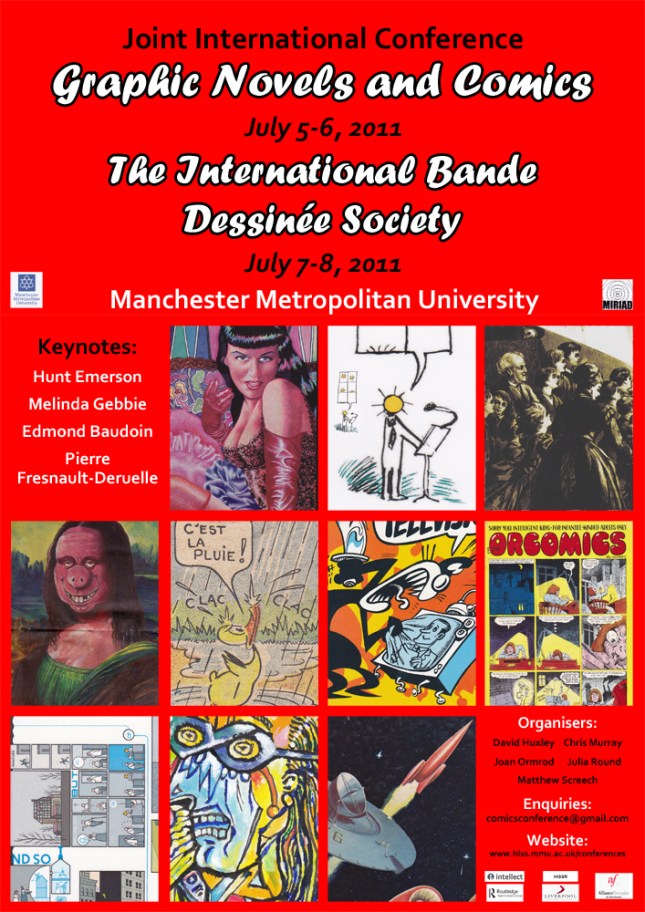
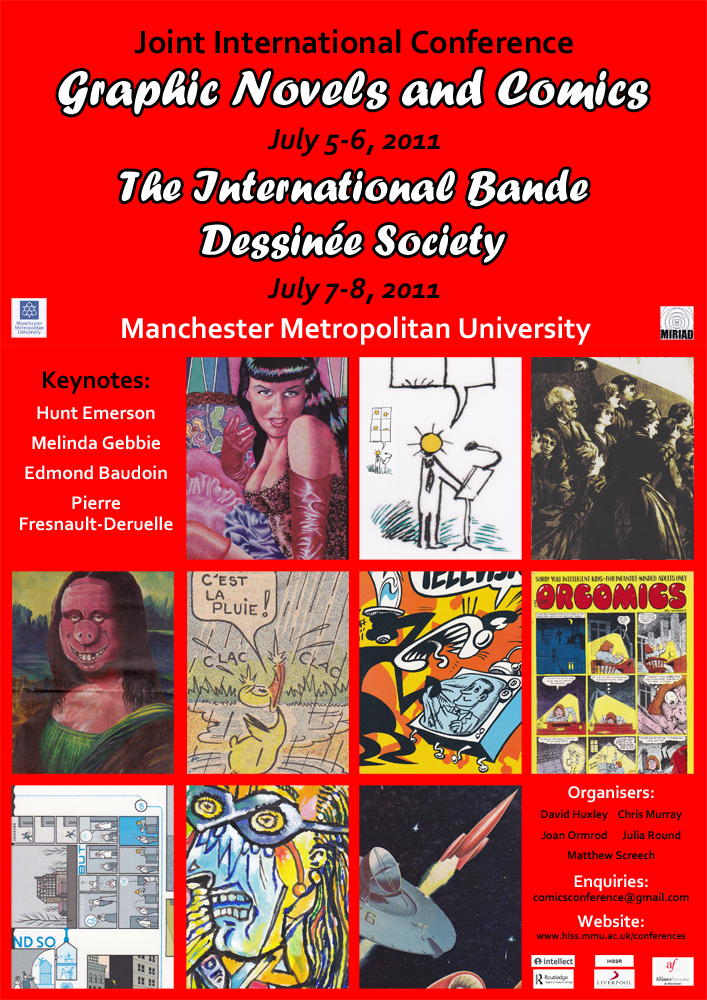
The Joint International Conference of Graphic Novels, Comics and the International Bande Dessinée Society’s Seventh International Conference
July 5-8 2011
Manchester Metropolitan University
The bande dessinée part of the joint conference took up the baton after two very stimulating days with GNAC and SIC. We too were pleased by the quantity and quality of papers and we ran parallel sessions. The morning of 7th July began with panels comprising two distinct strands: bandes dessinées and Francophone Africa, and BDs drawing upon the European Classics. The first strand began with Laurike in’t Veld’s insights into how the Rwandan genocide was represented in comics, and continued with Michel Bumatay’s study of Sub-Saharan African Francophone BDs. The focus on Africa continued with Mark Mckinney, who drew upon (post) colonial strips to argue that autobiography began in BDs earlier than is generally recognised. This was followed by Cathal Kilcline’s analysis of Boudjellal, who depicts an immigrant family in Toulon. The European Classics strand began with papers by Linda Rabea-Heyden and Matthew Screech on comic strip adaptations of canonical literary works: Goethe’s Faust and Voltaire’s Candide. Next came a re-examination of bande dessinée Classics with Bart Beaty, who closely scrutinised panels from Bravo’s re-make of the best-selling hero Spirou. Another strip to enter the pantheon of classics, Lieutenant Blueberry, was discussed by Martha Zan, who established its similarities with ss.
Read the rest of this entry »
Tags: Africa, Alberto Cipriani, Ann Miller, Annick Pellegrin, anti-comics feeling, architecture, autobiography, Émile Bravo, bande dessinée, Bart Beaty, body, Canada, Catriona Macleod, Charlotte Pylyser, China, Christophe Meunier, Clare Tufts, colonialism, Dali, detective BD, dramatic intensity, Edmond Baudoin, Etienne Davodeau, excess, Fernand Stefanich, Flanders, France, Gender, Germany, Goethe, Greice Schneider, Guy Delisle, Hélène Sirven, Hergé, Holland, immgration, Jimenez Lai, Jorge Catala-Carrasco, Klara Arnberg, Latin America, Laurence Grove, Laurike in’t Veld, Le Temple du Soleil, Les Sept Boules de Cristal, Lieutenant Blueberry, Linda Rabea-Heyden, Louvre, Manchester Metropolitan University, Manuel de la Fuente, Mark McKinney, Mary Toft, Matthew Screech, Mauro Marchesi, Michael D. Picone, Michel Bumatay, Michel Rabagliati, Michelle Bloom, Moebius, Morris, museum, narrative tension, Paracuellos, parody, Paul Malone, Pénélope Bagieu, Pierre Fresnault-Deruelle, post-feminism, Renata Pascoal, Rik Sanders, Rikke Platz Cortsen, Rwandan genocide, space, spaghetti Westerns, Spanish Civil War, Spirou, Steven Surdiacourt, Sub-Saharan African Francophone BD, Sweden, Sylvie Dardaillon, time, Tomas Nilson, UK, Voltaire, Western Comics, Women

 Comics Forum