Takeuchi Osamu, a professor of media studies at Doshisha University, is likely not the best manga studies critic to use as an introduction to problems surrounding the relatively recent turn in Japanese manga studies discourse to formalism or, more specifically, to the study of manga expression (manga hyōgen), since his work is something of a too easy target. It is parochial—his examples, despite pretensions toward general principles, are exclusively Japanese—and has changed surprisingly little since the late 1980s, despite the fact that his contemporaries, such as Natsume Fusanosuke and Yomota Inuhiko, and the manga expression discourse in toto have changed considerably in the intervening years. Yomota’s Manga genron (Principles of Manga) makes reference to at least some non-Japanese comics artists, notably Windsor McCay, and in the introduction to a recent translation of two chapters of his Tezuka Osamu wa doko ni iru (Where is Tezuka Osamu?), Natsume reflects on how limited this early formalist work was and, if reproduced today, would have to be understood within the context of a global comics studies discourse:
At the time I wrote this book, my interests generally centered on postwar Japanese manga, and the scope of my inquiry was almost entirely limited to Japan. If we were to consider European and American influences on manga from the Meiji period [1868-1912], the discussion in this book on transformations related to time and panel articulation would link to world-historical questions of modernity (changes in the expression of time and space in modern times)… Future research will surely depend on sharing knowledge and intellectual exchanges between scholars in different countries.[1]
While a turn away from more parochial concerns is admirable, a broadening of perspective on manga-as-comic expression is not guaranteed to overcome or even make apparent a number of assumptions underlying the study of manga expression as it emerged historically and in direct response to the currents of nearly two decades of manga criticism that preceded it. In order to make those assumptions more apparent, my use of Takeuchi’s critical oeuvre here is directed more toward discourse analytical ends than toward a detailed explication of what his theory of manga expression entails.
Read the rest of this entry »
Tags: Biranji, Cinematism, CJ Suzuki, Donald Duck Finds Pirate Gold!, Doshisha University, eiga-teki shuhō, Europe, film, formalism, Frederick Schodt, gekiga, Helen McCarthy, historiography, image-text, Ishiko Junzō, Itō Gō, Japan, Japanese manga, jaqueline berndt, Kitazawa Rakuten, Kure Tomofusa, manga criticism, Manga genron, manga hyōgen, Mangashugi, Media Studies, Meiji period, Mizuki Shigeru, Nakano Haruyuki, Natsume Fusanosuke, New Treasure Island, Osamu Tezuka, Ryan Holmberg, Sakai Shichima, Scott McCloud, Shin takarajima, Shintakarajima, Shirato Sanpei, Shishido Sakō, shōjo, Speed Boy, Supīdo tarō, Takeuchi Osamu, Tatsumi Yoshihiro, Tezuka, Tezuka Osamu, Tezuka Osamu wa doko ni iru, Thierry Groensteen, Thomas Lamarre, Tsuge Yoshiharu, Tsurumi Shunsuke, USA, Winsor McCay, WWII, Yomota Inuhiko
1. Introduction
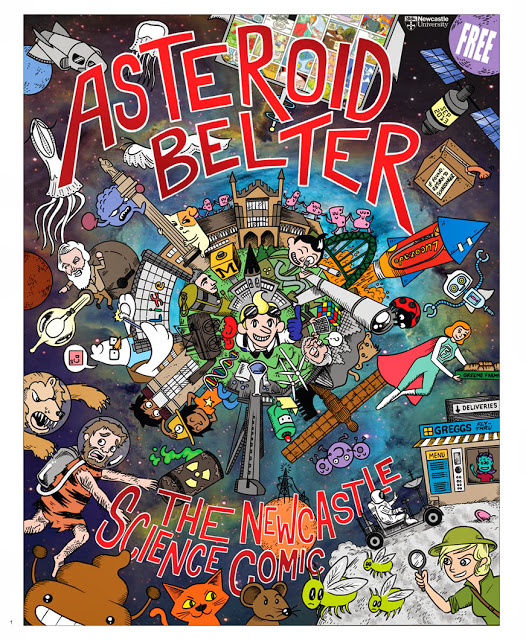
Asteroid Belter: The Newcastle Science Comic is a 44-page, newsprint, 10000 copy print run comic for the British Science Festival 2013 hosted by Newcastle University, England. It was produced as collaboration between a total of 76 artists, writers and scientists, led by our editorial team: Lydia Wysocki, Paul Thompson, Michael Thompson, Jack Fallows, Brittany Coxon and Michael Duckett. The comic sought to put university science research and concepts into the hands of children in a way that is meaningful, interesting, and inspiring to them. We did this by supporting scientists and comics creators to work together and increase each party’s understanding of the value of the other’s work. This article first outlines how we made Asteroid Belter, where we locate it in the wider field of comics, and then goes on to identify what we can and cannot show as evidence of its success.
Read the rest of this entry »
Tags: Artists, Asteroid Belter, British Science Festival, Brittany Coxon, Jack Fallows, Lydia Wysocki, Michael Duckett, Michael Thompson, Newcastle University, Paul Thompson, UK
Brooklyn-based autobiographical cartoonist Julia Wertz published her first graphic novel, Drinking at the Movies, through Three Rivers Press, an imprint of Random House, during a brief period which she depicts in her second book, The Infinite Wait, as something of a minor boom in interest in comics from mainstream book publishers. However, once this period was over and the sales of Drinking at the Movies had proved lower than expected (in the words of Wertz’s publisher, ’these numbers would be great if it was with a smaller comics press, but since it’s with a major publisher whose standards are much higher…’) (Wertz 2012: 91), Wertz found herself dropped from her publisher. The Infinite Wait was published in 2012 by Koyama Press, a Canadian small press. Wertz is more comfortable with this arrangement, as evidenced by her autobiographical stories’ portrayals of events. Drawing herself writing to Annie Koyama, publisher of Koyama Press, she says ‘I just want to be with my people,’ (Wertz 2012: 93) the implication being that mainstream book publishers, despite their ability to pay her enough money to enable full-time cartooning, are not a home for the work of an alternative cartoonist. This article will explore the relationship between small presses and alternative comics, with Wertz’s two graphic novels and their publishing background as a case study, examining Wertz’s above implication that her work is best suited to being published with a small press.
Read the rest of this entry »
Tags: alternative comics, auteurism, autobiography, Julia Wertz, Small Press, small press comics, USA
I. Who is Ishiko Junzō?[1]
Arguably, one of the first Japanese critics to discuss graphic narratives (story manga) for mature audiences is Ishiko Junzō (1928 – 1977).[2] Initially active as an art critic who explored a wide range of contemporaneous artistic and popular movements, he began to publish writings more specifically on manga between the mid-1960s and mid-1970s. To many English-language readers his name might be obscure, perhaps even more so than his contemporary, philosopher and cultural critic Tsurumi Shunsuke, whose book Sengo Nihon no taishū bunkashi (A Cultural History of Postwar Japan 1945-1980)—a chapter of which is devoted to postwar manga—is available in English. Yet, in present-day Japanese-language manga research, Ishiko is repeatedly referenced, especially in relation to his media-specific discussion of manga. This article shall introduce art critic Ishiko Junzō and his scholarship, concentrating on his contribution to Japanese comics criticism and manga studies.
Read the rest of this entry »
Tags: adult readership, aesthetics, alternative comics, alternative manga, art, Artists, “anti-art” movements, censorship, Charles Hatfield, children readers, comics industry, Dick Higgins, digital media, Doryun Chong, dōjinshi, education, fandom, film, formalism, Garo, gekiga, Gondō Suzumu, graphic narratives, historiography, hyōgen-ron, intermediality, Ishiko Junzō, Japan, Japanese manga, jaqueline berndt, Kajii Jun, Kajiya Kenji, kashihon-ya, Kikuchi Asajirō, Magnificent 49ers, manga, manga criticism, Manga geijutsu-ron, manga studies, Manga to eiga, Mangashugi, mature readers, Miryam Sas, Miwa Kentarō, Mizuki Shigeru, MOMA, Negative Perceptions of Comics, Osamu Tezuka, psychology, Scott McCloud, seinen, Shirato Sanpei, shōjo, social class, structuralism, taishū bunka, Takano Shinzō, Tatsumi Yoshihiro, Tezuka, Tezuka Osamu, Tsuge Yoshiharu, Tsurumi Shunsuke, Uryū Yoshimitsu, USA, Walter Benjamin, Weekly Shōnen Magazine, Yamane Sadao
As with the larger field of manga studies, the earliest attempts at theorizing what we now call Boys’ Love (hereafter BL) manga were made by Japanese critics and authors in the 1980s when the genre itself surfaced. Academic BL studies, however, had to wait until the 2000s, with some key works published after 2005, and these are the main focus of this article.
The first analyses of the roots of BL manga were written by Nakajima Azusa.[1] She traced the genre back to shōnen’ai manga (boy love)[2], stories about romantic and sexual love between boys that were serialized in shōjo [girls] manga magazines.[3] While shōnen’ai has become a popular loanword within non-Japanese manga fandom, in Japan, the most widespread term — not just for graphic narratives, but also novels, audio-dramas, and games — is BL, which overwhelmingly tends to signify the commercially published variant of this cross-media genre as distinct from the fandom-based, and often more sexually explicit yaoi variant. The shōnen’ai stories of the 1970s were revolutionary as they replaced the conventional girl protagonists of shōjo manga with boys, and they appealed to female fans in a way which went beyond the act of reading. In her early essays, Nakajima dissected not only BL narratives as such but also fans’ motivations for consuming and creating them. However, her psychoanalytical focus was often interpreted as fans of the genre being unable to cope with societal gender roles, to the extent of being, at best, escapist, and at worst, pathological. Nakajima herself was an author and editor of BL literature (which is often accompanied by single-image manga-style illustrations), and she played a seminal role in June (1978–2012), the first magazine dedicated to BL manga and fiction.[4] It goes without saying that her creative involvement in the formation of the genre shaped also her stance as a critic.
Read the rest of this entry »
Tags: adult readership, AIDS, Boys’ Love, cross-media, cultural studies, dōjinshi, Eureka, fandom, film, fujoshi, Gender, gender roles, Hagio Moto, Hana to Yume, Hata Mikako, hentai, Hermann Hesse, HIV, homosexuality, Hori Akiko, Ishida Minori, Japan, Japanese manga, June, Magnificent 49ers, manga, manga criticism, manga studies, mature readers, Mishima Yukio, Mori Mari, Mori Naoko, Nakajima Azusa, post-war period, psychoanalysis, Race/ethnicity, Ragawa Marimo, sex, sexual imagery, Sexual Violence, sexuality, shōjo, shōnen’ai, sociology, Takemiya Keiko, yaoi
 Comics Forum