by Andrea De Falco
‘Fluid Images – Fluid Text’ was the title of an interdisciplinary conference that took place at Cardiff University (Wales) on 23-24 January 2020. The conference, organised by Dr Tilmann Altenberg (School of Modern Languages) and Dr Lisa El Refaie (School of English, Communication and Philosophy), hosted eighteen speakers from twelve institutions spread across seven different countries, featuring a wide range of backgrounds and approaches. The conference received financial support from Institute of Modern Languages Research (London), University Council of Modern Languages, Cardiff Comics Storytelling Network, Cardiff School of Modern Languages and Cardiff School of English, Communication and Philosophy.
The aim was to investigate from a transdisciplinary perspective three different and interlinked dimensions underpinning comics’ mobility: time, space and artistic media. The chronological dimension covers a broad field including the relationships between comics and history and the transformations investing their editorial and reading practices. Translation is the key word to understand how comics have been able to transcend national borders, by means of transmission in different languages and cultures. The last dimension leads us to comics’ adaptation in other media, investigating their relationships with different forms of artistic expression.
Read the rest of this entry »
Tags: A Borrowed Life, A Distant Soil, adaptation, Aka B, Alessandro Tota, Alison Bechdel, Ana Penyas, art, Asterix, autobiography, Ángel de la Calle, Bea Enriquez, biography, Caterina Sansone, classroom, Colleen Doran, dictatorship, digital comics, Disney, Edgar Clement, family, film, Fumettibrutti, Fun Home, Gender, Graphic Novels, Greece, heritage, History, humour, identity, Il tempo materiale, intermediality, intertextuality, Italy, Je est un autre, Kobane Calling, Luigi Ricca, Martin Lemelman, memory, Mendel’s Daughter, Mexico, nationalism, Núria Tamarit, Non-fiction Comics, Operación Bolívar, P. La mia adolescenza trans, Palacinche, Paperinik, Phoebe Gloeckner, Photography, Pinturas de guerra, place, Politics, Race/ethnicity, social conflict, Spain, Storia di una madre, Taiwan, The Adventures of Tintin, The Diary of a Teenage Girl, The Story of a Mother, theatre, time, Tintin, Translations, transmediality, Transphobia, transsexual abuse, UK, Wales, Women, Zerocalcare
by Iain A. MacInnes
Medieval history is very much in vogue at the present time. Driven by representations of the period in various forms of popular culture, there appears to be a great appetite for all things medieval. From television (Vikings, The Name of the Rose, Knightfall) to film (The Green Knight, The King, Outlaw King) to video games (A Plague Tale: Innocence, Kingdom Come: Deliverance, Medieval Dynasty), representations of the medieval world are hard to avoid.[1] And that is before we get to the more medieval-influenced forms of media that perhaps drive interest in the medieval even more than apparently “real” representations of the past. Where Game of Thrones led the way, The Witcher is now appealing to a mass global audience.[2] The forthcoming Lord of the Rings television series, films like Nimona and games like Godfall will similarly bring different varieties of medieval aesthetics to modern audiences across the globe.[3]
Another medium, perhaps more niche than the above, is that of the graphic novel. Comics set in both the medieval past and medieval-inspired worlds have gained increasing popularity in recent years, and it can be argued that these are as important as the above examples in terms of influencing modern perceptions and understanding of our medieval past. One potential reason why this is not as well-recognised is that many medieval comics are not available in English. While there do exist prominent examples of English-language medieval comics by noted authors and special releases timed to coincide with historical anniversaries (such as Crécy, Templar, Nevsky: A Hero of the People, On Dangerous Ground: Bannockburn 1314 and Agincourt 1415: A Graphic Novel), this output pales into relative insignificance when compared with that produced in continental Europe.[4] The remainder of this post will therefore consider the range of medieval comics produced for the European market, with a focus on Spain and particularly France. While some broader context for these works is provided, the main focus will be on comics of the last decade to allow consideration of increased interest in the medieval period as reflected in the comic medium.
Read the rest of this entry »
Tags: Agincourt 1415: A Graphic Novel, Alessandro Calore, Alex Puvilland, Alfonso Zapico, Ana Miralles, Anne Curry, Antonio Hernández Palacios, Arnaud Delalande, Éric Lambert, bande dessinée, Ben McCool, Bruno Falba, Cathares, Champs d’honneur, comics, Conor Boyle, Crécy, El capitán Trueno, El Cid, El guerrero del antifaz, El otro mar, Emilio Ruiz, En busca del Unicornio, Fabio Bono, Fiona Watson, France, France Richemond, Fred Blanchard, Fred Duval, Graeme Howard, Graphic Novels, Hawkwood: Mercenaire de la guerre de Cent Ans, Histoire dessinée de la France, History, Igor Kordey, Ils ont fait l’Histoire, Ira Dei, Jaime Calderón, Japan, Japanese manga, Je François Villon, Je suis Cathare, Jean-Charles Kraehn, Jean-Pierre Pécau, Jesús Cano de la Iglesia, Jordan Mechner, Jour J, Juan Carlos Mora, La Ballade des pendus, Lajos Farkas, L’Empire des steppes, Léo Pilipovic, Le Dernier Cathare, Le Dieu vert, Le Trône d’argile, Les Aigles décapités, Les Ombres de Constantinople, Les Reines de sang, LeUyen Pham, Luigi Critone, Makyo, manga, Manuel Gago García, Mario Guevara, medieval comics, medievalism, Middle Ages, Miguel Ambrosio Zaragoza, Nevsky: A Hero of the People, Nicolas Jarry, Notre-Dame de Londres, On Dangerous Ground: Bannockburn 1314, Oriol García i Quera, Patrice Pellerin, Rajko Milošević-Gera, Raulo Cáceres, Ronan Toulhoat, Roncevalles, Spain, tebeos, Templar, Thierry Gloris, Tommy Ohtsuka, Tout l’or de Constantinople, Uchronia, Valois, Víctor Mora, Vincent Brugeas, Warren Ellis, Will Gill, Yana
By Antarleena Basu
In 2015, while Paul Gravett was affirming that “the Indian graphic novel is here to stay” (Gravett), a 162-page comic/graphic novel that raised many an eyebrow for its dauntless representation of the Naxalite movement and the rise of the communist ideology across India was published in book form somewhere in Bhilai, a bustling industrial city in the state of Chattisgarh in India. The Naxalite movement, also known as the “peasant uprising”, refers to the armed struggle of the peasants against wealthy and exploitative land-owners and it was initiated by a small fraction of the Communist Party of India (Marxist) led by Charu Mazumdar in a small village of West Bengal in India called “Naxalbari”; hence the name “Naxal uprising”. Titled Amar Bari Tomar Bari Naxalbari (which roughly translates from Bengali as “my house and your house is Naxalbari” and echo the popular Bengali slogan of the Naxals), Sumit Kumar’s comic was the first of its kind—it not only dares to portray the serious topic of the Naxal and communist uprising through the verbal and visual interaction of the comic mode but also experiments with a wide array of styles and techniques in the text, thereby injecting the necessary dosage of plurality that could go into the making of an Indian comic. By amalgamating the present political events with those of the past, by invoking classics as well as pop-culture and its icons, by mixing colourful pages with stark blacks and whites, among his many binaries, Kumar creates a scathing, tragic-comic narrative that almost borders on the absurd.
Read the rest of this entry »
Tags: History, India, Indian Comics, Indian graphic novel, Politics, South Asia, violence
Verisimilitude and (The Act of) Reading
by Yiru Lim
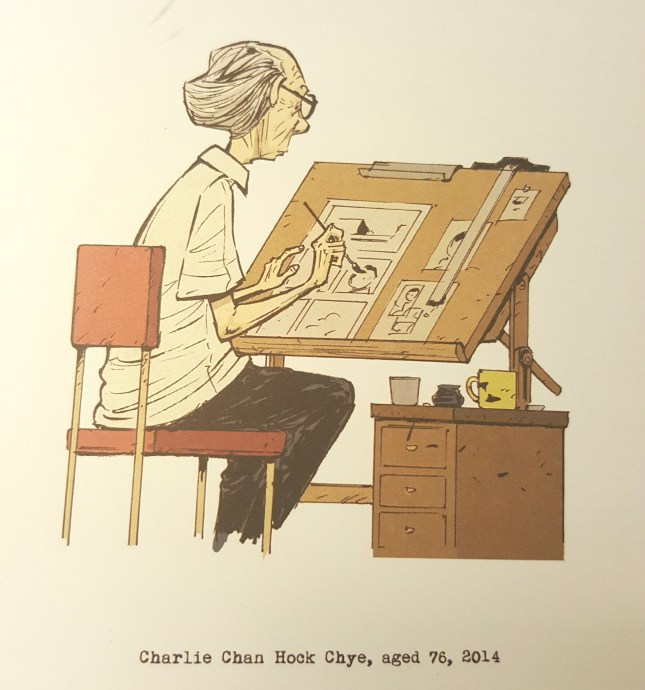
Figure 1
Source: The Art of Charlie Chan Hock Chye, p. 307. Copyright © 2015 by Sonny Liew. Published in Singapore by Epigram Books http://www.epigrambooks.sg
Singapore’s official version of history is primarily enshrined in the memoirs of Mr Lee Kuan Yew, Singapore’s first Prime Minister. Titled The Singapore Story: Memoirs of Lee Kuan Yew, the memoirs were originally published in two volumes in 1998 and 2000 and a memorial edition was released by Marshall Cavendish in 2015, the year of Mr Lee’s passing. Revisionist accounts that stand in opposition to this seminal publication attempt to fill what they see as a void in Singapore’s history: the voice of the opposition, especially in the narratives concerning nation building and independence. They exist in a myriad of forms and genres—film, scholarly publications, prose, poetry—and they seek to debunk existing narratives and proffer more balanced perspectives of history.
Some recent examples include academic publications like Comet in Our Sky (2015), that speaks of the alleged communist Lim Chin Siong and his role in securing Singapore’s independence; Tan Pin Pin’s documentary film To Singapore, With Love (2013); Jeremy Tiang’s State of Emergency: A Novel (2017); and Sonny Liew’s graphic novel The Art of Charlie Chan Hock Chye (2015). Tan’s film has been banned from being screened in Singapore while the latter two have had their grants revoked by the National Arts Council of Singapore (NAC) (Ho, 2017, Today Online 2015 & 2014). Although Liew’s graphic novel did not receive government approval, it has taken the literary world by storm. It became the first graphic novel to win the Singapore Literature Prize in 2016 and has garnered Liew six Eisner nominations and three Eisner Awards this year (Martin, 2017).
Read the rest of this entry »
Tags: archives, autobiography, biography, Charlie Chan Hock Chye, Eisner Awards, Graphic Novels, History, illusion of the real, limits of representation, Singapore, Sonny Liew, verisimilitude
Graphic Realities: Comics as Documentary, History, and Journalism
International Conference
22.-23.02.2018, Justus-Liebig-University Giessen/GCSC
While comics have traditionally been associated with fictional, especially funny and/or fantastic stories, they have in recent decades become a major vehicle for nonfiction, as well. This development coincides with a time that has been described as ‘post-truth’, in which established news media face a crisis of confidence. The turn towards comics is a turn towards a medium, which inherently promotes simplification and exaggeration. Cartoon imagery thus immediately exhibits the subjectivity of the artist and her or his interpretation – but what could be considered a hindrance towards factual reporting has become an important resource. The overt display of subjectivity and medial limitations as a show of honesty has been described as an authentication strategy of graphic nonfiction. In contrast to formats based on camera-recorded images like photography and film nonfiction comics cannot lay claim to indexing premedial reality. Rather, individual graphic styles index their own creator who as witness becomes the main authenticator. Thus, comics shift the weight of authentication from medial prerequisites towards their authors and artists and thus the textual properties referencing them. One of the questions that will be discussed at the conference is thus the relation of inherent medial properties of comics as vehicle for nonfiction. While among graphic nonfiction life
While among graphic nonfiction life writing in particular has received widespread scholarly attention, this conference will focus on recent approaches to comics as documentary, history, and journalism. As opposed to graphic memoirs in which authors reflect upon their own lives and experiences, these works focus on the lives and experiences of others. Thus, authors and artists need to do justice towards their subjects, as well as to their own experience and negotiate their own voices within their stories. This becomes especially relevant as a majority of graphic reportages centers around highly traumatizing crises and catastrophes, such as war, displacement, natural disasters, and oppression. The conference is intended to explore how authors and artists utilize the medium of comics for nonfiction and address these ‘graphic realities’.
Invited Speakers:
Prof. Dr. Jörn Ahrens (Justus-Liebig-Universität Giessen)
Dr. Nina Mickwitz (University of the Arts London)
Prof. Dr. Dirk Vanderbeke (Friedrich-Schiller-Universität Jena)
Prof. Dr. Wibke Weber (Züricher Hochschule für Angewandte Wissenschaften
Winterthur)
Submission for talks should address one or more of the following questions:
How is the medium of comics employed for reportage, history writing, and to report
on war, crises, and trauma?
Which narrative and aesthetic strategies do authors and artists employ to present and
authenticate their comics as nonfiction?
How do the genres of ‘documentary’, ‘history’, and ‘journalism’ in comics relate to
each other and how do they relate to other genres of graphic nonfiction such as ‘lifewriting’ or educational formats?
Does the medium of comics inherently support nonfictionality, or does it depend on con- and paratexual framing practices?
How do different ‘transfer media’ such as comic books or webcomics affect the
potential of comics for factual reporting?
How and to what extent is nonfictionality created through intermediality, especially
with regard to more conventionally ‘factual’ media such as photography and film?
In how far do different comics traditions differ transnationally and -culturally with
regard to their status as nonfiction?
Please submit your proposals (no longer than 300 words) for talks (20 min) and a short CV including your affiliation to graphicrealities@gcsc.uni-giessen.de until November 3rd, 2017.
The conference is organized as collaboration between the International Centre for the Study of Culture Giessen (GCSC) and the Comics Studies Working Group (AG Comicforschung) of the German Society for Media Studies (GfM) by Laura Schlichting (Justus-Liebig-University Giessen) and Johannes C. P. Schmid (University of Hamburg).
A membership in the Comics Studies Working Group is not mandatory for participation.
Tags: call for papers, ComFor, Conference, Documentary, Germany, History, Journalism
 Comics Forum