by Neal Curtis
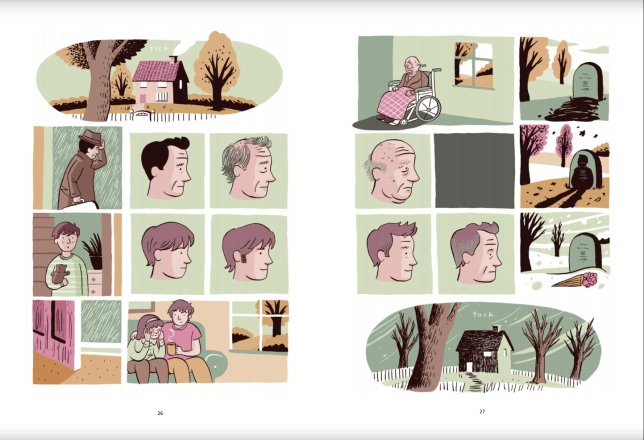
Definitions of comics are numerous and yet no single version can quite capture the fecundity, variety and experimental profusion of the medium as it continues to evolve. I would therefore agree with Joseph Witek who suggests that arguments over what defines or qualifies as a comic often “devolve into analytical cul-de-sacs and hair splitting debates over an apparently endless profusion of disputed boundary cases and contradictory counter-examples” (149). Witek continues that in light of this, “‘comicness’ might usefully be reconceptualized from being an immutable attribute of texts to being considered as a historically contingent and evolving set of reading protocols that are applied to texts, that to be a comic text means to be read as a comic” (149). Although this suggests a cultural relativist approach to the medium it does still enact some boundary policing in the sense that the graphic information sheet placed in the pockets of airplane seats, while sharing certain features with the comics medium—panels and a combination of word and image—is not a comic because it is not read as such.
Read the rest of this entry »
Tags: After Maria, Andy Warhol, comicity, comicness, digital comics, digital media, directed reading, double page, Emma Sou, Gemma Sou, John Cei Douglas, memory, multi-directional reading, multiframe, newspaper strips, Off Life, online comics, open access, page, page layout, Show Me The Map To Your Heart, smartphones, space, spatial co-presence, spatial solidarity, Static, tablets, Thierry Groensteen, Tick Tock, time, trauma, UK, wordless comics
This year’s conference of the German Society for Comics Studies (ComFor) “Comics and Agency – Actors, Publics, Participation” will take place online. The deadline for submissions has been extended until 15 June, 2020. Interested scholars can send an abstract of approx. 500 words plus a short biography (in English or German) to comfor2020@comicgesellschaft.de. All papers will be presented October 8-10, 2020 live via Zoom.
Read the rest of this entry »
Tags: CFP, ComFor
by Fransiska Louwagie and Simon Lambert
On 13 March 2020 the University of Leicester hosted an International Symposium titled “Tradition and Innovation in Franco-Belgian bande dessinée” organised in collaboration with Wallonia-Brussels International. This one-day symposium – for which the progamme can be found here – was organised with generous support from the ASMCF, the Society for French Studies and the School of Arts at the University of Leicester.
The day was opened by Simon Lambert as Academic and Cultural Liaison Officer for Wallonia-Brussels in the UK, in conjunction with Fransiska Louwagie (University of Leicester). Keynote speakers were Professor Laurence Grove from the University of Glasgow and graphic novelist Michel Kichka, who also delivered a public seminar on his work. Across three panels, the day focussed on various forms of tradition and innovation in Franco-Belgian bande dessinée: the first panel was dedicated to “Revisiting the classics”, the second panel to “Contemporary perspectives”, and the final ASMCF panel to “Reshaping Franco-Belgian bande dessinée”. The closing remarks were organised as a roundtable session on collaborative international research projects.
Read the rest of this entry »
Tags: Abrégé de bande dessinée franco-belge, Émile Bravo, bande dessinée, Belgium, Deuxième génération, digital comics, education, France, Franco-Belgian Comics, Gaston Lagaffe, Gender, Hergé, History, Holocaust, Ilan Manouach, Mad, MAD Magazine, memory, Michel Kichka, Pilote, racism, Spirou, The Adventures of Tintin, Tintin, Transnational Comics, UK, University of Leicester, violence
by Andrea De Falco
‘Fluid Images – Fluid Text’ was the title of an interdisciplinary conference that took place at Cardiff University (Wales) on 23-24 January 2020. The conference, organised by Dr Tilmann Altenberg (School of Modern Languages) and Dr Lisa El Refaie (School of English, Communication and Philosophy), hosted eighteen speakers from twelve institutions spread across seven different countries, featuring a wide range of backgrounds and approaches. The conference received financial support from Institute of Modern Languages Research (London), University Council of Modern Languages, Cardiff Comics Storytelling Network, Cardiff School of Modern Languages and Cardiff School of English, Communication and Philosophy.
The aim was to investigate from a transdisciplinary perspective three different and interlinked dimensions underpinning comics’ mobility: time, space and artistic media. The chronological dimension covers a broad field including the relationships between comics and history and the transformations investing their editorial and reading practices. Translation is the key word to understand how comics have been able to transcend national borders, by means of transmission in different languages and cultures. The last dimension leads us to comics’ adaptation in other media, investigating their relationships with different forms of artistic expression.
Read the rest of this entry »
Tags: A Borrowed Life, A Distant Soil, adaptation, Aka B, Alessandro Tota, Alison Bechdel, Ana Penyas, art, Asterix, autobiography, Ángel de la Calle, Bea Enriquez, biography, Caterina Sansone, classroom, Colleen Doran, dictatorship, digital comics, Disney, Edgar Clement, family, film, Fumettibrutti, Fun Home, Gender, Graphic Novels, Greece, heritage, History, humour, identity, Il tempo materiale, intermediality, intertextuality, Italy, Je est un autre, Kobane Calling, Luigi Ricca, Martin Lemelman, memory, Mendel’s Daughter, Mexico, nationalism, Núria Tamarit, Non-fiction Comics, Operación Bolívar, P. La mia adolescenza trans, Palacinche, Paperinik, Phoebe Gloeckner, Photography, Pinturas de guerra, place, Politics, Race/ethnicity, social conflict, Spain, Storia di una madre, Taiwan, The Adventures of Tintin, The Diary of a Teenage Girl, The Story of a Mother, theatre, time, Tintin, Translations, transmediality, Transphobia, transsexual abuse, UK, Wales, Women, Zerocalcare
by Morgan Podraza
French Comics Poster
During the weekend of 28–29 February 2020, scholars from France, Belgium, the United States and the United Kingdom came together for “Drawing Gender: Women and French-language Comics,” a symposium presented and sponsored by the Billy Ireland Cartoon Library and Museum in partnership with the Department of French and Italian at the Ohio State University. Framed by the events surrounding the 2016 Angoulême International Comics Festival in which the nominations for the Grand Prix included all men and happening in coordination with the Billy Ireland Cartoon Library and Museum’s exhibit “Ladies First: A Century of Women’s Innovations in Comics and Cartoon Art,” the symposium was dedicated to the representation of and contributions by women in comics within the Francophone world. Thus, central discussions during the symposium were concerned with not only bringing the work of women to the foreground but also calling attention to the ways that women’s experiences and identities are conveyed through such work. Importantly, these conversations also highlighted and engaged with artists and works that expanded beyond the boundaries of any one identity—including a range of languages; nationalities; sexual and gender identities; and social and cultural backgrounds—in order to further emphasize the incredible contributions of creators who have not been historically canonized.
Read the rest of this entry »
Tags: Abir Gasmi, abortion, Ah! Nana, Alain Frappier, Alexis Horellou, Angouleme, Anjela, Aude Mermilliod, Aya de Yopougon, Aya of Yop City, Émilie Plateau, bande dessinée, Billy Ireland Cartoon Library, Billy Ireland Cartoon Library and Museum, Brigande! Marion du Faouët: Vie amours et mort, Canada, Catherine Muller, Cham, Christelle Le Guen, Colored: The Unsung Life of Claudette Colvin, colourists, Désirée Frappier, Delphine Le Lay, Des salopes et des anges, Elyon’s, feminism, FIBD, Florence Cestac, France, Francophone comics, Gender, gendered violence, Gustave Doré, Hshouma, Il fallait que je vous le dise, Jean-Louis Bocquet, Josephine Baker, Julie Delporte, Kiki de Montparnasse, La Vie d’Ébène Duta, Laëtitia Rouxel, Le Choix, Lebanon, Leila Slimani, Lena Merhej, Marguerite Abouet, Martin Winckler, Moi aussi je voulais l’emporter, Moomins, Morocco, Nicole Claveloux, Noire: La Vie méconnue de Claudette Colvin, Nora Habaieb, Nour Hifaoui Fakhoury, Ohio State University, Okapi, Olympe de Gouges, parenthood, Paroles d’honneur, Plogoff, Rodolphe Töpffer, Roland Michon, Samandal Collective, sex, Sex and Lies: True Stories of Women's Intimate Lives in the Arab World, Sexe et mensonges: La Vie sexuelle au Maroc, sexuality, Studios Hergé, The Diary of Ebene Duta, This Woman’s Work, Tonino Benacquista, Tove Jansson, Women, Zainab Fasiki
 Comics Forum